Semax 10mg: Research Overview, Peptide Properties, Evidence and Quality Guide
Introduction
Semax 10mg is a search term commonly used by people researching synthetic peptides associated with neurological and cognitive science. Semax is a synthetic heptapeptide related to a fragment of adrenocorticotropic hormone (ACTH). It has been investigated primarily in Russia, particularly in research involving neurological conditions and brain-related biological pathways.
Interest in Semax has grown through online discussions about nootropic peptides, neuroprotection, memory, attention and cognitive performance. However, it is important to distinguish scientific investigation from established clinical evidence. Research findings do not automatically demonstrate that a compound is safe or effective for healthy individuals, and products marketed online are not necessarily equivalent to regulated medicines.
This guide explains what Semax is, what the “10mg” label means, how the peptide has been studied, what its limitations are, and why independent quality information matters. It is intended for educational and research information—not as medical advice or instructions for human use.
What Is Semax?
Semax is a synthetic peptide based on a short sequence derived from the ACTH molecule. It is commonly described as ACTH(4–7) with a Pro-Gly-Pro extension. Its seven-amino-acid sequence is:
Met-Glu-His-Phe-Pro-Gly-Pro
The compound is also known by names such as ACTH(4-7)-PGP and Semax heptapeptide. The US Food and Drug Administration’s substance database records Semax as an identifiable chemical substance, but the existence of a database entry does not mean that a drug has been approved or evaluated as safe and effective.
Semax has been investigated for possible effects on neurological processes. Published research has explored areas such as cerebral ischaemia, neurological recovery and pathways associated with brain-derived neurotrophic factor (BDNF). These subjects remain areas of scientific investigation rather than proof of broad cognitive benefits.
What Does Semax 10mg Mean?
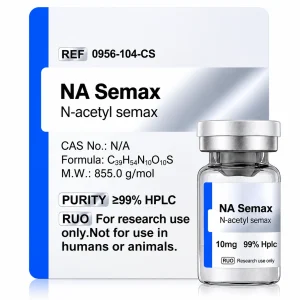
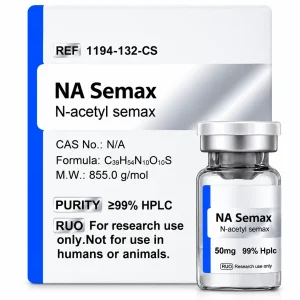
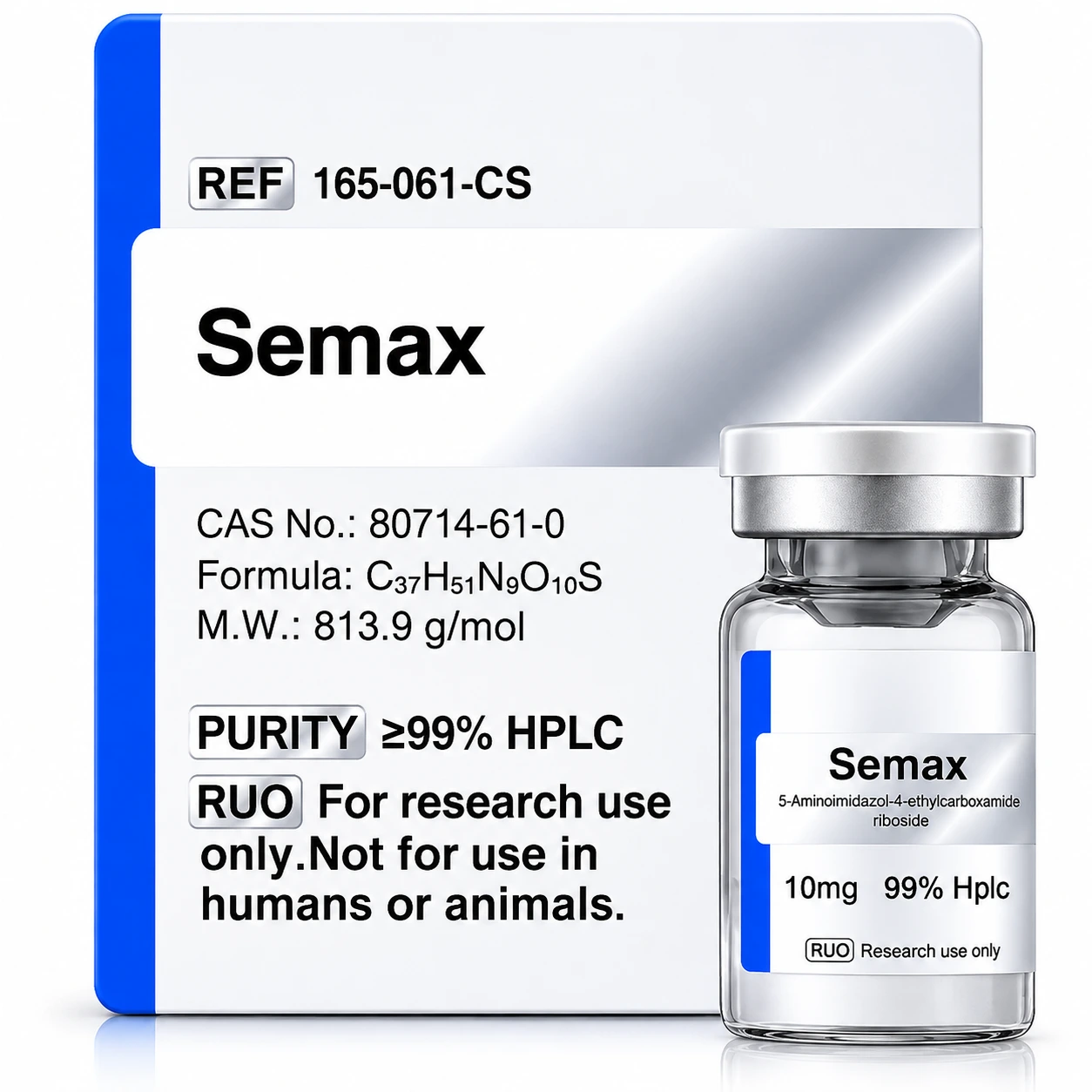
The phrase “Semax 10mg” generally describes a product listing that states a total quantity of 10 milligrams. It should not be confused with a clinically established dose, a recommended amount for an individual, or an approved treatment strength.
A label showing 10mg does not independently confirm:
- The identity of the material.
- The amount of actual Semax peptide present.
- Whether the material is Semax free base or a salt form such as Semax acetate.
- The level of peptide-related impurities.
- Whether the product is sterile or suitable for any particular route of administration.
- Whether the material has been manufactured under pharmaceutical standards.
These distinctions are important because a stated quantity is only one part of product information. A reliable technical description should identify the chemical form, batch, analytical methods, test results and intended research status.
How Does Semax Work? Understanding the Research
Semax is studied in connection with several biological pathways involved in nervous-system function. Some preclinical studies have investigated its relationship with neurotrophic signalling, including BDNF-related activity.
BDNF is a protein involved in neuronal development, maintenance and synaptic plasticity. These processes are important to research into learning, memory and the brain’s response to injury. However, observing changes in a biological marker does not establish that a peptide improves memory, concentration or everyday cognitive performance in people.
Researchers have also explored Semax in models and clinical settings related to cerebral ischaemia. Cerebral ischaemia occurs when blood flow to part of the brain is reduced. This is a serious medical condition requiring evidence-based clinical management. Research involving Semax should not be interpreted as a reason to delay or replace established emergency treatment.
The central distinction is between a plausible biological mechanism and a demonstrated clinical outcome. More rigorous, independently replicated human research is needed before broad claims about Semax can be justified.
What Does Scientific Research Say About Semax?
Research into Semax includes laboratory investigations, animal studies and human publications, many of which originate from Russia. Some reports have examined neurological outcomes following stroke, while other work has investigated brain activity and neurotrophic signalling.
Although these publications provide material for further investigation, the evidence has important limitations. Study size, design, reporting quality, controls and independent replication all influence how confidently results can be interpreted.
The FDA’s July 2026 briefing materials evaluated Semax-related bulk drug substances for possible use in compounding. The agency identified concerns including insufficient physicochemical characterisation, limited information about appropriate intranasal delivery systems, potential immunogenicity and inadequate evidence of effectiveness for the proposed conditions. The FDA’s evaluation weighed against placing Semax free base and Semax acetate on the relevant 503A Bulks List.
This regulatory assessment is significant because it highlights gaps in the available evidence and product-characterisation information. It does not mean that every scientific question about Semax has been answered; it means that the information reviewed was not sufficient to support the proposed regulatory use.
Semax and Cognitive Performance
Semax is frequently discussed online in connection with focus, memory, learning and mental performance. These topics are commercially popular, but marketing language can go beyond what published evidence establishes.
A scientifically responsible article should not claim that Semax reliably improves concentration, increases intelligence, prevents cognitive decline or enhances productivity. Such statements require well-designed human trials with meaningful clinical outcomes and independent replication.
For researchers, the more useful questions concern the specific biological pathways being investigated, the quality of the study design, the reproducibility of results and whether findings can be translated from laboratory models to humans.
Semax and Neuroprotection Research
Neuroprotection refers to strategies investigated for their potential to limit damage to nerve cells or support neurological function. Semax has been studied in this context, including research connected with cerebral ischaemia and recovery after neurological injury.
However, the term “neuroprotective” should be used carefully. A compound showing an effect in a laboratory or animal model has not necessarily demonstrated a meaningful benefit in patients. Human studies must establish the relevant population, treatment conditions, safety profile and clinical outcomes.
Semax should therefore be described as a peptide investigated in neurological research, not as a proven neuroprotective treatment or a substitute for approved medical care.
Semax 10mg: Research Material and Product Quality
For research organisations and qualified laboratories, material identity and analytical characterisation are essential. A product description should provide enough information to distinguish the substance being offered from similarly named materials or different chemical forms.
Important quality information may include:
1. Identity testing
An appropriate analytical method should support the identity of the peptide. Depending on the material and testing strategy, this may involve mass spectrometry and other complementary techniques.
2. Peptide purity
A high percentage on a certificate of analysis should be interpreted in the context of the method used. High-performance liquid chromatography (HPLC) is commonly used to assess peptide-related purity, but a single purity result does not establish every aspect of product quality.
3. Molecular characterisation
Mass spectrometry can help assess whether the measured molecular mass is consistent with the expected compound. The report should clearly identify the chemical form tested.
4. Impurity assessment
Peptide-related impurities, residual solvents, water content and other process-related materials may be relevant to a complete quality assessment. FDA materials specifically raise concerns about aggregation and peptide-related impurities for Semax.
5. Batch traceability
A useful certificate of analysis should identify the batch or lot number, test date, analytical methods, specifications and actual results. Generic certificates that cannot be connected to the supplied batch provide limited assurance.
6. Independent laboratory testing
Where appropriate, independent testing can provide additional confidence that reported results are not based solely on a supplier’s internal documentation.
A certificate of analysis (COA) is a technical document, not a regulatory approval. It cannot establish that a research material is suitable for human administration.
Understanding Semax Free Base and Semax Acetate
Semax may be described in different chemical forms, including free base and acetate. These forms should not be treated as interchangeable labels without checking the product’s actual specification.
The chemical form can affect how the material is described, characterised and formulated. It may also affect the interpretation of molecular mass and analytical results. A supplier or technical document should clearly state which form is being discussed.
This is particularly important when comparing research papers, reference materials and commercial listings. A difference in salt form or formulation can make direct comparisons misleading if the underlying details are not reported.
Regulatory Status: What Buyers and Researchers Should Know
Regulatory status depends on the country and the intended use. Semax has been used as a medicine in Russia, but that does not mean it is approved in every other jurisdiction.
In the United States, Semax is not an FDA-approved drug. In July 2026, the FDA published briefing materials assessing Semax free base and Semax acetate for possible inclusion on the 503A Bulks List. The agency’s evaluation raised concerns about characterisation, safety information, immunogenicity and evidence of effectiveness. An advisory committee recommendation is not itself FDA approval or a final regulatory determination.
Regulations in the United Kingdom, European Union and other markets may differ. Importation, sale, supply, compounding and possession can be subject to different rules depending on the substance, formulation and intended purpose. Anyone handling these questions should consult the relevant national medicines regulator and qualified legal or regulatory professionals.
A product marketed online as “research use only” should not be presented as an approved medicine or as suitable for personal treatment.
Why Responsible Semax Information Matters
The popularity of peptide products has created a large amount of online content, but not all of it is reliable. Claims about cognitive enhancement, recovery or neurological benefits can be exaggerated when preliminary findings are presented as established facts.
Responsible product information should explain the compound’s identity, research background, evidence limitations and regulatory status. It should also avoid implying that a laboratory certificate proves clinical safety or effectiveness.
For research-focused websites, transparent descriptions are more useful than unsupported promises. They help readers understand what is known, what remains uncertain and which questions require further investigation.
Frequently Asked Questions About Semax 10mg
What is Semax 10mg?
Semax 10mg is a product-search phrase generally referring to a listing that states a total quantity of 10mg. The label alone does not establish purity, chemical form, clinical dose or regulatory approval.
What type of peptide is Semax?
Semax is a synthetic seven-amino-acid peptide related to a fragment of ACTH. It is commonly described as ACTH(4–7) with a Pro-Gly-Pro extension.
Is Semax FDA-approved?
No. Semax is not an FDA-approved drug. FDA reviewed Semax-related bulk drug substances in 2026 and identified important evidence and quality concerns.
Is Semax used in scientific research?
Yes. Published research has investigated Semax in neurological and neurobiological contexts, including cerebral ischaemia and pathways associated with neurotrophic signalling. The strength and generalisability of the evidence remain limited.
Does Semax improve memory or focus?
Current evidence does not establish that Semax reliably improves memory, focus or cognitive performance in healthy people. Such claims should not be presented as proven benefits.
What is the difference between Semax and Semax acetate?
Semax free base and Semax acetate are different chemical forms of the related peptide. Product documentation should identify the form being tested and supplied.
What should a Semax COA include?
A useful COA should include a batch identifier, identity testing, analytical methods, purity results, relevant impurity information and the date of testing. A COA does not prove that a product is approved or suitable for human use.
Is Semax 10mg a medical treatment?
A product labelled Semax 10mg should not automatically be regarded as a regulated treatment. Regulatory status and permitted uses depend on the country and product classification.
Conclusion
Semax 10mg is a search term associated with a synthetic ACTH-related heptapeptide that has been investigated in neurological and neurobiological research. Scientific publications have explored its potential relevance to cerebral ischaemia, neurotrophic signalling and other areas, but the available evidence does not justify broad claims about cognitive enhancement or established clinical benefits.
For research and educational purposes, the most important considerations are accurate chemical identification, clear distinction between free base and acetate forms, meaningful analytical testing, batch traceability and transparent regulatory information. A stated 10mg quantity or a high-purity claim is not, by itself, proof of safety, efficacy or pharmaceutical approval.


Reviews
There are no reviews yet.