
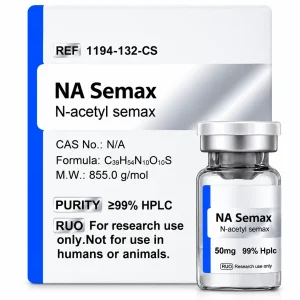
NA Semax
Price range: $60.00 through $320.00
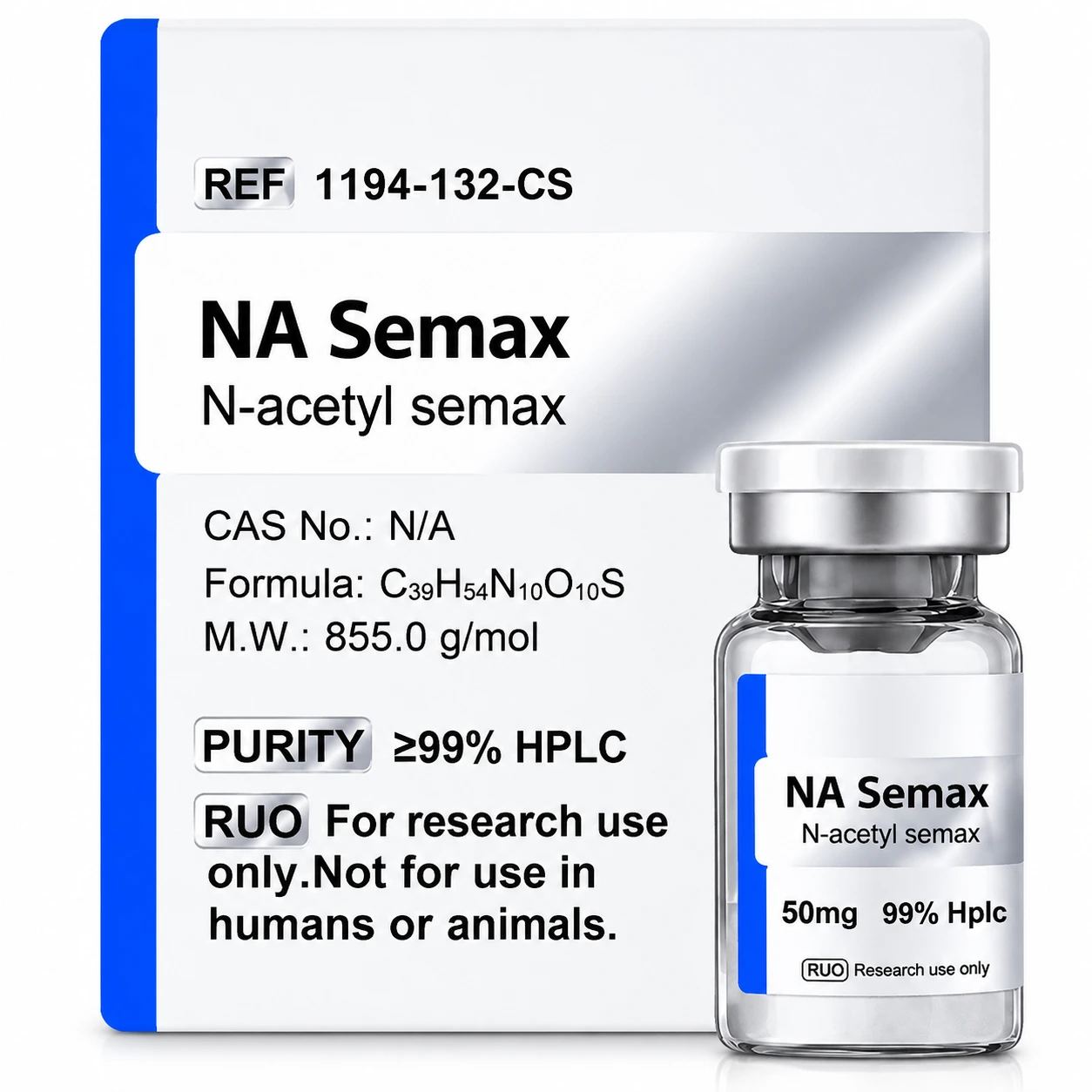
NA Semax 50 mg offers a higher dosage option for research, enabling in-depth exploration of its neuromodulatory effects. It participates in central signaling regulation by influencing neurotransmitter release and neuroplasticity processes. This dosage specification facilitates the study of dose-related effects and neuromodulatory mechanisms, providing valuable reference for cognitive and neurological function research.
The peptide will be provided as lyophilized powder to ensure maximum stability.
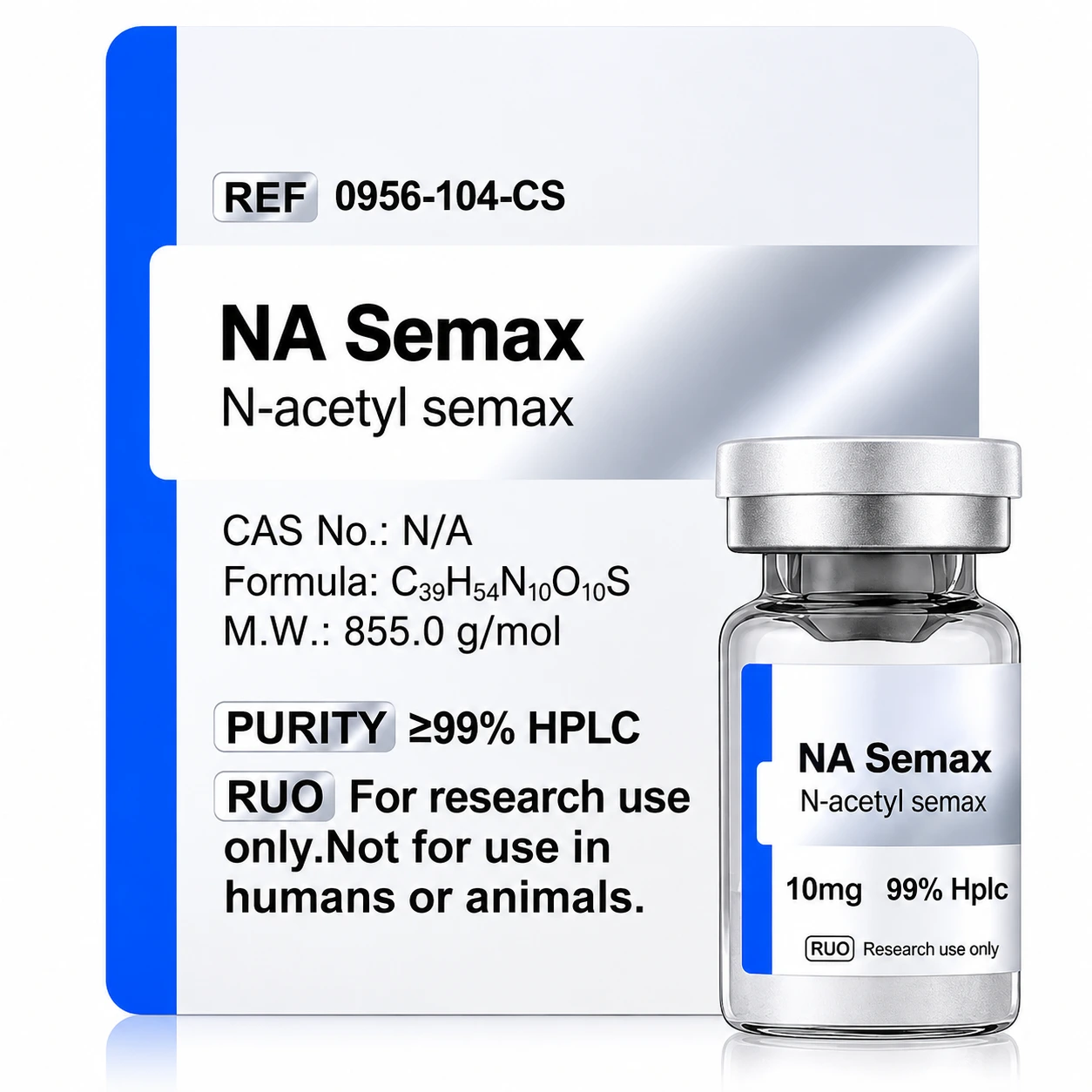
| Dosage: | 10 | 50 mg |
| Total amount: | 10 vials / Kit |
| Component: | NA Semax |
NA Semax: N-Acetyl Semax Research, Quality, Evidence & Scientific Overview
NA Semax, commonly used as shorthand for N-Acetyl Semax, is a modified form of the peptide Semax that has attracted growing interest in the research-peptide market. The modification involves adding an acetyl group to the peptide’s N-terminus, creating a chemically distinct compound from standard Semax.
Interest in NA Semax is often connected to the established scientific interest surrounding its parent compound, Semax. However, one of the most important facts for researchers and anyone creating responsible scientific content is that evidence relating to Semax should not automatically be treated as evidence for N-Acetyl Semax.
Current evidence reviews report that there are no published human clinical studies specifically establishing the safety, effectiveness, pharmacokinetics, or therapeutic effects of N-Acetyl Semax. Available discussions of potential advantages, such as improved stability or longer duration, are largely theoretical or based on chemical rationale rather than demonstrated human outcomes.
This guide provides a research-focused overview of NA Semax, including its relationship to Semax, peptide modification, research evidence, quality considerations, Certificates of Analysis, and the importance of distinguishing scientific findings from unsupported commercial claims.
What Is NA Semax?
NA Semax generally refers to N-Acetyl Semax, an acetylated derivative of the parent peptide Semax.
Standard Semax is commonly described by the amino-acid sequence:
Met-Glu-His-Phe-Pro-Gly-Pro
or:
MEHFPGP
Semax itself was developed as a synthetic analogue related to the ACTH(4-10) region and has been investigated in neurological and cognitive research.
N-Acetyl Semax modifies the parent peptide by adding an acetyl group at the N-terminus.
This chemical modification means that NA Semax is not simply another name for standard Semax. It is a distinct molecular form.
That distinction is essential for scientific accuracy.
A modification designed to alter how a peptide interacts with enzymes or other molecules may also change other characteristics of the compound. Therefore, claims about the pharmacological activity of standard Semax cannot automatically be transferred to N-Acetyl Semax. Current reviews specifically emphasize that direct evidence for the modified compound is extremely limited or absent.
NA Semax vs. Standard Semax
One of the most important SEO and scientific topics surrounding NA Semax is the difference between the modified peptide and its parent compound.
Standard Semax
Semax has a longer research history and has been studied in connection with neurological processes, cognitive research, and neuroprotective mechanisms.
Semax is registered as a medicine for certain indications in Russia, but it is not authorized as an approved medicine in the United States or European Union.
N-Acetyl Semax
NA Semax is chemically modified through N-terminal acetylation.
The purpose commonly proposed for this modification is to alter enzymatic stability. However, altered stability does not automatically mean greater effectiveness, longer-lasting activity in humans, or improved safety.
Available evidence reviews report no adequate published human research specifically evaluating N-Acetyl Semax as a distinct compound.
This is why a scientifically responsible website should clearly separate:
- Evidence about standard Semax
- Chemical information about N-acetylation
- Direct evidence about NA Semax
Why Is NA Semax Modified?
Peptide modifications are commonly investigated in chemistry and pharmaceutical research because peptides can be susceptible to enzymatic degradation.
Adding an acetyl group to a peptide’s N-terminus changes its chemical structure and may influence interactions with enzymes or metal ions.
Research examining N-terminal acetylation of Semax has demonstrated that acetylation can alter the peptide’s coordination chemistry with metal ions such as copper and zinc. However, chemical changes alone do not establish improved clinical or neurological outcomes.
This distinction is especially important because marketing descriptions may describe NA Semax as a “stronger” or “longer-lasting” version of Semax.
At present, those claims require evidence specific to the modified molecule.
A chemical modification can change a compound’s behavior, but different is not automatically better.
NA Semax and Scientific Research
The parent compound Semax has generated research interest in several areas, including:
- Neurological research
- Cognitive research
- Neurotrophic signaling
- Brain-function research
- Ischemic injury research
- Peptide pharmacology
However, the research history of standard Semax should not be presented as proof of identical effects from NA Semax.
Current reviews report that N-Acetyl Semax itself has no established body of published human clinical evidence and no registered clinical-trial program demonstrating therapeutic benefits.
For researchers, this creates an important distinction:
Semax research may generate hypotheses about related compounds, but it does not replace direct experimentation and validation of N-Acetyl Semax.
What Does the Current Evidence Show?
The available evidence for NA Semax is limited.
Current evidence assessments report:
- No established human clinical studies specifically evaluating NA Semax
- No reliable human pharmacokinetic data for the modified compound
- No established clinical dosing standard
- No demonstrated therapeutic indication
- No adequate safety database specific to the modified peptide
Some chemical research has examined acetylated forms of Semax and how N-terminal modification affects molecular interactions. However, laboratory chemistry is not equivalent to evidence of clinical effectiveness.
For this reason, the most accurate description of NA Semax is as a modified peptide of research interest with a limited direct evidence base.
NA Semax and Claims About Cognitive Performance
Searches for NA Semax frequently include phrases related to:
- Focus
- Memory
- Learning
- Cognitive performance
- Brain health
- Neuroprotection
These topics are often associated with the broader Semax research literature.
However, it is important not to transform research hypotheses into established clinical claims.
A responsible NA Semax page should avoid statements such as:
- “Clinically proven to improve memory”
- “Guaranteed cognitive enhancement”
- “Treats neurological disorders”
- “Repairs brain damage”
- “Proven neuroprotective therapy”
- “Improves intelligence”
Current reviews do not identify published human clinical evidence supporting those claims for N-Acetyl Semax specifically.
More accurate language includes:
- “A modified Semax derivative”
- “Studied in peptide and chemical research”
- “Of interest for investigating modified peptide stability”
- “Research evidence remains limited”
- “Parent-compound findings should not automatically be extrapolated”
NA Semax Research Quality Considerations
For laboratories evaluating a modified peptide, accurate identification is essential.
A product name alone is not sufficient to establish chemical identity.
Researchers should consider:
1. Exact Compound Identity
The supplier should clearly specify whether the product is:
- Standard Semax
- Semax acetate
- N-Acetyl Semax
- N-Acetyl Semax Amidate
These names may refer to different chemical forms.
2. Peptide Sequence and Modification
The sequence and the precise location of any modification should be clearly documented.
For NA Semax, the N-terminal acetylation should be specifically identified.
3. Analytical Purity
Purity should be supported by appropriate analytical testing.
4. Molecular Identity
Mass spectrometry or another suitable method can help support identification of the intended peptide.
5. Batch Traceability
A batch or lot number allows analytical results to be associated with a specific production lot.
6. Certificate of Analysis
A Certificate of Analysis (COA) can provide useful information regarding a specific batch.
Why a Certificate of Analysis Matters
A COA can help researchers evaluate whether a research material matches its stated specification.
Depending on the analytical program, a COA may include:
- Product name
- Compound identity
- Batch or lot number
- Net peptide content
- Purity result
- Analytical method
- Mass identification
- Testing date
A publicly available example of an NA-Semax analytical report demonstrates the type of information that may be supplied for a specific batch, including HPLC and mass-spectrometry testing. Such results are batch-specific and should never be generalized to every product sold under the same name.
Researchers should review documentation associated with the actual material being studied.
NA Semax vs. NA Semax Amidate
Online product descriptions sometimes create confusion between N-Acetyl Semax and N-Acetyl Semax Amidate.
These should not automatically be treated as identical.
N-Acetyl Semax generally refers to modification at the N-terminus.
N-Acetyl Semax Amidate describes a more extensively modified form that may include:
- N-terminal acetylation
- C-terminal amidation
That additional modification creates another distinct chemical form.
Evidence reviews report that the amidated form has no established published human or animal evidence demonstrating its specific activity or safety.
For SEO and product accuracy, suppliers should clearly identify exactly which molecular form they are describing.
Regulatory Status of NA Semax
N-Acetyl Semax should not be confused with standard Semax for regulatory purposes.
Current evidence reviews report that N-Acetyl Semax has no approved medical indication in the United States or European Union, and registration of standard Semax in Russia does not automatically extend to chemically modified derivatives.
This is important for responsible product descriptions.
A website should not imply that NA Semax is:
- FDA approved
- EMA approved
- An approved nootropic medicine
- Clinically proven for cognitive enhancement
- Approved because standard Semax has registration elsewhere
Regulatory approval is specific to the compound, formulation, manufacturer, jurisdiction, and approved indication.
NA Semax Safety Considerations
The limited direct evidence base also means that the safety profile of NA Semax remains uncertain.
The absence of published adverse-event reports should not be interpreted as proof that the compound is safe.
A lack of studies can simply mean that the relevant questions have not yet been adequately investigated.
Current evidence reviews emphasize that:
- No adequate human safety database exists for the modified compound
- Potential pharmacological differences from Semax have not been fully characterized
- Interactions and contraindications remain insufficiently characterized
- Claims about improved safety are unsupported by direct evidence
This makes careful scientific language especially important.
How to Evaluate an NA Semax Research Supplier
Researchers can use a structured checklist when evaluating NA Semax research materials.
Verify the Exact Chemical Form
Confirm whether the material is standard Semax, N-Acetyl Semax, or an amidated derivative.
Review Analytical Documentation
Look for identity and purity information supported by appropriate analytical methods.
Check Batch Information
A unique batch or lot number improves research traceability.
Examine the COA
Confirm that the documentation corresponds to the specific product batch.
Review Storage Information
Follow the supplier’s documented storage specifications for the actual material supplied.
Avoid Unsupported Claims
Supplier claims about human cognitive benefits, safety, or clinical effectiveness should be supported by direct evidence for the specific compound.
NA Semax and Research Reproducibility
Reproducibility depends on knowing exactly what material was used.
Research records should ideally include:
- Full compound name
- Peptide sequence
- Chemical modification
- Batch number
- Purity specification
- Analytical method
- COA reference
- Storage conditions
- Experimental conditions
This is particularly important for modified peptides because even apparently small structural changes can alter molecular behavior.
Documenting the precise form helps researchers avoid incorrectly comparing standard Semax data with data generated using N-Acetyl Semax.
Frequently Asked Questions About NA Semax
What is NA Semax?
NA Semax generally refers to N-Acetyl Semax, a chemically modified form of standard Semax containing an acetyl modification at the N-terminus.
Is NA Semax the same as Semax?
No. N-Acetyl Semax is chemically distinct from standard Semax. Research findings involving standard Semax should not automatically be considered evidence for the modified compound.
Is NA Semax FDA approved?
No. Current evidence reviews report no FDA approval or approved medical indication for N-Acetyl Semax.
Does NA Semax improve memory or focus?
There is no adequate published human clinical evidence establishing memory or focus benefits specifically for N-Acetyl Semax. Claims based on standard Semax research should not automatically be transferred to the modified compound.
Does N-acetylation make Semax longer lasting?
N-terminal acetylation changes the chemical structure and may affect peptide stability, but direct evidence establishing a longer duration in humans for N-Acetyl Semax has not been identified.
What is the difference between NA Semax and NA Semax Amidate?
NA Semax generally refers to N-terminal acetylation. NA Semax Amidate refers to a further modified form that includes amidation at the C-terminus. They should be treated as distinct compounds.
Why is a COA important?
A batch-specific Certificate of Analysis can provide information about identity, purity, and analytical testing for the specific research material being evaluated.
Conclusion: Understanding NA Semax
NA Semax is a keyword commonly used to describe N-Acetyl Semax, a modified derivative of the parent peptide Semax.
The scientific distinction between the two compounds is crucial.
Standard Semax has a substantially broader research history and has regulatory recognition in Russia for specific formulations and indications, while N-Acetyl Semax is a chemically modified derivative that does not automatically inherit either the parent compound’s evidence base or regulatory status.
Current evidence indicates that direct research on N-Acetyl Semax remains highly limited. Published human clinical evidence, established pharmacokinetic data, and a comprehensive safety database for the modified compound have not been identified.
For laboratories and research organizations, the most important considerations are therefore precise chemical identification, analytical purity, batch traceability, reliable Certificates of Analysis, and careful interpretation of the evidence.
| Quantity | 10 vials / Kit (10mg), 10 vials / Kit (50mg) |
|---|
Be the first to review “NA Semax”
Related products
Laboratory Peptides
Laboratory Peptides
Laboratory Peptides
Laboratory Peptides
Laboratory Peptides
Laboratory Peptides
Laboratory Peptides

Laboratory Peptides
Reviews
There are no reviews yet.