

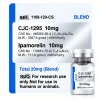
Tesamoreli, Ipamorelin, CJC-1295 6/3/3 (Blend)
$200.00
This triple combination is used to study the multi-level synergistic regulatory mechanisms of the growth hormone axis. Tesamoreli primarily acts on upstream regulatory signals, Ipamorelin stimulates growth hormone release through selective pathways, while CJC-1295 prolongs the duration of endogenous signaling. By covering distinct regulatory nodes, this triad enables systematic investigation of GH secretion rhythms, feedback control, and endocrine system synergism. This combination holds significant model research value for studies on the growth axis, circadian rhythms, and diabetes.
The peptide will be provided as lyophilized powder to ensure maximum stability.
| Dosage: | 6/3/3 mg |
| Total amount: | 10 vials / Kit |
| Component: | Tesamoreli, Ipamorelin, CJC-1295 Blend |
Tesamorelin, Ipamorelin, CJC-1295 Blend: Peptide Research, Mechanisms and Quality Guide
The Tesamorelin, Ipamorelin, CJC-1295 Blend is a combination of three peptides associated with research into growth hormone regulation, endocrine signaling, and the growth hormone–insulin-like growth factor 1 (GH–IGF-1) pathway. Each compound has a different molecular structure and biological profile, making it important to understand their individual characteristics before interpreting claims about a combined formulation.
Interest in these compounds reflects wider scientific attention to growth hormone–releasing pathways and their roles in human physiology. However, a blend containing all three compounds should not automatically be assumed to have greater effectiveness, improved safety, or proven benefits compared with the individual substances.
Tesamorelin has an approved prescription-drug indication in the United States for reducing excess abdominal fat in adults with HIV-associated lipodystrophy. It is not approved as a general weight-loss treatment. The US Food and Drug Administration (FDA) has also identified safety concerns and limited clinical data concerning compounded products containing CJC-1295 and ipamorelin acetate. These distinctions are essential when evaluating the scientific evidence and claims surrounding this combination.
This guide explains the three compounds, their research backgrounds, the limitations of combination products, and the analytical quality standards that matter when evaluating peptide research materials.
What Is a Tesamorelin, Ipamorelin, CJC-1295 Blend?
A Tesamorelin, Ipamorelin, CJC-1295 Blend combines three compounds associated with the regulation of growth hormone signaling.
Although these substances are often discussed together in peptide research, they are not identical. They differ in molecular design, interactions with biological pathways, available clinical evidence, and regulatory status.
The three components are:
- Tesamorelin: A growth hormone–releasing hormone (GHRH) analogue that stimulates the body’s growth hormone pathway.
- Ipamorelin: A peptide that acts as a ghrelin receptor agonist and has been investigated for its effects on growth hormone release.
- CJC-1295: A synthetic peptide investigated for its ability to stimulate growth hormone release through the GHRH receptor pathway.
Combining compounds with related biological targets does not establish that their effects will be additive or beneficial. A specific blend requires its own evidence concerning formulation, pharmacology, safety, and efficacy.
For that reason, content about this combination should distinguish established information about individual compounds from hypotheses about how they might interact when combined.
1. Tesamorelin: Scientific Background and Approved Use
Tesamorelin is a synthetic analogue of growth hormone–releasing hormone. It acts on the pituitary growth hormone pathway and can increase growth hormone and IGF-1 levels.
In the United States, prescription tesamorelin products are approved for reducing excess abdominal fat in adults with HIV-associated lipodystrophy. The approved product information explicitly states that tesamorelin is not indicated for general weight management. Long-term cardiovascular safety has not been established, and the prescribing information includes important warnings and precautions.
This approved indication should not be confused with broader online claims about body composition, athletic performance, or anti-aging.
When evaluating a Tesamorelin, Ipamorelin, CJC-1295 Blend, it is particularly important not to transfer the approved status of a prescription tesamorelin product to a three-compound combination. The combination itself is not established as an approved medicine simply because one component has an approved medical use.
2. Ipamorelin: Receptor Activity and Research
Ipamorelin is a synthetic peptide studied for its activity at the growth hormone secretagogue receptor, also known as the ghrelin receptor.
This pathway is distinct from the GHRH receptor pathway associated with tesamorelin and CJC-1295. The distinction helps explain why researchers may study the compounds separately when investigating endocrine signaling.
However, evidence that a compound interacts with a particular receptor does not establish a clinically meaningful outcome. The effect depends on factors such as dose, exposure, biological context, formulation, and individual physiology.
Safety is also an important consideration. The FDA has identified concerns about compounded ipamorelin acetate, including possible immunogenicity, peptide-related impurities, and limited information about safety for certain routes of administration. The agency also refers to a study reporting serious adverse events, including death, in the context of intravenous ipamorelin use for gastric motility.
These concerns should be considered when evaluating online descriptions of ipamorelin-containing combinations.
3. CJC-1295: Growth Hormone–Releasing Pathway Research
CJC-1295 is a synthetic peptide investigated for its activity within the growth hormone–releasing hormone pathway.
It is frequently discussed in peptide research alongside other compounds that influence endocrine signaling. However, its scientific background does not make it interchangeable with tesamorelin or ipamorelin.
The precise identity of a product labelled CJC-1295 should also be verified. Products can differ in formulation, molecular design, and labeling, and a product name alone is not sufficient evidence of composition or quality.
The FDA has identified potential safety concerns associated with compounded CJC-1295, including immunogenicity risks, peptide impurities, and limited clinical data. It has also identified serious adverse events associated with CJC-1295, including increased heart rate and systemic vasodilatory reactions.
These findings underscore the need for careful evidence evaluation rather than assuming that a research peptide is safe because it is marketed online.
Understanding the GH–IGF-1 Pathway
Growth hormone is involved in several physiological processes, including growth, metabolism, and the regulation of other signaling molecules. One of these molecules is insulin-like growth factor 1, commonly known as IGF-1.
The GH–IGF-1 pathway is complex. Its effects depend on the relationship between hormone release, tissue responses, metabolic status, age, underlying health conditions, and other biological factors.
A combination containing multiple compounds associated with this pathway cannot be assumed to produce predictable or desirable results. More than one compound influencing a related pathway may also create overlapping effects or additional safety uncertainties.
Consequently, claims about a blend should be evaluated using direct evidence for that exact formulation—not simply by adding together claims made about its individual ingredients.
Potential Research Areas and Evidence Limitations
Scientific interest in growth hormone–related peptides includes endocrine signaling, receptor interactions, hormone regulation, and metabolic physiology.
Research involving individual compounds may help investigators understand specific mechanisms. Nevertheless, several evidence categories must be kept separate:
- Mechanistic evidence: Findings about receptor activity or molecular pathways.
- Preclinical evidence: Results from laboratory or animal experiments.
- Clinical evidence: Results from studies involving human participants.
- Combination-specific evidence: Findings directly evaluating the exact formulation and its individual components together.
Evidence from one category cannot automatically substitute for another.
For example, an experimental finding involving tesamorelin alone does not establish the safety or effectiveness of a blend containing tesamorelin, ipamorelin, and CJC-1295. Likewise, results from a study involving one CJC-1295 formulation cannot necessarily be generalized to a differently labelled product.
A scientifically credible article should clearly identify these distinctions and avoid presenting research hypotheses as established medical benefits.
Is the Blend Proven for Fat Loss, Muscle Growth or Anti-Aging?
Claims involving fat loss, muscle growth, recovery, or anti-aging frequently appear in online discussions of growth hormone–related peptides.
However, these claims should not be presented as established outcomes for the Tesamorelin, Ipamorelin, CJC-1295 Blend without appropriate clinical evidence.
Tesamorelin’s approved use is specific to excess abdominal fat associated with HIV lipodystrophy, and its prescribing information states that it is not indicated for weight management. That indication does not validate general fat-loss claims for the individual drug or for a combination containing additional compounds.
Similarly, the presence of compounds associated with growth hormone release does not demonstrate improved muscle development, athletic performance, recovery, or longevity.
Responsible product content should explain what is known, what remains uncertain, and whether the evidence actually concerns the specific blend being described.
Quality Evaluation for Peptide Research Materials
For legitimate laboratory research, product identity and analytical documentation are important considerations.
A product name and a stated quantity alone cannot confirm that a vial contains the expected substances or that its contents meet a particular analytical specification.
When evaluating research materials, researchers may review the following information.
Certificate of Analysis (COA)
A certificate of analysis should identify the material and, where applicable, the batch or lot tested.
Useful documentation may include:
- Product and sample identification
- Batch or lot number
- Testing date
- Analytical methods
- Reported purity
- Molecular identity data
- Laboratory identification
- Results and relevant limitations
A COA should correspond to the actual batch supplied. A generic certificate, an unrelated sample report, or a document without adequate traceability provides limited assurance.
High-Performance Liquid Chromatography
High-performance liquid chromatography (HPLC) can be used to assess the chromatographic profile of a sample and estimate purity under a defined analytical method.
However, an HPLC percentage alone does not establish complete molecular identity, biological activity, sterility, endotoxin status, or suitability for human use.
Mass Spectrometry
Mass spectrometry can help assess molecular mass and support identity verification. Complementary methods may be needed to evaluate other aspects of a peptide’s structure and composition.
Blend-Specific Verification
For a multi-compound material, analytical evaluation should address the individual components rather than assume that a single purity result verifies the entire formulation.
Researchers should also consider whether the documentation establishes the identity and quantity of each stated ingredient, as well as relevant impurities and formulation characteristics.
Analytical testing can support material characterization, but it does not prove clinical effectiveness or establish that a blend is safe for administration to people.
Regulatory Status and Responsible Product Information
The regulatory status of a peptide depends on the compound, formulation, intended use, jurisdiction, and applicable rules.
Tesamorelin has an approved prescription-drug indication in the United States for a specific population and condition. That approval does not extend automatically to products combining tesamorelin with ipamorelin and CJC-1295.
The FDA’s published safety information concerning compounded CJC-1295 and ipamorelin acetate also makes it inappropriate to describe these substances as risk-free or to assume that every formulation has been adequately evaluated.
Businesses publishing information about peptide research materials should avoid unsupported treatment claims, misleading approval statements, and language implying that laboratory materials are suitable for human use.
For readers, the practical lesson is to verify the exact product identity, review the available evidence, and consult a qualified healthcare professional about medical questions involving hormone-related products.
Frequently Asked Questions
What is a Tesamorelin, Ipamorelin, CJC-1295 Blend?
It is a combination of three compounds associated with growth hormone–related pathways. The blend’s specific composition, quality, safety, and effects require direct evidence and cannot be inferred from the ingredients alone.
Are all three compounds the same?
No. Tesamorelin is a GHRH analogue, ipamorelin acts at the ghrelin receptor, and CJC-1295 is investigated in relation to the GHRH pathway. Their molecular characteristics and evidence bases differ.
Is the combination FDA-approved?
The combination should not be described as FDA-approved based on tesamorelin’s separate prescription-drug approval. The exact formulation and its regulatory status must be assessed independently.
Is the blend proven to cause fat loss?
No established conclusion about general fat loss can be drawn from the blend’s ingredients alone. Tesamorelin’s approved US indication concerns excess abdominal fat in adults with HIV-associated lipodystrophy, and the drug is not indicated for general weight management.
What is a COA?
A certificate of analysis is a document reporting analytical results for an identified sample or batch. Its usefulness depends on traceability, the methods used, the tests performed, and the clarity of the reported findings.
Does a high purity percentage prove a product is safe?
No. Purity is only one aspect of quality. It does not establish clinical safety, suitability for human administration, or effectiveness.
Can the individual compounds’ research results be applied to the blend?
Not automatically. A combination requires evidence that specifically addresses its formulation, interactions, and safety. Results from individual compounds cannot establish the effects of a three-compound blend.
Conclusion
The Tesamorelin, Ipamorelin, CJC-1295 Blend brings together three compounds associated with growth hormone–related research, but their shared research context should not be mistaken for proof that the combination is effective or safe.
Tesamorelin has a specific approved prescription use in the United States, while the FDA has identified important safety uncertainties concerning compounded ipamorelin acetate and CJC-1295. Evidence for individual ingredients does not establish the clinical profile of the combined formulation.
| Quantity | 10 vials / Kit |
|---|
Be the first to review “Tesamoreli, Ipamorelin, CJC-1295 6/3/3 (Blend)”
Related products
Laboratory Peptides
Laboratory Peptides
Laboratory Peptides
Laboratory Peptides
Laboratory Peptides
Laboratory Peptides
Laboratory Peptides
Laboratory Peptides
Reviews
There are no reviews yet.