

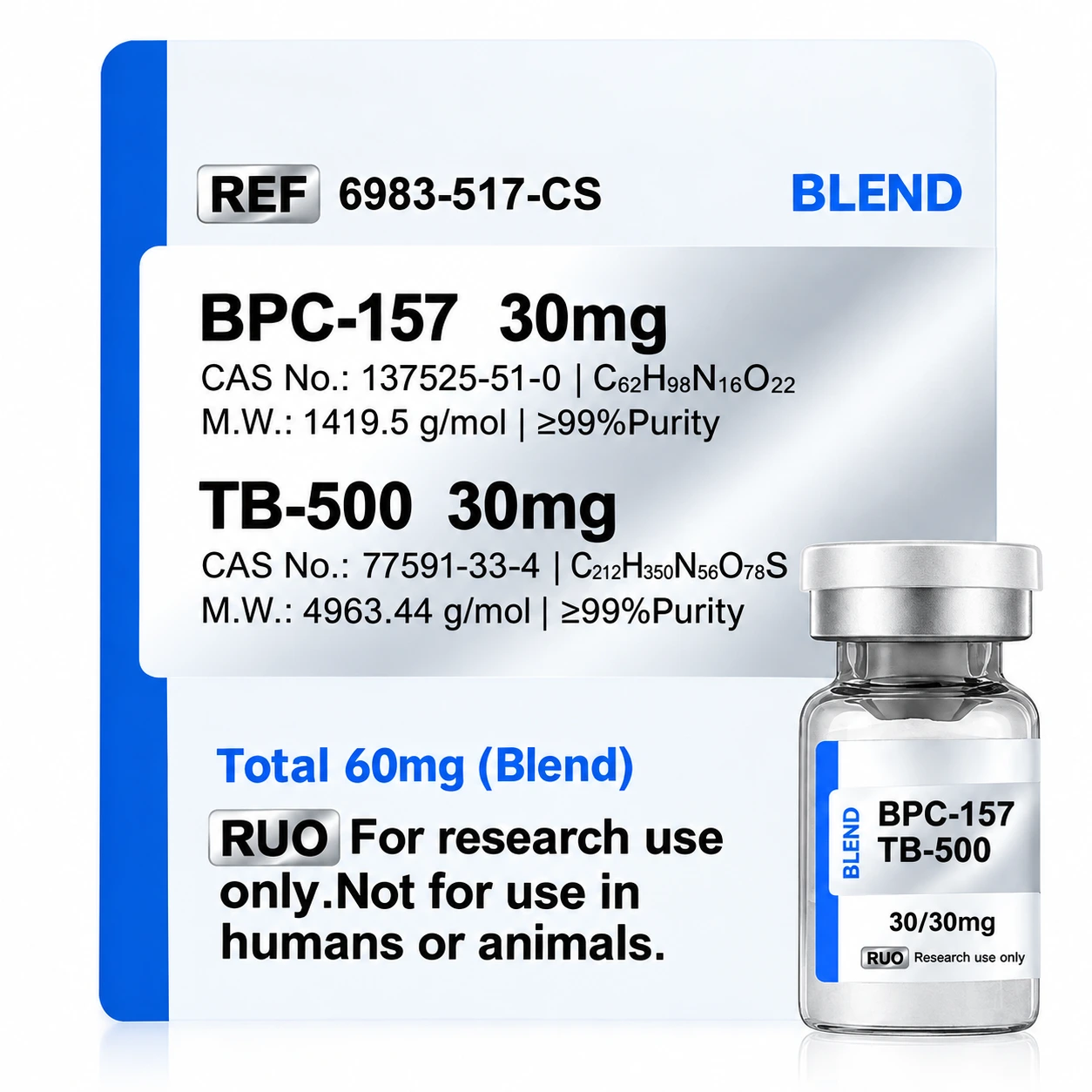
BPC-157, TB-500 Blend 30mg+30mg

$520.00
BPC157 and TB-500 are two research peptides widely studied in regenerative biology and cellular signaling research. BPC157 is investigated for its involvement in tissue-related biological pathways and molecular communication, while TB-500 is a synthetic fragment related to Thymosin Beta-4 research, focusing on cellular migration and repair-related mechanisms. This combination provides researchers with a dual-peptide research material for exploring complementary biological pathways.
The 30mg+30mg specification is suitable for laboratory studies and peptide analysis. Supplied as Research Use Only (RUO) material.
| Dosage: | 30/30 mg |
| Total amount: | 10 vials / Kit |
| Component: | BPC-157, TB-500 Blend |
BPC-157, TB-500 Blend 30mg+30mg: Research, Peptide Quality & Scientific Guide
Introduction
The BPC-157, TB-500 Blend 30mg+30mg is a combination of two peptides that have attracted interest in preclinical research involving cellular processes, tissue biology, and wound-healing pathways. The product name typically indicates a formulation containing 30mg of BPC-157 and 30mg of TB-500, representing 60mg of combined labeled peptide content.
Interest in these compounds has grown alongside broader scientific investigation into peptides and their potential roles in cellular signaling. However, scientific research, commercial product descriptions, and established medical treatments are three different things. Neither BPC-157 nor TB-500 is an FDA-approved medicine, and the available evidence does not establish the safety or effectiveness of this particular blend for treating injuries or other medical conditions. The FDA has also identified important data gaps concerning the safety of these substances in humans.
For researchers, laboratories, and readers investigating the BPC-157 TB-500 blend 30mg+30mg, understanding the individual peptides, the limitations of combination research, analytical quality control, and regulatory considerations is essential.
This guide examines the scientific background, terminology, research questions, product documentation, and quality factors associated with this peptide combination.
What Is the BPC-157, TB-500 Blend 30mg+30mg?
The BPC-157 and TB-500 blend combines two distinct peptide-related substances in one labeled formulation.
BPC-157 is a synthetic peptide investigated predominantly in preclinical models involving gastrointestinal biology, vascular signaling, and tissue-related processes. TB-500 is a name commonly associated with a short peptide fragment related to thymosin beta-4, a naturally occurring protein involved in cellular processes.
Although the compounds are frequently discussed together in online research-peptide communities, they are not identical substances and should not be treated as interchangeable.
The designation 30mg+30mg ordinarily means:
- BPC-157: 30mg labeled quantity
- TB-500: 30mg labeled quantity
- Combined labeled quantity: 60mg
The exact contents must be confirmed through product labeling and batch-specific analytical documentation. The notation does not establish the actual purity, identity, formulation, or suitability of a particular vial.
It is also important to distinguish product quantity from dosage. A 30mg+30mg label describes the stated amount of each component, not a validated dose for human use.
Understanding BPC-157
BPC-157 is a synthetic peptide that has been studied in laboratory and animal models. Research has explored several biological processes, including vascular signaling, inflammatory pathways, and tissue responses.
These findings have contributed to interest in BPC-157 within experimental biology and sports-recovery discussions. Nevertheless, the existence of preclinical studies does not demonstrate that the peptide produces the same outcomes in humans.
The FDA’s assessment of BPC-157 has highlighted significant limitations in the available safety information, including concerns relating to immunogenicity, peptide impurities, and the absence of adequate data to determine whether certain compounded formulations could cause harm.
For scientific content, BPC-157 is therefore best described as an investigational peptide rather than a proven treatment for tendon injuries, ligament damage, muscle strains, or gastrointestinal disease.
Understanding TB-500
TB-500 is commonly associated with a peptide fragment derived from thymosin beta-4. Accurate identification matters because TB-500 and full-length thymosin beta-4 are not necessarily the same material.
Research on thymosin beta-4 cannot automatically be used as proof of the safety or effectiveness of a TB-500 fragment. Differences in molecular structure can affect biological activity, distribution, metabolism, and potential risks.
In its 2026 briefing materials, the FDA noted that it had not identified clinical studies establishing the safety of administering TB-500 to humans and that the available evidence was insufficient to evaluate its effectiveness for wound healing. The agency also highlighted the importance of distinguishing TB-500 from thymosin beta-4.
For this reason, claims about TB-500 should specify which substance and formulation the evidence actually concerns.
Why Are BPC-157 and TB-500 Combined?
The two peptides are often discussed together because researchers and commercial marketers associate them with different proposed biological pathways.
BPC-157 has been investigated in experimental models involving vascular and tissue-related signaling. Thymosin beta-4 research has examined cellular migration and other biological processes, while the evidence specific to TB-500 remains limited.
This has encouraged the hypothesis that combining the substances might produce complementary effects. However, a plausible hypothesis is not the same as a demonstrated outcome.
There is insufficient evidence to conclude that a BPC-157 and TB-500 blend is more effective than either component alone. Findings from studies of one compound cannot establish the benefits of the combination.
The FDA’s review materials also identify major gaps in human safety information for these substances.
Responsible research communication should make this limitation clear rather than presenting a blend as a proven recovery solution.
BPC-157, TB-500 Blend 30mg+30mg: What Does Research Show?
Research involving these peptides falls into several broad categories.
1. Preclinical tissue biology
Studies of BPC-157 have investigated biological responses in experimental models involving different tissues. Such work may help researchers formulate hypotheses about cellular processes, but animal findings cannot establish clinical effectiveness in humans.
2. Cellular signaling
Peptide research can investigate how molecules interact with signaling pathways, cellular structures, or biological systems. Results depend on the experimental conditions, molecular identity, concentration, and methods used.
3. Thymosin beta-4 research
Research on full-length thymosin beta-4 provides context for understanding the biological family associated with TB-500. It does not automatically validate the activity of a shorter fragment or a commercial blend.
4. Combination research
The central question for a blend is whether the combined substances have been evaluated together in a properly designed study.
A combination requires its own evidence. Results for BPC-157 alone and results for thymosin beta-4 or TB-500 alone cannot demonstrate that the mixture has additive or synergistic effects.
Accordingly, the BPC-157, TB-500 Blend 30mg+30mg should not be marketed as clinically proven to accelerate recovery, repair injuries, reduce inflammation, or improve athletic performance.
Understanding the 30mg+30mg Product Label
The product name is important for search visibility, but its meaning must be communicated accurately.
The “30mg+30mg” notation typically identifies the labeled quantity of each component. It does not tell a researcher everything necessary to evaluate the material.
Important questions include:
- Does the label identify both ingredients clearly?
- Does the stated composition match the batch documentation?
- Are the molecular identities independently characterized?
- Is there a lot-specific certificate of analysis?
- Are the analytical methods described?
- Is the total quantity distinguished from the amount of each individual component?
These details matter because a combined product introduces two separate identity questions as well as the question of whether the blend has been prepared and characterized consistently.
The presence of two ingredients on a label is not proof that both have been correctly identified or that the combined formulation has been evaluated for safety.
Quality Control and Certificate of Analysis (COA)
Analytical documentation is an important consideration when evaluating research materials.
A Certificate of Analysis (COA) should be relevant to the actual product batch and should provide information that can be independently assessed.
HPLC analysis
High-performance liquid chromatography (HPLC) can help characterize chromatographic purity and identify major components in a sample.
However, an HPLC purity result alone does not prove molecular identity, sterility, endotoxin status, or suitability for human administration.
Mass spectrometry
Mass spectrometry can provide information about molecular mass and help support compound identification. Depending on the substance and method, additional analytical techniques may be needed to characterize sequence, structure, or other relevant properties.
Batch traceability
A useful documentation system connects the product, batch number, laboratory analysis, and reported results.
For a two-component blend, researchers should examine whether the documentation addresses both components rather than relying on a single general purity statement.
Independent testing
Independent analytical testing can provide additional information when the laboratory, methods, sample identity, and chain of custody are clearly documented.
A supplier’s COA should not be treated as proof of clinical efficacy or human safety. Analytical quality and clinical evidence answer different questions.
Storage, Handling and Laboratory Considerations
Research materials should be stored and handled according to their specific product documentation and the requirements of the relevant laboratory.
Researchers should consider container integrity, environmental exposure, labeling, sample identification, and any manufacturer-specified storage conditions.
A generic product description cannot establish the correct storage conditions for every formulation. Requirements may vary according to composition, manufacturing process, packaging, and stability data.
Likewise, a product labeled for research purposes should not be assumed to be sterile, suitable for injection, or appropriate for use in people.
Is the BPC-157, TB-500 Blend FDA Approved?
The BPC-157 and TB-500 combination is not an FDA-approved drug product.
In 2026, the FDA published briefing documents concerning these substances as part of its review of bulk drug substances proposed for use in compounding. An advisory committee review or recommendation is not equivalent to FDA approval of a drug or combination product.
Regulatory status can change, so businesses should check current official guidance before publishing claims about compounding, permitted uses, or product availability.
Companies should not describe this blend as an FDA-approved therapy or imply that research-use labeling establishes authorization for human use.
How to Evaluate a Research Peptide Supplier
When assessing a supplier of BPC-157 and TB-500 research materials, prioritize verifiable documentation over promotional claims.
Consider the following criteria:
Product transparency: The product description should identify the stated components and quantities without confusing total blend mass with individual ingredient amounts.
Analytical documentation: Batch-specific testing should be available and should identify the methods used.
Traceability: Lot numbers and supporting documentation should correspond to the product supplied.
Clear labeling: Research materials should be described accurately, without unsupported claims of medical benefits.
Evidence-based communication: Claims should distinguish published findings, proposed mechanisms, and unproven hypotheses.
Regulatory awareness: A supplier should not imply that research products are approved medicines simply because they are commercially available.
These criteria help readers assess the quality of product information without assuming that a high purity percentage or professional-looking label establishes safety or effectiveness.
Frequently Asked Questions
What is BPC-157, TB-500 Blend 30mg+30mg?
It is a product designation that typically describes a blend containing 30mg of BPC-157 and 30mg of TB-500. The exact composition should be verified against the product label and batch documentation.
Does 30mg+30mg mean 60mg of total peptide?
The notation generally indicates 30mg of each component, for 60mg of combined labeled content. It does not establish the verified content or purity of a particular batch.
Are BPC-157 and TB-500 proven to work better together?
No. The available evidence does not establish that the combination produces better outcomes than either component alone in humans.
Is the blend proven to heal tendons, muscles, or ligaments?
No. Preclinical findings are not sufficient to establish that the blend safely and effectively treats human injuries.
What should a COA for a BPC-157 and TB-500 blend contain?
Useful documentation may include the batch number, component identity, analytical methods, purity results, testing date, and laboratory information. Researchers should verify that the results actually apply to the batch being evaluated.
Is the blend approved for human use?
The combination is not an FDA-approved medicine. Research-use labeling does not establish approval for human administration.
Why is analytical testing important?
Testing helps assess the identity and quality of a research material. It cannot, by itself, establish that a substance is safe or effective as a medical treatment.
Conclusion
The BPC-157, TB-500 Blend 30mg+30mg brings together two peptides frequently discussed in preclinical research involving cellular signaling and tissue biology. Its product designation generally refers to 30mg of each component, but that quantity should not be confused with a validated human dose.
The most important considerations are accurate ingredient identification, reliable batch documentation, appropriate analytical testing, transparent labeling, and careful interpretation of scientific evidence.
Neither the popularity of these peptides nor research involving related compounds establishes that the blend is a proven treatment. A credible scientific resource should communicate both the areas under investigation and the limitations of the evidence.
| Quantity | 10 vials / Kit |
|---|
Be the first to review “BPC-157, TB-500 Blend 30mg+30mg”
Related products
Laboratory Peptides
Laboratory Peptides
Laboratory Peptides
Laboratory Peptides
Laboratory Peptides
Laboratory Peptides
Laboratory Peptides
Laboratory Peptides
Reviews
There are no reviews yet.