
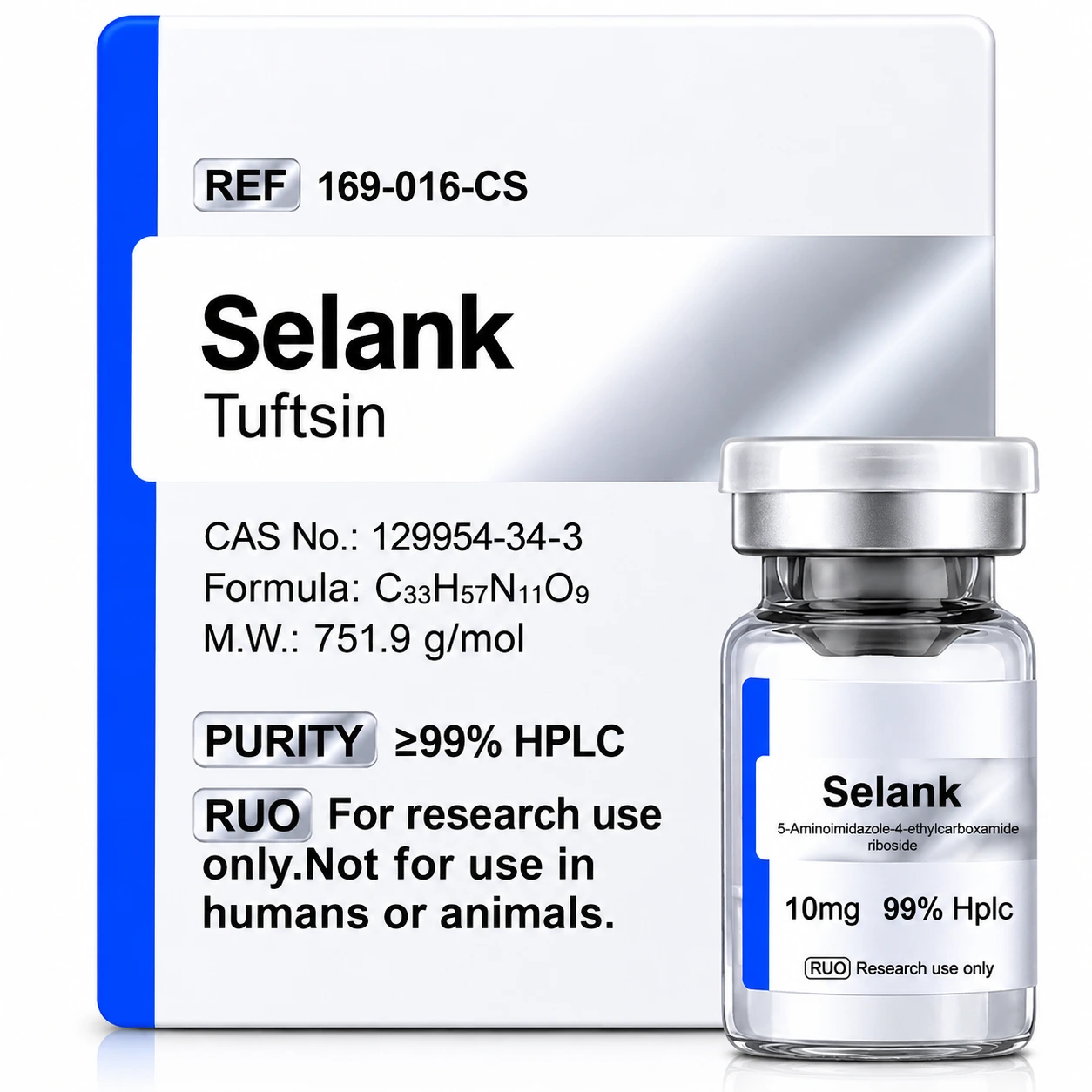
Selank 10mg

$60.00
Selank is a synthetic peptide product developed based on natural regulatory peptide cluster proteins, scientifically proven to comprehensively enhance nervous, immune, and cognitive health. It effectively alleviates anxiety and stress, regulates emotional balance, reduces symptoms of depression, and improves memory and attention, particularly in cases of age-related memory impairment. Additionally, Selank has immune-regulating properties that reduce inflammatory responses and enhance antiviral capabilities, making it effective in improving symptoms of post-COVID-19 asthenia and immune disorders such as atopic dermatitis.
The peptide will be provided as lyophilized powder to ensure maximum stability.
| Dosage: | 10 mg |
| Total amount: | 10 vials / Kit |
| Component: | Selank |
Selank 10mg: Peptide Research, Scientific Background and Quality Guide
Introduction to Selank 10mg
Interest in peptide science continues to grow as researchers investigate the relationship between short amino-acid sequences, biological signalling and neurological processes. One compound attracting attention in this field is Selank, a synthetic heptapeptide developed from the structure of tuftsin.
The search term Selank 10mg is commonly used by people researching Selank peptide products, laboratory materials and peptide specifications. However, understanding the compound requires more than looking at the quantity printed on a product label. Its molecular identity, research background, analytical quality and regulatory status are all important considerations.
Selank has been investigated primarily in connection with anxiety-related biological pathways and neurological research. Some published Russian clinical studies have explored its potential effects in people with anxiety disorders, while laboratory and animal studies have investigated possible mechanisms involving neurotransmitter-related systems.
Despite this scientific interest, the available evidence remains limited. Selank is not FDA-approved, and research-grade products should not be represented as approved medicines or treatments.
This guide explores Selank 10mg, including its molecular background, scientific research, potential mechanisms under investigation, quality considerations and frequently asked questions.
What Is Selank?
Selank is a synthetic peptide consisting of seven amino acids. It is commonly described as a tuftsin analogue because its structure is based on tuftsin, a naturally occurring peptide associated with immune-system activity.
The commonly reported amino-acid sequence of Selank is:
Thr-Lys-Pro-Arg-Pro-Gly-Pro (TKPRPGP)
Selank was developed by researchers in Russia and has been investigated in neurological and neurochemical research. Its scientific background has attracted attention because researchers are interested in how short peptides may interact with biological signalling pathways.
Unlike conventional small-molecule compounds, peptides are made from amino acids connected through peptide bonds. Their structures and biological properties depend on the sequence, chemical characteristics and surrounding experimental conditions.
Selank is also associated with the research category of neuroactive peptides. However, this classification does not establish that it is effective or safe as a treatment for any particular condition.
Understanding Selank 10mg
The term Selank 10mg generally describes a product advertised as containing 10 milligrams of Selank material.
It is important to distinguish product quantity from an established medical dosage. A label stating 10mg does not establish an appropriate human dose, route of administration, treatment duration or clinical effectiveness.
There is no FDA-approved Selank dosage for treating anxiety, improving memory or addressing other health conditions. Consequently, a 10mg research product should not be interpreted as a pharmaceutical presentation or a recommended treatment amount.
For laboratory research, the amount of material supplied is only one part of the specification. Researchers also need reliable information about:
- Confirmed molecular identity.
- Peptide sequence and composition.
- Purity and analytical methodology.
- Batch identification and traceability.
- Storage and handling information.
- Supporting analytical documentation.
A clear distinction between product quantity and medical dosage helps prevent misleading interpretations.
Selank Peptide: Molecular Structure and Scientific Background
Selank belongs to a group of synthetic peptides studied for their possible interactions with biological systems.
Its relationship with tuftsin provides part of the scientific foundation for investigating the compound. The addition of the Pro-Gly-Pro sequence distinguishes Selank from the shorter parent peptide sequence.
Researchers have explored whether structural characteristics influence peptide stability, biological activity and interactions with signalling systems.
The molecular structure is also relevant when evaluating analytical identity. A laboratory should not rely solely on a product name or supplier description to establish that a material is Selank.
Appropriate analytical methods may include mass spectrometry and chromatographic techniques. These methods can contribute to the evaluation of molecular identity, purity and potential impurities.
The FDA’s substance database identifies Selank as a peptide and records its seven-amino-acid sequence. This provides a useful reference point when checking the identity of the compound.
Selank Research and Areas of Scientific Interest
Selank has been studied primarily in relation to anxiety-associated biological processes. Its research history includes laboratory investigations, animal studies and a limited number of clinical publications.
1. Anxiety-related research
One of the main areas of interest in Selank research concerns anxiety-related processes.
A 2008 clinical publication indexed in PubMed compared Selank with medazepam in 62 patients with generalised anxiety disorder and neurasthenia. The researchers reported similar anxiolytic effects between the comparison groups.
A separate 2014 publication examined Selank in comparison with phenazepam in patients with anxiety-related disorders.
These studies are relevant to the compound’s research history, but they should be interpreted cautiously. Small studies, limited independent replication and differences in research methods make it difficult to draw broad conclusions about effectiveness.
They do not establish that commercially advertised Selank 10mg products can treat anxiety.
2. Neurotransmitter-related investigations
Researchers have also investigated possible relationships between Selank and neurotransmitter systems.
One published molecular study explored possible interactions involving gamma-aminobutyric acid (GABA) receptors. GABA is an important inhibitory neurotransmitter involved in regulating activity within the central nervous system.
The study proposed a possible mechanism involving allosteric modulation of GABA receptors. However, a proposed molecular mechanism is not equivalent to demonstrated clinical effectiveness.
Further independent research would be needed to establish the relevance of these findings in humans.
3. Experimental neurological research
Other investigations have considered Selank in connection with gene expression, neurochemical activity and stress-related biological responses.
These studies help researchers develop hypotheses about the compound’s possible biological properties.
However, findings from cells or animal models cannot automatically be applied to people. Additional well-designed human research is needed before reliable clinical conclusions can be reached.
What Does the Research Actually Establish?
A responsible Selank research guide should distinguish published findings from claims that have not been adequately demonstrated.
The existing literature includes small Russian clinical studies and preclinical investigations. The evidence is not comparable to the extensive clinical development programme expected for an established medicine.
Important limitations include:
- Relatively small clinical study populations.
- Limited independent replication.
- Restricted availability of full English-language research reports.
- Insufficient long-term human safety information.
- Uncertainty about the relevance of laboratory findings to everyday human use.
For this reason, claims that Selank reliably improves memory, concentration, mood, sleep or general cognitive performance should not be presented as established medical facts.
Scientific accuracy is particularly important for websites discussing neuroactive peptides. Clear descriptions of the evidence help readers distinguish genuine research from promotional statements.
Selank 10mg and Product Quality
For laboratory research, product quality is an essential consideration. A product’s advertised name and quantity are not enough to establish its identity or analytical characteristics.
Researchers evaluating Selank materials should consider several quality indicators.
1. Peptide identity
The supplier should provide documentation that identifies the compound and its relevant molecular characteristics.
Analytical identification is important because similarly named materials and incorrectly labelled products can create problems during laboratory investigations.
2. Purity testing
Purity information helps researchers understand the proportion of the target compound relative to detected impurities.
High-performance liquid chromatography (HPLC) is commonly used in peptide analysis. However, a reported purity percentage should always be interpreted alongside the method, testing conditions and supporting documentation.
A high HPLC purity result does not automatically demonstrate sterility, safety or suitability for human administration.
3. Mass spectrometry
Mass spectrometry can help verify molecular mass and support compound identification.
When combined with other analytical techniques, it provides additional information that can help researchers assess whether a supplied material corresponds to the expected molecular characteristics.
4. Certificate of Analysis
A Certificate of Analysis (COA) is an important quality document for laboratory materials.
A useful Selank COA should identify:
- Product or compound name.
- Batch or lot number.
- Testing date.
- Analytical method.
- Reported purity.
- Identity or molecular-mass findings.
- Laboratory or testing-provider information.
The document should correspond to the actual batch being supplied. Generic certificates that cannot be connected to a specific batch offer limited assurance.
5. Supplier transparency
Reliable laboratory-material suppliers should communicate product specifications clearly and avoid unsupported medical or performance claims.
Transparent documentation, identifiable batch information and accessible customer support are useful indicators when evaluating a supplier.
Regulatory Status and Research-Use Considerations
Regulatory status is an important part of any Selank 10mg product description.
Selank is not approved by the United States Food and Drug Administration (FDA) as a medicine. Its presence in scientific databases or regulatory discussions does not constitute approval.
The FDA has specifically identified potential concerns relating to compounded drugs containing Selank acetate. These include possible immunogenicity risks associated with peptide aggregation and peptide-related impurities. The agency has also stated that it lacks important safety information concerning Selank acetate administered to humans.
In addition, the removal of Selank acetate from an FDA compounding nomination category does not mean that the compound has received approval.
Regulatory requirements differ between countries. Businesses and researchers should check applicable national rules rather than assuming that the legal position in one jurisdiction applies everywhere.
Products labelled for laboratory research should not be marketed as approved medicines, and research-grade materials should not be presented as suitable for human consumption.
Selank vs Semax: Understanding the Difference
Selank and Semax are frequently discussed together because both are synthetic peptides developed in Russia and investigated in neurological research.
However, they have different molecular sequences and research backgrounds.
| Feature | Selank | Semax |
|---|---|---|
| Peptide type | Synthetic heptapeptide | Synthetic heptapeptide |
| Structural background | Tuftsin analogue | ACTH-fragment analogue |
| Amino-acid sequence | TKPRPGP | MEHFPGP |
| Main research interest | Anxiety-related pathways | Neurochemical and neurological research |
| Research status | Limited clinical and preclinical evidence | Separate clinical and preclinical literature |
Although both compounds are discussed in the context of neuroactive peptides, they should not be treated as interchangeable substances.
Their molecular structures, experimental findings and regulatory positions must be evaluated separately.
Why Accurate Selank Product Information Matters
The peptide market contains products with different levels of documentation and quality transparency. For researchers, accurate product information is important when comparing materials and planning laboratory investigations.
A well-structured product specification should clearly explain what the material is, how much is supplied and what analytical information is available.
For a product described as Selank 10mg, the product page should avoid confusing the supplied quantity with an established therapeutic dosage.
It should also avoid unsupported statements such as guaranteed anxiety relief, improved intelligence, enhanced memory or clinically proven cognitive benefits.
A transparent description is more useful to research professionals and helps establish trust with readers.
Frequently Asked Questions About Selank 10mg
1. What is Selank 10mg?
Selank 10mg generally refers to a product advertised as containing 10 milligrams of the synthetic heptapeptide Selank. The stated quantity is a product specification, not an established human treatment dose.
2. What is the Selank peptide sequence?
The commonly reported sequence is Thr-Lys-Pro-Arg-Pro-Gly-Pro (TKPRPGP). It is a synthetic analogue of the naturally occurring peptide tuftsin.
3. What is Selank studied for?
Selank has been investigated primarily in anxiety-related research, alongside studies examining possible neurochemical and neurological mechanisms. The available human evidence remains limited.
4. Is Selank FDA-approved?
No. Selank is not an FDA-approved medicine. The FDA has also identified potential immunogenicity and peptide-impurity concerns involving compounded Selank acetate.
5. Does Selank improve memory?
There is insufficient high-quality clinical evidence to establish that Selank improves memory in healthy people. Marketing statements about cognitive enhancement should not be confused with proven clinical outcomes.
6. Is Selank the same as Semax?
No. Both are synthetic heptapeptides, but they have different amino-acid sequences and research backgrounds.
7. What is a Selank COA?
A Certificate of Analysis is a document containing batch-specific analytical information. It may include identity testing, purity results, analytical methods and batch identification.
8. Does a 10mg label indicate a recommended dose?
No. The 10mg description refers to the advertised quantity of material. It does not establish a safe or effective human dosage.
9. Why is peptide purity important?
Purity testing helps researchers evaluate the composition of a laboratory material and identify potential impurities. Results should be interpreted alongside the analytical method and supporting documentation.
10. Can research-grade Selank be used as a medicine?
Research-grade Selank should not be treated as an approved medicine. It is not an FDA-approved treatment, and the safety and effectiveness of research products for human use have not been established.
Conclusion: Understanding Selank 10mg Through Reliable Research
Selank 10mg is a search term associated with a synthetic seven-amino-acid peptide that has attracted scientific interest because of its relationship with tuftsin and its investigation in anxiety-related and neurological research.
Published studies provide some background on the compound, but the available clinical evidence is limited and does not establish broad therapeutic or cognitive-enhancement claims.
For laboratory research, accurate molecular identification, analytical purity, batch-specific documentation and supplier transparency are essential considerations. A Certificate of Analysis and supporting analytical information can help researchers evaluate the characteristics of a supplied material.
The most reliable approach to Selank is evidence-led: understand its molecular background, distinguish preliminary research from established clinical findings and recognise the limitations of research-grade products.
Research transparency, accurate product specifications and responsible scientific communication should remain central to every Selank-related product or information page.
| Quantity | 10 vials / Kit |
|---|
Be the first to review “Selank 10mg” Cancel reply
Related products

Laboratory Peptides
Laboratory Peptides
Laboratory Peptides
Laboratory Peptides
Laboratory Peptides

Laboratory Peptides
illumineuro (Pinealon/NA Selank/NA Seamx/PE22-28) 50mg Blend
Laboratory Peptides
Laboratory Peptides
Reviews
There are no reviews yet.