KLOW 80mg (Blend): Ingredients, Peptide Research, Composition and Quality Guide
KLOW 80mg (Blend) is a four-component peptide formulation commonly described as a combination of GHK-Cu, BPC-157, TB-500, and KPV. It has attracted interest in peptide research discussions involving skin biology, cellular signaling, extracellular matrix processes, and inflammatory pathways.
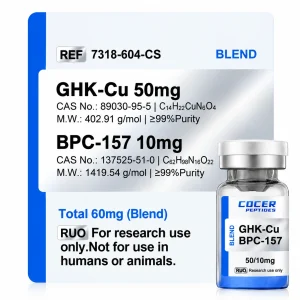
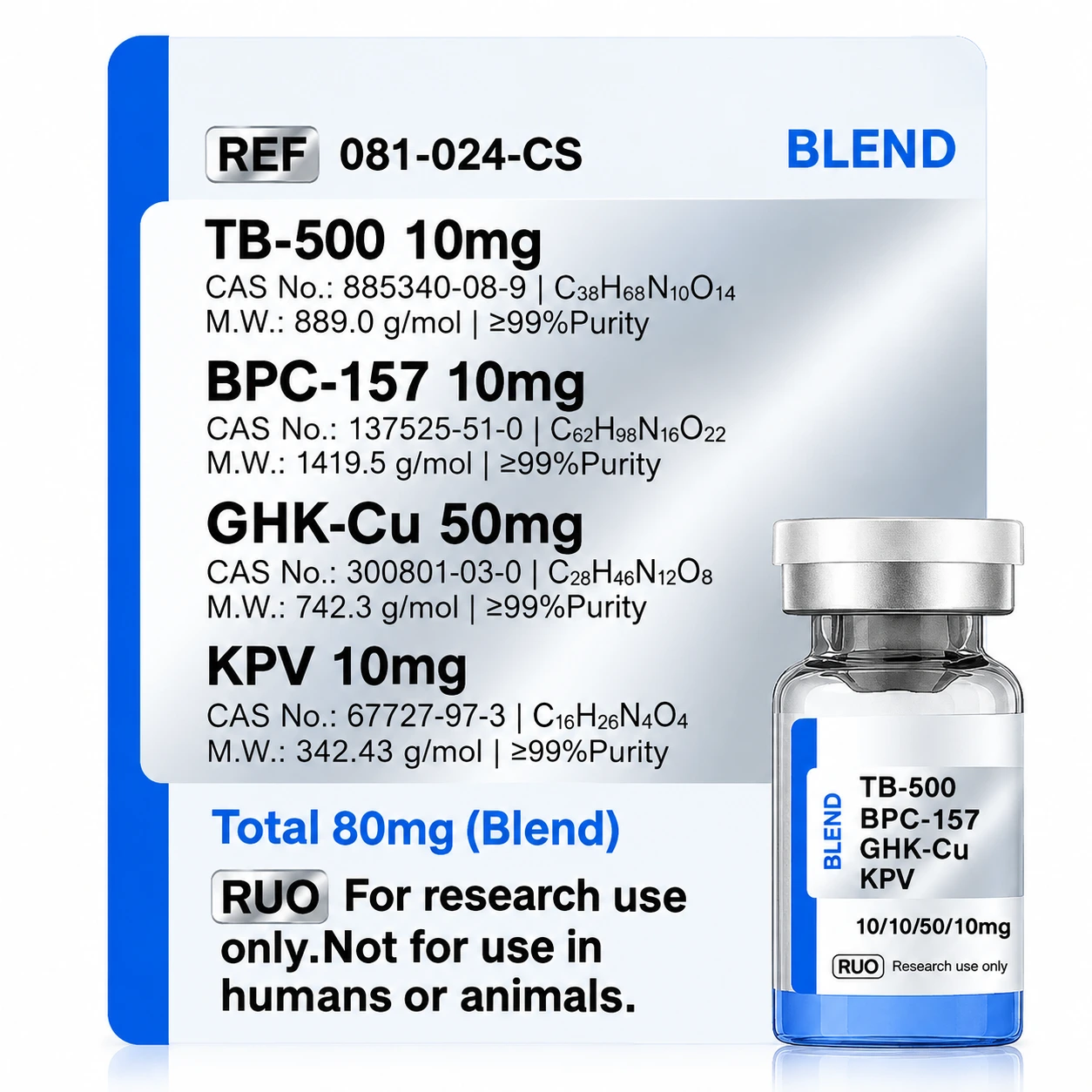
Unlike a single peptide product, KLOW combines several distinct compounds in one research formulation. The most commonly listed composition is 50mg of GHK-Cu, 10mg of BPC-157, 10mg of TB-500, and 10mg of KPV, giving a stated total of 80mg. Individual product formulations should always be verified against their own labels and batch documentation. <Cite refs={[“turn196385search0″,”turn196385search8”]}/>
For laboratories and readers researching KLOW 80mg peptide blend, understanding the ingredients, available scientific evidence, product characterization, and quality documentation is essential. Just as importantly, research on individual ingredients should not be confused with evidence that the complete combination is safe or effective in humans.
What Is KLOW 80mg Blend?
KLOW is a commercial name for a combination of four research peptides rather than the scientific name of one naturally occurring or independently characterized molecule.
The blend is commonly discussed in relation to four research areas: copper-peptide biology, cellular and tissue signaling, actin-associated cellular processes, and inflammatory signaling. Each ingredient has its own molecular identity and research history.
The word “blend” describes the formulation: several separate compounds are supplied together in one vial. It does not mean that the ingredients chemically combine to form a new peptide.
The 80mg designation represents the sum of the four commonly listed ingredient quantities. It should not be interpreted as a recommended human dose, an established treatment protocol, or proof of a particular biological effect.
KLOW should be approached as an investigational research formulation. The complete four-peptide combination has not been established as an approved medicine, and research on its individual components cannot establish the safety or efficacy of the blend.
KLOW 80mg Composition: What Is Inside the Blend?
The commonly listed formulation contains four components in a fixed mass ratio.
| Ingredient | Commonly listed amount | General research area |
|---|---|---|
| GHK-Cu | 50mg | Copper-peptide biology and skin-related research |
| BPC-157 | 10mg | Experimental cellular and tissue biology |
| TB-500 | 10mg | Research involving thymosin-beta-4-related pathways |
| KPV | 10mg | Peptide and inflammatory-signaling research |
| Total | 80mg | Four-component research blend |
Source: Commonly listed commercial formulations; verify the composition of the specific product being evaluated. <Cite refs={[“turn196385search0″,”turn196385search8”]}/>
GHK-Cu accounts for 62.5% of the stated blend by mass, while each of the other three components accounts for 12.5%.
These percentages describe mass, not relative potency, biological activity, or clinical effectiveness. Different peptides have different molecular properties, and the relative mass of an ingredient cannot independently establish its contribution to a biological outcome.
GHK-Cu: The Copper Peptide Component
GHK-Cu is a copper-binding tripeptide that has been studied in skin biology, extracellular matrix processes, and other areas of experimental biology.
Copper-binding peptides are of interest because copper participates in numerous biological processes. Research on GHK-Cu has examined cellular signaling and pathways associated with tissue biology, although findings depend on the model, formulation, concentration, and experimental conditions.
Within the commonly listed KLOW blend, GHK-Cu is the largest component by mass.
However, evidence involving topical GHK-Cu preparations should not automatically be extrapolated to a mixed research vial or to other routes of exposure. The safety and behavior of a compound can differ with its formulation and intended application.
The U.S. Food and Drug Administration (FDA) has also identified potential safety concerns involving compounded injectable GHK-Cu, including possible immunogenicity associated with aggregation and peptide-related impurities. <Cite refs={[“turn577746search0”]}/>
For this reason, a product’s inclusion of GHK-Cu does not establish that the complete KLOW blend is suitable for human use.
BPC-157: Experimental Peptide Research
BPC-157 is a synthetic peptide investigated in preclinical research involving cellular signaling and tissue-related biological processes.
Interest in BPC-157 has grown because experimental studies have examined a range of biological pathways. Nevertheless, preclinical observations are not equivalent to demonstrated clinical benefits, and they do not establish an approved medical use.
The FDA has stated that it has identified limited safety-related information for BPC-157 and has raised concerns about potential immunogenicity, aggregation, peptide-related impurities, and difficulties in characterizing the active ingredient. <Cite refs={[“turn577746search0″,”turn577746search22”]}/>
These considerations matter when evaluating KLOW because the presence of BPC-157 introduces additional analytical and safety questions that cannot be answered solely by measuring the overall purity of a mixed sample.
A responsible scientific overview should therefore describe BPC-157 in terms of its investigational research history rather than promising injury recovery, accelerated healing, pain relief, or other clinical outcomes.
TB-500: Understanding the Terminology
TB-500 is a commercial research term commonly associated with a fragment of thymosin beta-4. It is important not to assume that every product described as TB-500 is identical to full-length thymosin beta-4.
Thymosin beta-4 has been studied in cellular processes that include cell migration and tissue biology. However, research involving the full-length molecule cannot automatically establish the properties of a particular fragment or commercial preparation.
The FDA has identified limited or absent human safety information for thymosin beta-4 fragment products and has raised concerns about possible immunogenicity, aggregation, and peptide-related impurities. <Cite refs={[“turn577746search0″,”turn577746search21”]}/>
For KLOW 80mg, accurate ingredient identification is therefore especially important. Product documentation should identify the specific material represented by the TB-500 label rather than relying on broad terminology alone.
KPV: The Fourth Component
KPV is a short peptide that has been investigated in experimental research involving inflammatory signaling.
Its presence distinguishes the commonly listed KLOW formulation from the related GLOW blend, which is generally described as containing GHK-Cu, BPC-157, and TB-500 without KPV.
Although KPV has attracted scientific interest, its inclusion does not establish that KLOW has a proven anti-inflammatory effect in humans.
The FDA reported that it had not identified human exposure data for drug products containing KPV and lacked important information needed to determine potential safety risks. <Cite refs={[“turn577746search0″,”turn577746search20”]}/>
Researchers evaluating KPV should distinguish between laboratory hypotheses, findings from individual experimental models, and clinically demonstrated outcomes.
What Is KLOW 80mg Studied For?
The four components are associated with different areas of preclinical research. Broadly, the literature surrounding these individual ingredients has prompted interest in:
- Copper-peptide and skin biology
- Cellular signaling
- Extracellular matrix research
- Cell migration and related processes
- Inflammatory pathway research
- Peptide characterization and analytical chemistry
- Experimental studies of interactions between different molecules
These topics describe research interests, not established indications for KLOW.
An important scientific limitation is that evidence for the individual ingredients does not prove the efficacy of the combined blend. The formulation may behave differently from its individual components, and the available evidence does not establish the best ratio, combined effects, stability, interactions, or safety profile of KLOW as a whole.
A properly designed research program would need to evaluate the combination directly rather than assuming that the properties of its components simply add together.
KLOW vs. GLOW: What Is the Difference?
KLOW and GLOW are commercial blend names rather than standardized names for approved medicines.
The commonly listed formulations differ as follows:
| Feature | KLOW 80mg | GLOW 70mg |
|---|---|---|
| GHK-Cu | 50mg | 50mg |
| BPC-157 | 10mg | 10mg |
| TB-500 | 10mg | 10mg |
| KPV | 10mg | Not included |
| Stated total | 80mg | 70mg |
<Cite refs={[“turn196385search0″,”turn196385search4”]}/>
The principal difference is the addition of KPV in KLOW. The extra ingredient changes the total stated mass and the formulation’s composition.
That difference alone does not demonstrate that KLOW is more effective than GLOW. Comparative conclusions would require appropriately designed studies evaluating both formulations under defined conditions.
Researchers should also avoid comparing products by total milligrams alone. Ingredient identity, component ratios, sample characterization, and study design all influence whether two formulations can be meaningfully compared.
How to Evaluate KLOW 80mg Quality
Quality assessment is an important part of selecting research materials. A product description or purity claim should not substitute for evidence that identifies the sample and documents the analytical methods used.
When evaluating a KLOW blend, consider the following areas.
1. Ingredient identification
The product documentation should list each component separately and state its quantity. Ambiguous descriptions such as “four-peptide complex” are less informative than a complete composition statement.
2. Certificate of Analysis
A Certificate of Analysis (COA) should be traceable to the specific batch being evaluated. Useful information may include the product identifier, batch number, test date, laboratory, analytical methods, and reported results.
A generic COA without a matching lot number provides limited assurance about the material in a particular vial.
3. HPLC analysis
High-performance liquid chromatography (HPLC) can help characterize chromatographic purity. However, an overall purity percentage for a mixture may not establish the identity, amount, or purity of every individual component.
For a multi-peptide blend, ask whether the reported analysis is specific to the complete mixture or separately identifies each ingredient.
4. Mass spectrometry
Mass spectrometry can provide evidence about molecular mass and support compound identification. It should be interpreted alongside appropriate analytical methods and reference information.
5. Batch traceability
The batch or lot number on the product should correspond to the documentation provided. Testing dates, sample identifiers, and laboratory details should be clear enough to support independent review.
6. Appropriate limits on quality claims
A high reported purity result does not prove sterility, endotoxin status, stability, clinical safety, or effectiveness. Each of those questions requires suitable evidence.
A COA is an analytical document, not proof that a product is approved for human use.
Regulatory Status and Safety Considerations
KLOW 80mg should not be described as an FDA-approved treatment. The commonly listed combination is a research formulation, and its complete safety and effectiveness have not been established through controlled clinical trials.
The FDA has published substance-specific information highlighting important evidence gaps and potential safety concerns for BPC-157, KPV, injectable GHK-Cu, and thymosin beta-4 fragment (TB-500) in the context of drug compounding. These concerns include insufficient human safety data and possible immunogenicity or impurity-related risks. <Cite refs={[“turn577746search0″,”turn577746search21″,”turn577746search22”]}/>
This regulatory information should be interpreted precisely: it addresses the FDA’s assessment of particular substances and their use in compounding, not a clinical trial of the KLOW blend itself.
A research-use label does not establish that a substance is safe for injection, ingestion, topical use, or any other form of human exposure. Individuals should not use an unapproved peptide blend as a substitute for medical care or a treatment recommended by a qualified healthcare professional.
Frequently Asked Questions About KLOW 80mg
What is KLOW 80mg?
KLOW 80mg is a commercial name for a commonly listed four-component research blend containing GHK-Cu, BPC-157, TB-500, and KPV. Product composition should be verified against the relevant label and batch documents.
What are the ingredients in KLOW?
The commonly listed composition is GHK-Cu 50mg, BPC-157 10mg, TB-500 10mg, and KPV 10mg, totaling 80mg. Formulations may differ between suppliers.
Is KLOW a single peptide?
No. KLOW is a blend of distinct peptide compounds, not one single peptide molecule.
What is the difference between KLOW and GLOW?
The commonly listed KLOW formulation includes KPV in addition to GHK-Cu, BPC-157, and TB-500. The commonly listed GLOW formulation contains the other three ingredients without KPV.
Is KLOW clinically proven to work?
The complete blend has not been established as a clinically proven treatment. Research involving its individual ingredients does not prove that the combination is effective or safe in humans.
What does 80mg mean?
It refers to the total of the commonly listed component quantities. It is not a validated human dosage or a recommendation for administration.
What should a KLOW COA include?
A useful COA should identify the batch and sample, provide analytical methods and results, and give enough information to evaluate ingredient identity and reported purity. Testing claims should be interpreted within the scope of the methods used.
Is KLOW approved by the FDA?
KLOW is not an FDA-approved medicine. Its complete formulation does not have established clinical safety and efficacy.
Conclusion: An Evidence-Based Guide to KLOW 80mg Blend
KLOW 80mg is commonly described as a combination of GHK-Cu, BPC-157, TB-500, and KPV. Each component has a separate research history, but the evidence does not establish the complete blend as a proven human treatment.
For readers comparing KLOW research materials, the most useful considerations are clear ingredient identification, batch-specific documentation, appropriate analytical testing, and an accurate understanding of the limits of the available evidence.


Reviews
There are no reviews yet.