Tri-Heal Max (TB-500, KPV, BPC-157) 25mg + 10mg + 10mg Blend: Research, Peptide Science & Quality Guide
Introduction to Tri-Heal Max Blend
Tri-Heal Max (TB-500, KPV, BPC-157) 25mg + 10mg + 10mg Blend is a combination of three peptides that are discussed in experimental research involving cellular signaling, inflammatory pathways, and tissue biology. Interest in these compounds has grown as researchers investigate how short peptides and peptide fragments interact with biological systems.
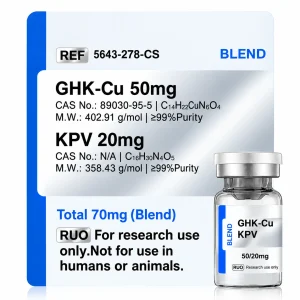
The blend name identifies three components: TB-500 at a labeled quantity of 25mg, KPV at 10mg, and BPC-157 at 10mg. These quantities describe the stated composition of the product, not clinically validated human doses.
Each component has a distinct research background. BPC-157 has primarily been investigated in preclinical models involving tissue biology and repair-related processes. TB-500 is commonly associated with a fragment of thymosin beta-4, a peptide studied in connection with cell migration and tissue biology. KPV is a short peptide studied in experimental models of inflammatory signaling.
Although these research areas help explain the interest in Tri-Heal Max, research into the individual ingredients does not establish the safety or effectiveness of the combined product. The blend should not be represented as a proven treatment for injuries, pain, inflammation, or other medical conditions. The U.S. Food and Drug Administration (FDA) has identified significant gaps in the available safety information for BPC-157, KPV, and TB-500-related substances.
For anyone researching Tri-Heal Max, the most useful starting points are ingredient identity, scientific evidence, analytical quality, batch documentation, and a clear understanding of the product’s research status.
What Is Tri-Heal Max 25mg + 10mg + 10mg?
Tri-Heal Max is a product name for a three-component peptide blend. Its listed composition is:
- TB-500 — 25mg: A peptide fragment commonly discussed in relation to thymosin beta-4 research.
- KPV — 10mg: A short peptide investigated in experimental inflammatory-signaling research.
- BPC-157 — 10mg: An experimental peptide studied predominantly in preclinical models of biological and tissue-related processes.
The total labeled quantity across these three components is 45mg. This arithmetic total does not establish the product’s purity, bioavailability, clinical suitability, or effectiveness.
Researchers should also distinguish between the amount listed on a label and the amount of a chemically verified ingredient in a finished product. Independent testing and appropriate documentation are needed to assess the identity and quality of a specific batch.
Because the available evidence does not establish a validated human dosing regimen for this combination, the ingredient quantities should be treated as product-composition information rather than instructions for human use.
Understanding the Three Peptides
1. TB-500: Research Into Thymosin Beta-4-Related Peptides
TB-500 is commonly described in commercial research contexts as a thymosin beta-4-related peptide fragment. The distinction between TB-500 and full-length thymosin beta-4 matters: evidence involving the full-length molecule cannot automatically be attributed to a shorter fragment.
Thymosin beta-4 has been investigated in biological research involving cell migration, wound-related processes, and tissue biology. However, findings about the parent peptide do not establish that TB-500 produces the same effects.
The FDA has noted that TB-500, identified as a thymosin beta-4 fragment, lacks sufficient human exposure and safety information to determine whether products containing the substance would cause harm. The agency has also raised concerns about possible immunogenicity, aggregation, and peptide-related impurities in relevant compounded products.
For an SEO article about Tri-Heal Max, TB-500 is therefore best described in terms of its research identity and the limitations of current evidence, rather than as a proven recovery or injury-treatment ingredient.
2. KPV: A Short Peptide Investigated in Inflammatory Signaling
KPV is a short peptide composed of three amino acids. It has attracted scientific interest in preclinical studies examining inflammatory pathways and biological signaling.
These experimental findings provide a basis for further research into KPV’s molecular properties. They do not, however, demonstrate that a KPV-containing product can safely or effectively treat inflammatory diseases in humans.
The FDA has stated that it has not identified human exposure data for drug products containing KPV and lacks important information needed to determine whether such products would cause harm in humans.
When evaluating KPV as part of Tri-Heal Max, researchers should look for evidence specific to the exact peptide, experimental model, and proposed application. General claims about inflammation should not be confused with demonstrated clinical outcomes.
3. BPC-157: A Peptide Studied Primarily in Preclinical Models
BPC-157 is an experimental peptide that has been investigated in laboratory and animal research involving several biological processes, including pathways related to tissue responses.
The compound receives considerable attention in online discussions about recovery and tissue repair. Nevertheless, online popularity is not equivalent to scientific validation.
A 2026 review of BPC-157 research describes substantial limitations in the human evidence and concludes that the available studies do not support evidence-based clinical recommendations.
The FDA has separately highlighted uncertainties involving the immunogenicity of BPC-157, peptide-related impurities, and active pharmaceutical ingredient characterization. It has also noted that available safety information is insufficient to determine whether compounded products containing BPC-157 would cause harm when administered to humans.
For these reasons, BPC-157 should be described as an investigational research peptide, not as an established therapy.
Why Combine TB-500, KPV and BPC-157?
The combination of three peptides may attract interest from people exploring multiple areas of peptide research within one product. Each ingredient has a different scientific background, which can make the blend a subject of questions about molecular identity, component interactions, and formulation.
However, combining ingredients does not automatically create a synergistic effect.
To establish whether Tri-Heal Max has a distinct biological effect, researchers would need studies that evaluate the exact blend. Relevant questions include:
- Are all three components correctly identified?
- Does the formulation remain stable over time?
- Do the components interact chemically or biologically?
- Does the combination change the activity of any individual ingredient?
- Are there new safety concerns associated with combining the components?
- Can the findings be reproduced under controlled experimental conditions?
Evidence for one ingredient cannot answer these questions by itself.
Unless adequate studies directly evaluate the exact 25mg + 10mg + 10mg formulation, claims that Tri-Heal Max is more effective than individual peptides—or that its components work synergistically—would be premature.
Tri-Heal Max and Tissue-Related Research
Tissue biology is a broad scientific field that includes cellular responses, extracellular matrix processes, inflammatory signaling, cell migration, and other mechanisms involved in normal biological function.
BPC-157 and thymosin beta-4-related research are often discussed in this context, while KPV has been investigated in preclinical inflammatory-signaling models.
These areas of investigation can help researchers develop questions about how different molecules behave under controlled conditions. However, several important distinctions should remain clear:
Preclinical findings: Results obtained in laboratory experiments or animal models.
Clinical evidence: Findings from appropriately designed studies involving human participants.
Established treatment: A therapy supported by adequate evidence and authorized for the relevant medical use.
These categories are not interchangeable. A biological effect observed in a cell model may not occur in a living organism, and a result in an animal model does not establish a safe or effective treatment for people.
Consequently, Tri-Heal Max should not be promoted as a proven solution for sports injuries, tendon problems, muscle damage, joint pain, surgical recovery, or chronic inflammation.
Tri-Heal Max Quality Control and Peptide Purity
For legitimate laboratory research, reliable characterization is essential. A product label alone cannot verify the identity, purity, or quality of a peptide blend.
When evaluating Tri-Heal Max, researchers should consider the following documentation.
Certificate of Analysis (COA)
A certificate of analysis should identify the tested material and provide results relevant to the specific batch.
Useful information may include:
- Product and ingredient identification
- Batch or lot number
- Testing date
- Analytical methods
- Purity results for the individual components, where validated methods are available
- Molecular identity or mass confirmation
- Laboratory identification
- Relevant limitations of the testing procedure
A COA should be traceable to the batch being evaluated. A generic document that does not identify the product lot provides less assurance.
HPLC Analysis
High-performance liquid chromatography (HPLC) is commonly used to assess chromatographic purity and separate components in a sample.
For a three-peptide blend, testing needs to account for the individual components and the characteristics of the formulation. A single purity percentage should not be assumed to represent all three peptides equally.
Furthermore, chromatographic purity alone does not establish sterility, endotoxin status, correct formulation, or suitability for human administration.
Mass Spectrometry
Mass spectrometry can provide evidence about molecular mass and help support identity assessment.
For a multi-component blend, appropriate analytical methods should be capable of distinguishing the components and evaluating whether the test results support the stated composition.
Batch Traceability
Reliable documentation should connect the product label, batch number, analytical results, and testing laboratory.
This traceability supports research recordkeeping and makes it easier to investigate discrepancies between a label and the available analytical evidence.
Quality documentation is useful, but it should never be presented as proof that a product is clinically safe or effective.
Safety, Regulatory Status and Research Limitations
One of the most important considerations when evaluating Tri-Heal Max is the limited human safety information available for its components.
The FDA has identified BPC-157, KPV, and TB-500-related substances among the compounds for which important questions remain about safety, immunogenicity, impurities, or characterization. Its published materials emphasize that information is insufficient to determine whether relevant products would cause harm in humans.
This does not mean that every possible adverse effect has been established. It means that the available evidence is inadequate to confidently characterize the risks.
The following points are particularly important:
- Do not assume that research peptides are safe because they are discussed online.
- Do not interpret animal or cell research as proof of human benefit.
- Do not assume that combining several peptides is safer or more effective than using one.
- Do not treat a certificate of analysis as evidence of clinical approval.
- Do not use a product’s stated milligram quantity as a validated human dose.
- Consult a qualified healthcare professional for medical concerns rather than self-treating with unapproved research substances.
Regulatory requirements differ between countries. Businesses should verify applicable local rules before making, importing, advertising, or distributing peptide products. A research-use label does not automatically make every product or transaction lawful.
Frequently Asked Questions About Tri-Heal Max
What is Tri-Heal Max 25mg + 10mg + 10mg?
Tri-Heal Max is described as a blend containing 25mg TB-500, 10mg KPV, and 10mg BPC-157. These figures describe the stated product composition and are not established human dosing recommendations.
What does Tri-Heal Max contain?
The stated formulation contains TB-500, KPV, and BPC-157. The exact identity and amount of each component should be verified through reliable, batch-specific documentation.
Is Tri-Heal Max clinically proven?
The available evidence does not establish this specific three-peptide blend as a clinically proven treatment. Studies of individual ingredients do not demonstrate the safety or efficacy of the combined formulation.
What is TB-500 researched for?
TB-500 is commonly associated with thymosin beta-4 fragment research. The full-length peptide and the fragment should not be treated as interchangeable, and adequate human safety and efficacy evidence for TB-500 remains lacking.
What is KPV?
KPV is a short peptide studied in experimental research involving inflammatory signaling. Its preclinical research should not be interpreted as proof of an effective human treatment.
What is BPC-157?
BPC-157 is an experimental peptide investigated primarily in preclinical models. Current evidence does not establish it as a proven treatment for injuries or other medical conditions.
Why is a COA important for a peptide blend?
A COA can provide analytical information about a particular batch. For a blend, documentation should ideally address the identity and relevant quality attributes of each component, while making clear what the tests do and do not establish.
Does 45mg total mean the blend is more potent?
No. The combined labeled quantity is simply the sum of the three stated amounts. It does not establish potency, effectiveness, bioavailability, or clinical suitability.
Conclusion: An Evidence-Based Approach to Tri-Heal Max
Tri-Heal Max (TB-500, KPV, BPC-157) 25mg + 10mg + 10mg is a three-component peptide blend that brings together compounds discussed in research involving cellular biology, inflammatory signaling, and tissue-related processes.
The scientific background of its individual ingredients explains why the blend attracts attention, but important evidence gaps remain. In particular, the effects of the exact combination cannot be inferred from studies of its components, and available information does not establish a validated human dose or proven clinical benefit.


Reviews
There are no reviews yet.