CJC-1295 Ipamorelin Blend: Research, Composition, Quality and Scientific Guide
Introduction to CJC-1295, Ipamorelin 10/10 (Blend)
CJC-1295, Ipamorelin 10/10 (Blend) is a combination of two synthetic peptides investigated for their interactions with the body’s growth hormone signaling system. The combination is commonly discussed in peptide research, endocrine science, and laboratory investigations into growth hormone secretagogues.
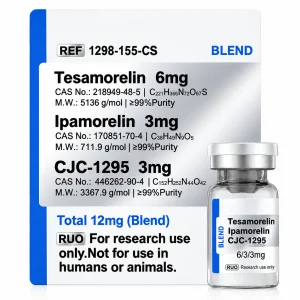
The “10/10” designation commonly indicates a product labeled as containing 10 mg of CJC-1295 and 10 mg of ipamorelin, for a nominal combined quantity of 20 mg. However, the precise composition should always be verified against the individual product label and batch-specific analytical documentation. The designation alone does not establish the identity, purity, or biological activity of the material.
CJC-1295 is a synthetic analogue related to growth hormone-releasing hormone (GHRH), while ipamorelin is a growth hormone secretagogue that acts through the growth hormone secretagogue receptor system. Although these peptides interact with different signaling pathways, the scientific rationale for combining them does not establish that the blend is clinically effective, safe, or superior to either compound alone.
The U.S. Food and Drug Administration (FDA) has highlighted important safety and characterization concerns involving CJC-1295 and ipamorelin in its reviews of substances proposed for pharmaceutical compounding. Neither compound should be represented as an FDA-approved treatment.
This guide examines the blend’s composition, scientific background, research limitations, analytical quality considerations, and the information readers should evaluate when reviewing CJC-1295 and ipamorelin research materials.
What Is CJC-1295, Ipamorelin 10/10?
CJC-1295 and ipamorelin are synthetic peptides studied in relation to growth hormone regulation.
The combination brings together two different signaling approaches:
- CJC-1295: A synthetic peptide related to GHRH signaling, which participates in the regulation of growth hormone secretion.
- Ipamorelin: A synthetic peptide that acts as a growth hormone secretagogue through the ghrelin/growth hormone secretagogue receptor pathway.
The scientific interest in this pairing comes from the fact that the two compounds interact with different parts of the growth hormone signaling system.
Nevertheless, the effects of an individual peptide cannot automatically be applied to a combined formulation. The exact blend requires its own evidence, including information about its composition, stability, pharmacology, and safety.
For researchers evaluating a product labeled CJC-1295, Ipamorelin 10/10, the first step is to establish exactly which chemical forms are present and whether the declared quantities are supported by analytical testing.
Understanding the 10mg/10mg Blend
The term “10/10” is a product descriptor rather than a recognized clinical dosage standard.
If a product label specifies 10 mg of each peptide, the nominal composition is:
- CJC-1295: 10 mg
- Ipamorelin: 10 mg
- Total labeled peptide quantity: 20 mg
These figures describe the stated contents, not a validated amount for administration to humans.
It is also important to clarify which form of CJC-1295 is included. CJC-1295 with Drug Affinity Complex (DAC) and formulations described as CJC-1295 without DAC or modified GRF (1-29) should not be treated as interchangeable. The chemical form affects how the compound behaves, and the available human evidence differs between forms.
Consequently, a reliable product description should identify the stated peptide forms, individual quantities, batch number, and relevant analytical methods rather than relying solely on the name “CJC-1295 Ipamorelin 10/10.”
How CJC-1295 and Ipamorelin Differ
CJC-1295 and GHRH signaling
Growth hormone-releasing hormone is involved in regulating growth hormone secretion by the pituitary gland. CJC-1295 was developed as a synthetic analogue associated with this signaling pathway.
Human research has investigated certain CJC-1295 formulations for their pharmacological effects on growth hormone and insulin-like growth factor 1 (IGF-1). However, these findings must be interpreted in the context of the particular formulation and study conditions.
Evidence involving CJC-1295 with DAC does not automatically establish equivalent effects for a formulation without DAC or for a blend containing another peptide.
Ipamorelin and secretagogue signaling
Ipamorelin is a synthetic peptide studied for its activity at the growth hormone secretagogue receptor, which is associated with ghrelin signaling.
This pathway differs from the receptor pathway associated with GHRH. The distinction is important when examining the scientific rationale for studying the two compounds together.
However, evidence that a compound interacts with a particular receptor does not establish that it produces a meaningful clinical benefit. Further research is required to determine the relationship between receptor activity, physiological effects, and clinical outcomes.
What Does Research Say About the Combination?
One of the most important questions for anyone researching CJC-1295, Ipamorelin 10/10 is whether the exact combination has been adequately evaluated in humans.
The available evidence is limited. Reviews of the scientific literature have not identified a published human clinical trial directly testing the CJC-1295 and ipamorelin combination as a blend. Research involving either ingredient individually cannot substitute for a clinical trial of the exact formulation.
This evidence gap matters because the two peptides may differ in their pharmacological behavior, duration of activity, and potential adverse effects. Their combination introduces additional questions that cannot be answered simply by examining the compounds separately.
A rigorous clinical study of a blend would need to specify the chemical forms, formulation, study population, treatment conditions, comparison groups, safety monitoring, and clinically relevant outcomes.
Until such evidence is available, claims that the blend has proven synergistic effects, improves recovery, increases muscle mass, reduces body fat, or reverses aging should not be presented as established clinical facts.
Why Growth Hormone Research Attracts Attention
Growth hormone is involved in a range of physiological processes, including growth, metabolism, and the regulation of IGF-1.
For this reason, the growth hormone signaling system is an established subject of endocrinology research. Scientists investigate how different signals regulate hormone release and how changes in these pathways relate to health and disease.
However, a biological pathway’s importance does not mean that increasing its activity will necessarily improve health. The effects of hormonal interventions depend on the substance, exposure, individual physiology, medical context, and possible adverse effects.
Marketing claims concerning sleep, athletic performance, muscle development, fat loss, skin quality, or longevity therefore require careful scrutiny. These outcomes cannot be assumed from the proposed mechanism of CJC-1295 and ipamorelin.
For an evidence-based article, distinguishing biological plausibility from demonstrated clinical outcomes improves credibility and helps readers understand the actual state of research.
CJC-1295, Ipamorelin 10/10: Safety Considerations
Safety is an essential consideration when evaluating experimental peptides, especially combinations intended to influence hormonal signaling.
The FDA has identified limited clinical data and potential safety concerns involving CJC-1295, including reported serious adverse events such as increased heart rate and systemic vasodilatory reactions.
For ipamorelin acetate, the FDA has raised concerns about immunogenicity, peptide aggregation, impurities, and the challenges of adequately characterizing the active ingredient. Its review also discusses serious adverse events reported in research involving intravenous administration for gastric motility. These findings should be interpreted in the context of the specific compound, formulation, and route studied.
These concerns do not establish that every formulation will produce the same outcome. They do, however, demonstrate why safety cannot be assumed from a product label or a supplier’s stated purity percentage.
A fixed blend can also make it harder to identify which ingredient is responsible if an adverse reaction occurs. There is no established human safety profile for the exact 10/10 combination.
The blend should not be described as a proven anti-aging treatment, muscle-building medicine, weight-loss product, or substitute for approved medical care.
Is CJC-1295, Ipamorelin 10/10 FDA Approved?
Neither CJC-1295 nor ipamorelin should be described as an FDA-approved drug treatment. The combined 10/10 blend is likewise not an FDA-approved medicine.
The FDA has published assessments addressing safety concerns associated with these substances in the context of pharmaceutical compounding. Regulatory classifications and compounding policies can change, so suppliers and publishers should consult current official FDA information rather than relying on outdated marketing claims.
It is also important to distinguish regulatory status from research interest. A peptide can be investigated in scientific studies without being approved for clinical treatment.
Where a product is offered as a research material, its intended use, labeling, and applicable legal requirements should be clearly established. Research labeling does not independently verify quality or make a product suitable for human use.
How to Evaluate Blend Quality and Documentation
Quality assessment is an important part of responsible peptide research. A product’s name, packaging, or advertised quantity is not sufficient to confirm its identity or composition.
When reviewing a CJC-1295, Ipamorelin 10/10 research material, consider the following documentation.
1. Certificate of Analysis
A Certificate of Analysis (COA) should be traceable to the specific product batch. It should identify the tested material, the batch or lot number, the analytical methods used, and the reported results.
A generic certificate without a clear connection to the supplied lot offers limited evidence about that particular batch.
2. HPLC analysis
High-performance liquid chromatography (HPLC) can help evaluate chromatographic purity and identify major components in a sample.
However, a stated HPLC purity percentage does not, by itself, prove the correct identity of both peptides or establish sterility, endotoxin status, safety, or suitability for human administration.
3. Mass spectrometry
Mass spectrometry can provide evidence concerning molecular mass and can complement other methods used for peptide characterization.
For a blend, documentation should make clear which components were identified and how the results relate to the declared composition.
4. Composition and batch traceability
The product documentation should identify the individual components and their stated quantities. Batch traceability allows the analytical results to be linked to the material under evaluation.
5. Storage and handling information
Storage requirements depend on the formulation and manufacturer’s validated specifications. Researchers should follow the product-specific documentation rather than assume that every peptide blend has identical stability requirements.
Together, these checks help researchers assess the quality of available documentation. They do not establish clinical efficacy or guarantee safety.
Frequently Asked Questions About CJC-1295, Ipamorelin 10/10
What does CJC-1295, Ipamorelin 10/10 mean?
The designation commonly refers to a blend labeled as containing 10 mg of CJC-1295 and 10 mg of ipamorelin. The exact composition should be verified using the product label and batch-specific documentation.
What is the difference between CJC-1295 and ipamorelin?
CJC-1295 is associated with GHRH signaling, while ipamorelin acts through the growth hormone secretagogue receptor pathway. They interact with different parts of the growth hormone signaling system.
Has the exact blend been proven effective in humans?
The available literature does not establish the exact CJC-1295 and ipamorelin blend as an effective human treatment. Reviews of the evidence have not identified a published human clinical trial directly testing this combination.
Is the 10/10 blend FDA approved?
No. The blend should not be represented as an FDA-approved medicine.
What should a COA for this blend include?
A useful COA should identify the batch, list the tested material, describe the analytical methods, and report relevant results. HPLC and mass spectrometry may provide complementary information about purity and molecular identity.
Can the blend be marketed as an anti-aging or muscle-building treatment?
Such claims should not be presented as established facts. The exact combination lacks sufficient clinical evidence to substantiate claims of proven anti-aging, muscle-building, fat-loss, or recovery benefits.
Conclusion: An Evidence-Based Guide to CJC-1295, Ipamorelin 10/10
CJC-1295, Ipamorelin 10/10 (Blend) combines two synthetic peptides investigated in relation to growth hormone signaling. Their different mechanisms provide a scientific rationale for research interest, but that rationale does not establish that the combination is safe, effective, or clinically superior to either compound alone.


Reviews
There are no reviews yet.