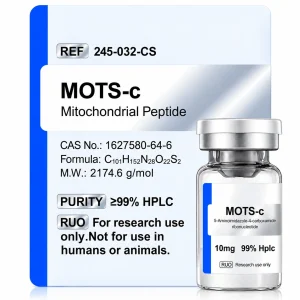
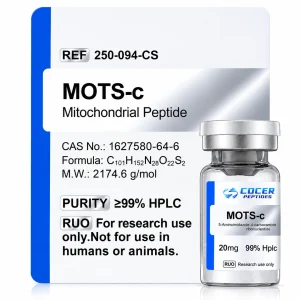
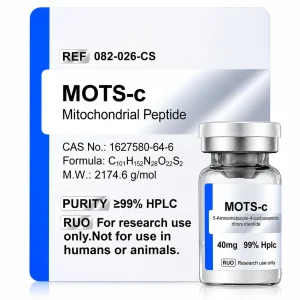


MOTS-c: Mitochondrial-Derived Peptide Research, Metabolism and Scientific Overview
MOTS-c is a mitochondrial-derived peptide that has attracted growing scientific interest for its potential role in cellular energy regulation, metabolic signaling, stress adaptation, exercise biology, and aging research.
Known formally as mitochondrial open reading frame of the 12S rRNA type-c, MOTS-c is a small peptide encoded within mitochondrial DNA. Unlike many signaling molecules encoded by nuclear genes, MOTS-c originates from a short open reading frame associated with the mitochondrial 12S rRNA region.
Researchers have investigated MOTS-c because mitochondria do more than produce cellular energy. They also participate in communication, stress responses, metabolic regulation, and cellular adaptation. MOTS-c is part of the growing field of mitochondrial-derived peptides, sometimes referred to as mitochondrial signaling peptides or mitokines.
Scientific studies have explored MOTS-c in connection with metabolic regulation, AMPK signaling, skeletal muscle biology, exercise adaptation, aging, and cellular stress responses. However, an important distinction must be made between promising preclinical findings and established human medical benefits. Much of the evidence concerning administered native MOTS-c remains based on laboratory and animal research.
What Is MOTS-c?
MOTS-c is a 16-amino-acid mitochondrial-derived peptide encoded within the mitochondrial 12S rRNA region, also known as MT-RNR1.
The full name is:
Mitochondrial Open Reading Frame of the 12S rRNA Type-C
The peptide was identified as part of a broader group of mitochondrial-derived peptides that has expanded scientific understanding of mitochondrial biology.
For many years, mitochondria were primarily described as the cell’s energy-producing structures. Modern research has demonstrated that mitochondria also participate in signaling processes that communicate information about cellular energy status and metabolic stress.
MOTS-c has attracted particular attention because studies suggest that it can participate in communication between mitochondria and the cell nucleus. Under certain experimental stress conditions, research has observed MOTS-c translocation toward the nucleus, where it may influence the expression of genes associated with cellular stress adaptation.
This area of research is sometimes described as retrograde mitochondrial signaling.
Why Is MOTS-c Important in Mitochondrial Research?
Mitochondria play essential roles in:
- Cellular energy production
- Metabolic regulation
- Oxidative stress responses
- Cellular signaling
- Adaptation to metabolic stress
- Aging-related biological processes
The discovery of mitochondrial-derived peptides added another dimension to mitochondrial research.
Rather than functioning exclusively as energy-producing organelles, mitochondria can also generate signaling molecules that may influence cellular processes elsewhere.
MOTS-c is one of the best-known mitochondrial-derived peptides studied in this area.
Scientific reviews have examined MOTS-c in relation to energy metabolism, insulin-related pathways, inflammatory signaling, exercise, stress responses, and aging-related biology. These findings have created significant research interest, although most mechanistic and intervention evidence remains preclinical.
MOTS-c and Cellular Energy Metabolism
One of the central areas of MOTS-c research involves energy metabolism.
Cells constantly respond to changes in nutrient availability and energy demand. Several signaling pathways help cells detect these changes and adjust their metabolic activity.
Research has linked MOTS-c with pathways involving AMP-activated protein kinase (AMPK), a major cellular energy sensor.
AMPK is activated when cells experience changes associated with reduced energy availability. It helps coordinate metabolic responses by influencing how cells use and generate energy.
Experimental research has suggested that MOTS-c may influence metabolic pathways involving:
- Glucose metabolism
- Cellular energy sensing
- Folate metabolism
- Purine metabolism
- AMPK-related signaling
- Stress adaptation
Scientific reviews describe the proposed folate-AICAR-AMPK pathway as an important component of MOTS-c biology.
These findings are scientifically significant, but laboratory mechanisms should not be confused with proven health benefits in humans.
MOTS-c and AMPK Research
AMPK is one of the most frequently discussed pathways in MOTS-c research.
AMPK acts as an energy sensor within cells. When energy conditions change, AMPK can influence multiple metabolic processes.
Experimental studies have suggested that MOTS-c may affect AMPK-related signaling through changes involving cellular metabolism.
This has led researchers to investigate MOTS-c in models involving:
- Metabolic stress
- Glucose regulation
- Insulin sensitivity
- Exercise adaptation
- Skeletal muscle metabolism
However, an important scientific principle applies here: a pathway observed in cells or animals does not automatically establish a clinical effect in people.
A responsible MOTS-c product page should therefore describe these findings as areas of scientific investigation rather than guaranteed outcomes.
MOTS-c and Exercise Research
MOTS-c has also generated interest in exercise and skeletal muscle research.
Exercise creates substantial changes in cellular energy demand. Muscle tissue must adapt to these changing conditions through coordinated metabolic and signaling responses.
Scientific research has examined whether MOTS-c expression and activity may be associated with exercise-related metabolic adaptation.
Reviews describe MOTS-c as being expressed in response to stress and exercise and discuss its potential role in skeletal muscle and systemic metabolic signaling.
Animal research has examined physical-performance and exercise-related endpoints, creating further interest in the peptide’s biological role.
However, this does not establish that synthetic MOTS-c improves athletic performance in humans.
Marketing claims such as:
- “Boosts athletic performance”
- “Increases endurance”
- “Builds muscle”
- “Enhances exercise capacity”
should not be presented as established human outcomes without appropriate clinical evidence.
MOTS-c and Metabolic Research
Metabolic research is another major area of scientific interest surrounding MOTS-c.
Preclinical studies have investigated the peptide in models involving:
- Insulin sensitivity
- Glucose metabolism
- High-fat diets
- Obesity-related biology
- Metabolic stress
- Skeletal muscle metabolism
Early research helped establish MOTS-c as a potentially important mitochondrial signaling molecule in metabolic regulation.
A 2023 scientific review summarized research connecting MOTS-c with glucose metabolism, insulin resistance, obesity, inflammation, and aging-related biological processes.
More recent experimental work has continued exploring MOTS-c in disease models. For example, a 2025 study investigated MOTS-c in pancreatic islet and diabetes-related mouse models, reporting findings involving cellular senescence and glucose-related outcomes in those experimental systems. These results remain model-specific and should not be represented as proof of a human treatment effect.
MOTS-c and Aging Research
Aging research is another reason MOTS-c has received attention.
Mitochondrial function changes with age, and mitochondrial dysfunction is frequently studied in connection with age-related biological processes.
Researchers have observed relationships between MOTS-c levels and aging in experimental and observational contexts.
Scientific reviews have discussed the possibility that MOTS-c participates in mechanisms associated with:
- Cellular stress adaptation
- Metabolic homeostasis
- Mitochondrial signaling
- Age-related physiological changes
This has generated interest in MOTS-c within the broader field of healthy-aging research.
However, MOTS-c should not be marketed as a proven “anti-aging peptide.”
There is a major difference between:
“MOTS-c is being studied in aging research”
and
“MOTS-c reverses aging.”
The first is an evidence-based description of ongoing scientific research. The second is an unsupported therapeutic claim.
MOTS-c and Cellular Stress Responses
Cells are continuously exposed to different forms of stress.
Metabolic stress, oxidative stress, nutrient changes, and environmental conditions can activate complex adaptive responses.
Research suggests that MOTS-c may participate in cellular responses to metabolic stress.
Under experimental conditions, studies have reported that MOTS-c can move toward the nucleus and influence stress-response gene expression.
This proposed mitochondria-to-nucleus communication is an important area of scientific interest because it may help researchers understand how cells coordinate energy status and nuclear responses.
Reviews have discussed MOTS-c involvement in antioxidant-response and stress-adaptation pathways, including nuclear signaling under metabolic stress.
What Does the Human Evidence Show?
One of the most important issues when discussing MOTS-c is the difference between preclinical evidence and human clinical evidence.
A large proportion of published MOTS-c research involves:
- Cultured cells
- Biochemical experiments
- Animal models
- Observational measurements of naturally occurring MOTS-c
- Mechanistic research
These studies are valuable for developing scientific hypotheses, but they cannot independently establish the safety or effectiveness of administering synthetic MOTS-c to humans.
FDA materials reviewing MOTS-c stated that no published studies were found in which compounded or non-compounded MOTS-c drug products were used in humans during the agency’s evidence review.
Therefore, claims that MOTS-c is clinically proven to:
- Cause weight loss
- Treat diabetes
- Reverse aging
- Improve athletic performance
- Cure metabolic disease
are not supported by the preclinical evidence alone.
MOTS-c Quality and Peptide Research
For laboratories studying MOTS-c, chemical identity and analytical quality are important.
A research peptide should be evaluated based on more than its product name.
Important considerations include:
Peptide Identity
The supplied material should correspond to the intended MOTS-c peptide.
Purity
Appropriate analytical testing can help researchers understand the composition of the material.
Batch Traceability
Lot or batch numbers allow researchers to connect experimental materials with relevant documentation.
Analytical Documentation
A Certificate of Analysis (COA) can provide information about the characteristics of a particular batch.
Stability and Storage
Peptides can be sensitive to environmental conditions. Researchers should follow supplier-provided specifications and documented storage requirements for the exact material being used.
Why a Certificate of Analysis Matters
A Certificate of Analysis can provide useful information when evaluating a research peptide.
Depending on the testing performed, a COA may include:
- Product identification
- Lot or batch number
- Purity results
- Analytical methodology
- Molecular-mass information
- Testing date
- Product specifications
For peptide research, analytical methods may include:
- High-performance liquid chromatography (HPLC)
- Mass spectrometry
- Other appropriate identity-testing methods
A COA should ideally be associated with the specific batch being evaluated.
However, a COA does not establish that a research material is an approved pharmaceutical product or suitable for human administration.
MOTS-c Research Supplier Checklist
When evaluating MOTS-c research material, laboratories can consider the following factors.
1. Verify Product Identity
Confirm that the product is clearly identified as MOTS-c.
2. Review Analytical Information
Look for appropriate documentation regarding identity and purity.
3. Check Batch Traceability
Batch-specific information can improve experimental reproducibility.
4. Review the COA
Where available, examine the actual analytical documentation rather than relying exclusively on marketing claims.
5. Check Storage Specifications
Follow the documented requirements for the specific research material.
6. Maintain Research Records
Record product identity, batch number, analytical specifications, storage information, and experimental conditions.
MOTS-c and Research Reproducibility
Reproducibility is essential in peptide research.
A researcher attempting to reproduce an experiment should know as much as possible about the original material.
Useful records can include:
- Compound name
- Peptide identity
- Batch number
- Purity specification
- Analytical method
- COA documentation
- Storage conditions
- Experimental conditions
Accurate records make it easier to determine whether differences between experimental results are related to biological variables, laboratory procedures, or differences in the research material.
Frequently Asked Questions About MOTS-c
What is MOTS-c?
MOTS-c is a 16-amino-acid mitochondrial-derived peptide encoded within the mitochondrial 12S rRNA region. It is studied in connection with metabolic regulation, cellular stress responses, exercise biology, and aging-related processes.
What does MOTS-c stand for?
MOTS-c stands for mitochondrial open reading frame of the 12S rRNA type-c.
Is MOTS-c a mitochondrial-derived peptide?
Yes. MOTS-c belongs to the family of mitochondrial-derived peptides encoded by mitochondrial DNA.
What is MOTS-c studied for?
Research has investigated MOTS-c in areas including cellular energy metabolism, AMPK-related signaling, metabolic stress, skeletal muscle biology, exercise adaptation, and aging-related processes.
Is MOTS-c clinically proven for weight loss?
No established clinical evidence demonstrates that administered MOTS-c is an approved or proven weight-loss treatment.
Is MOTS-c approved as a medicine?
MOTS-c should not be presented as an FDA-approved therapeutic product. FDA materials reviewing the compound found no published human studies of compounded or non-compounded MOTS-c drug products in the evidence reviewed.
Why is MOTS-c associated with exercise research?
Researchers have studied MOTS-c in relation to metabolic stress and skeletal muscle adaptation, including exercise-related biological pathways. This does not establish an athletic-performance benefit in humans.
Why is a COA important for MOTS-c?
A batch-specific COA can provide analytical information about the identity and characteristics of a particular research material.
Conclusion: Understanding MOTS-c Research
MOTS-c is one of the most scientifically interesting mitochondrial-derived peptides currently being investigated.
As a 16-amino-acid peptide encoded within mitochondrial DNA, it has opened new areas of research into communication between mitochondria, cellular metabolism, stress responses, and nuclear gene regulation.
Research has explored MOTS-c in connection with AMPK signaling, glucose metabolism, skeletal muscle biology, exercise adaptation, metabolic stress, and aging-related processes.
At the same time, scientific accuracy is essential.
Much of the intervention evidence remains preclinical, and laboratory or animal findings should not automatically be translated into claims about human weight loss, athletic performance, longevity, or disease treatment. FDA materials have also highlighted the absence of published human-use studies in the evidence reviewed by the agency.


Reviews
There are no reviews yet.