Testagen 20mg: Research Peptide Overview, Quality, Purity & Laboratory Considerations
What Is Testagen 20mg?
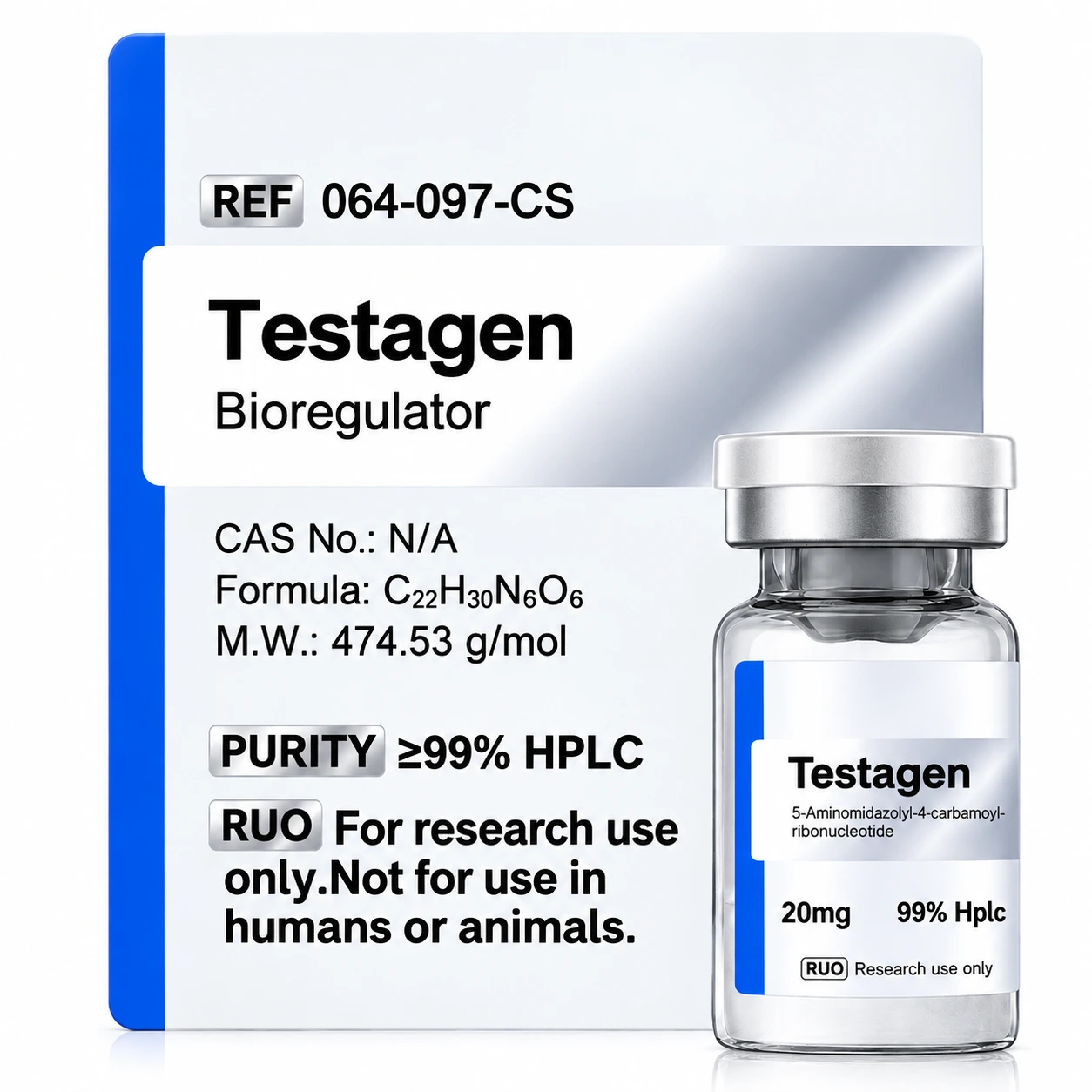
Testagen 20mg is a laboratory research peptide commonly identified by the sequence Lys-Glu-Asp-Gly (KEDG). It is a short synthetic tetrapeptide associated with the broader family of peptide bioregulator research compounds. Commercial laboratory listings generally describe the material as a 20mg lyophilized peptide intended for controlled scientific investigation rather than as an approved medicine or consumer health product.
Interest in Testagen has increased among researchers investigating short peptide sequences, tissue-associated bioregulator concepts, endocrine-related signaling, molecular biology and other experimental questions. However, it is important to distinguish research hypotheses and laboratory observations from established clinical evidence.
The 20mg designation normally refers to the labeled quantity of peptide in the vial. Independent certificates of analysis can provide additional information about identity, measured peptide content and analytical purity. For example, publicly available Testagen COAs have reported analytical testing using HPLC and mass spectrometry, although results naturally vary by manufacturer and batch.
For laboratories evaluating Testagen 20mg, product identity, batch documentation, analytical testing and appropriate storage are therefore important considerations.
Testagen 20mg at a Glance
| Specification | General Research Information |
|---|---|
| Product | Testagen |
| Common abbreviation | KEDG |
| Sequence | Lys-Glu-Asp-Gly |
| Product size | 20mg |
| Physical form | Commonly supplied as lyophilized powder |
| Classification | Synthetic tetrapeptide / research peptide |
| Research area | Peptide bioregulator and reproductive-system research |
| Analytical documentation | COA may include HPLC and mass spectrometry |
| Intended use | Laboratory research |
| Human use | Not established or approved |
Published supplier and analytical documentation supports the identification of Testagen as a short peptide with the KEDG sequence and a commonly marketed 20mg format.
Understanding the Testagen KEDG Sequence
One of the most useful ways to understand Testagen is to examine its peptide sequence.
Testagen is commonly described as:
Lys-Glu-Asp-Gly
The four amino acids are:
- Lys — Lysine
- Glu — Glutamic acid
- Asp — Aspartic acid
- Gly — Glycine
This compact sequence makes Testagen substantially different from larger peptides and proteins containing dozens or hundreds of amino acids.
Research involving short peptide bioregulators has explored the possibility that small peptide sequences may have biological signaling or regulatory properties. The proposed mechanisms and biological effects should, however, be treated as areas for investigation rather than established human therapeutic outcomes.
Some commercial research descriptions associate Testagen with testicular, reproductive and endocrine research. Other descriptions refer more broadly to pituitary-gonadal signaling and aging-related research models. Because these claims come from a mixture of supplier literature and limited research traditions, researchers should examine the underlying evidence rather than treating marketing terminology as proof of clinical efficacy.
Why Is Testagen 20mg Used in Research?
Testagen is primarily of interest because it provides researchers with a defined short peptide sequence for controlled laboratory investigation.
Potential research areas described in available product literature include:
1. Peptide Bioregulator Research
Testagen belongs to a research category commonly referred to as peptide bioregulators. Researchers can investigate how short peptide sequences behave under controlled experimental conditions and whether observed molecular effects can be reproduced.
2. Reproductive-System Research
Commercial research descriptions frequently associate Testagen with testicular and reproductive-system investigations. These descriptions should be interpreted as research applications rather than evidence that Testagen is an established treatment for reproductive or hormonal conditions.
3. Molecular Biology
A defined four-amino-acid sequence can be useful in experimental systems examining peptide interactions, molecular signaling and related biochemical processes.
4. Aging-Related Research
Some Testagen literature discusses potential relevance to aging models and age-associated biological pathways. These areas remain subjects for investigation, and claims about anti-aging benefits in humans should not be inferred from laboratory research alone.
Testagen 20mg Purity and Laboratory Testing
When selecting a research peptide, the product label alone is not enough to establish analytical quality.
Researchers should look for batch-specific analytical documentation, preferably a Certificate of Analysis (COA) identifying the exact lot being supplied.
Depending on the laboratory and product, analytical documentation may include:
- HPLC purity analysis
- Mass spectrometry identification
- Net peptide content
- Appearance
- Batch or lot number
- Testing date
- Analytical method
- Identity confirmation
- Laboratory information
For example, a publicly available 2026 Testagen analysis reported 99.32% HPLC purity and identity confirmation by LC-MS for a particular 20mg batch. A separate publicly available COA reported 99.61% purity for another Testagen batch. These figures demonstrate why purity should be evaluated batch by batch, rather than assuming every Testagen product has identical analytical results.
A credible research supplier should be able to connect the COA to the specific lot supplied.
How to Evaluate a Testagen 20mg Supplier
Researchers comparing Testagen suppliers should focus on documentation and transparency rather than relying exclusively on product descriptions.
Batch-Specific COA
A strong starting point is a COA that clearly identifies the product and corresponding batch number.
Independent Analytical Testing
Independent laboratory testing can provide additional confidence regarding identity and purity. Available Testagen documentation shows that HPLC and mass spectrometry are among the analytical methods used for this type of material.
Clear Product Specifications
A research supplier should clearly state:
- Peptide name
- Sequence where appropriate
- Quantity
- Physical form
- Batch number
- Purity specification
- Testing method
- Storage information
- Intended research use
Transparent Research-Only Positioning
Testagen should not be presented as an approved medicine or as a proven treatment. Current supplier documentation explicitly labels the material for laboratory research and excludes human or veterinary use.
Testagen 20mg Storage Considerations
Lyophilized research peptides require appropriate handling to preserve sample integrity.
Storage recommendations can vary according to the manufacturer, formulation and packaging. Researchers should therefore follow the specific storage instructions supplied with their batch rather than relying on a generic internet protocol.
One current Testagen safety-data document identifies the material as a lyophilized solid and provides supplier-specific storage and handling information.
Important laboratory practices may include:
- Keeping the vial properly sealed.
- Minimizing unnecessary exposure to moisture.
- Protecting the material from inappropriate temperature fluctuations.
- Following the manufacturer’s documented storage conditions.
- Recording batch and storage information.
- Avoiding repeated handling that could compromise sample integrity.
The objective is simple: preserve the integrity of the research material from receipt through laboratory analysis.
Why the Certificate of Analysis Matters
A Certificate of Analysis is one of the most valuable quality-control documents associated with a research peptide.
For Testagen 20mg, a useful COA should ideally allow a researcher to answer several questions:
Is this actually Testagen?
Identity testing can help establish whether the analyzed sample corresponds to the labeled compound.
How pure is the tested material?
HPLC or another validated analytical method can provide a measured purity result.
Does the COA correspond to my vial?
The batch or lot number should match the product being supplied.
When was the sample tested?
The testing date provides useful traceability.
Who performed the analysis?
Laboratory identification and analytical methodology add transparency.
Some publicly available Testagen certificates report identity through mass spectrometry alongside chromatographic purity analysis.
Testagen 20mg vs. Unsupported Marketing Claims
The growing market for research peptides has also created considerable variation in online product descriptions.
Some websites use terms such as “testosterone support,” “anti-aging,” “rejuvenation” or “hormone optimization.” Such language should be approached carefully.
The existence of a research hypothesis does not establish that a compound produces a particular clinical outcome in humans.
Current public research-oriented material itself acknowledges important limitations. One contemporary review of Testagen notes that the evidence base is limited and that claims concerning testosterone restoration, rejuvenation and anti-aging effects are not established by robust human clinical trials.
For SEO content and responsible product communication, the distinction is important:
Research interest ≠ clinical approval.
Laboratory findings ≠ proven human benefits.
Supplier claims ≠ independent clinical evidence.
This approach gives researchers more useful information while avoiding exaggerated product promises.
Testagen 20mg: What Researchers Should Check Before Ordering
Before purchasing Testagen 20mg for legitimate laboratory research, consider creating a simple quality checklist.
Product Identity
Confirm that the product is explicitly identified as Testagen/KEDG and that the sequence and specifications are consistent with the research documentation.
Quantity
Confirm that the vial is labeled for the expected 20mg quantity.
Purity
Look for a clearly documented analytical purity result.
COA
Request or review a lot-matched Certificate of Analysis.
Testing
Determine whether the supplier uses independent testing and which analytical methods are employed.
Traceability
Verify that the batch number on the COA corresponds to the batch being supplied.
Packaging
Check whether the product is appropriately sealed and labeled for laboratory handling.
Research-Only Documentation
Ensure that the supplier clearly identifies the material as a research compound rather than a consumer medication.
These checks can make supplier comparisons more objective and help laboratories maintain better documentation.
Frequently Asked Questions About Testagen 20mg
What is Testagen 20mg?
Testagen 20mg is a commonly marketed laboratory research peptide containing the short amino-acid sequence Lys-Glu-Asp-Gly (KEDG). It is generally supplied as a lyophilized research material.
Is Testagen a steroid?
No. Testagen is described as a synthetic tetrapeptide rather than an anabolic steroid. Its research classification and chemical structure are fundamentally different from testosterone and conventional anabolic-androgenic steroids.
What does KEDG mean?
KEDG represents the four amino acids in the commonly reported Testagen sequence: Lysine, Glutamic acid, Aspartic acid and Glycine.
What is Testagen 20mg used for?
It is supplied for laboratory research involving peptide biology, molecular mechanisms and research areas associated with reproductive and endocrine systems. It should not be represented as an approved human treatment.
Does Testagen 20mg have a proven human dose?
There is no established, clinically validated human dosing standard supported by robust regulatory clinical evidence. Research suppliers may publish experimental protocols, but those should not be confused with approved medical dosing.
How can Testagen purity be verified?
The most practical approach is to review a batch-specific COA and examine analytical testing such as HPLC and mass spectrometry. Publicly available Testagen COAs demonstrate that batch results can vary, reinforcing the importance of lot-specific documentation.
Is Testagen 20mg approved for human use?
Available supplier safety and product documentation identifies Testagen as a research material and specifically excludes human or veterinary use.
Choosing Quality Testagen 20mg for Laboratory Research
For laboratories searching for Testagen 20mg, quality documentation should be a central part of the purchasing decision.
Rather than selecting a product based solely on price or marketing claims, researchers can compare suppliers according to:
- Verified product identity
- Lot-specific COA
- Independent analytical testing
- Clearly documented purity
- Traceable batch information
- Appropriate packaging
- Transparent research-use labeling
- Clear storage and handling documentation
This approach helps create a more reliable purchasing process and supports reproducibility in laboratory work.
Final Thoughts on Testagen 20mg
Testagen 20mg is a short synthetic peptide commonly identified as Lys-Glu-Asp-Gly (KEDG) and marketed primarily as a laboratory research compound. Its small molecular structure and association with peptide bioregulator research have made it an area of interest for researchers investigating molecular signaling, reproductive-system biology and related experimental questions.
For anyone evaluating Testagen as a research material, the most important considerations are not exaggerated benefit claims but identity, purity, batch traceability, analytical testing and appropriate laboratory handling.
A high-quality Testagen 20mg listing should provide enough documentation for researchers to understand exactly what material is being supplied. A current, lot-matched COA can be particularly useful because analytical results belong to the tested batch rather than automatically applying to every product carrying the same name.
Most importantly, Testagen should be discussed within its appropriate scientific context. Research findings and proposed biological mechanisms require careful interpretation, and available evidence should not be converted into unsupported claims about human therapeutic benefits.
For laboratory research, transparent documentation and evidence-based product information provide a stronger foundation than aggressive marketing language.


Reviews
There are no reviews yet.