
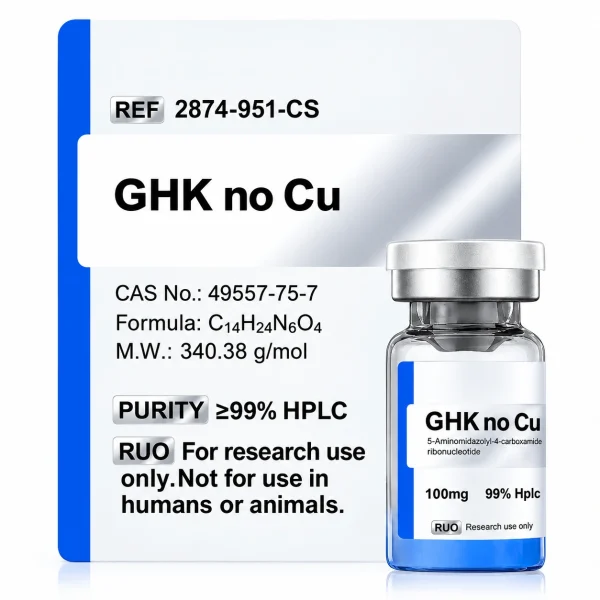
GHK No Cu 100mg
$100.00
GHK (Glycyl-L-Histidyl-L-Lysine) is a naturally occurring peptide studied for its role in cellular communication, molecular signaling, and extracellular matrix research. Unlike GHK CU, the copper-free form allows researchers to evaluate the peptide structure and biological properties independently. The 100mg specification is suitable for laboratory testing, peptide research, and formulation studies.
This product is supplied as Research Use Only (RUO) material for professional scientific research applications.
| Dosage: | 100 mg |
| Total amount: | 10 vials / Kit |
| Component: | GHK No Cu |
GHK No Cu 100mg: Understanding Copper-Free GHK for Research
GHK No Cu 100mg is a research-oriented peptide product containing copper-free GHK, also known as glycyl-L-histidyl-L-lysine (GHK). As interest in peptide science continues to grow, researchers are increasingly distinguishing between free GHK and its copper-complexed counterpart, GHK-Cu.
Although the names are closely related, these are chemically different forms. GHK is a small tripeptide composed of glycine, histidine, and lysine. GHK-Cu refers specifically to GHK coordinated with copper(II). The distinction matters when evaluating research papers, analytical results, product specifications, and experimental materials.
For laboratories and researchers seeking a copper-free GHK 100mg research product, identity, purity, documentation, storage conditions, and batch consistency are important considerations.
What Is GHK No Cu?
GHK No Cu refers to the copper-free form of the naturally occurring tripeptide GHK. The abbreviation GHK represents the amino-acid sequence Gly-His-Lys, or glycine-histidine-lysine.
Unlike GHK-Cu, copper-free GHK does not intentionally contain a coordinated copper ion as part of the supplied molecular form. This difference gives researchers the ability to study GHK independently from copper-associated effects.
GHK has attracted scientific interest for decades because of its relationship with extracellular-matrix biology, tissue remodeling, cellular signaling, and other biological processes. However, research involving GHK and research involving GHK-Cu should not automatically be treated as interchangeable. The chemical form used in an experiment can influence how results should be interpreted.
This makes GHK No Cu 100mg relevant to research workflows where investigators specifically require the copper-free peptide rather than the copper complex.
GHK vs. GHK-Cu: Why the Difference Matters
One of the most important considerations when purchasing or researching GHK is understanding the distinction between GHK and GHK-Cu.
GHK is the three-amino-acid peptide:
Glycine + Histidine + Lysine = GHK
GHK-Cu is a copper-associated complex in which GHK coordinates with copper(II).
The copper ion is not simply an incidental ingredient added to GHK-Cu. Copper coordination changes the chemical species being studied. Consequently, scientific findings involving GHK-Cu should not automatically be attributed to copper-free GHK, and findings involving free GHK should not automatically be described as evidence for GHK-Cu.
This distinction is particularly important when researchers are designing comparative experiments or attempting to reproduce published results.
Copper-Free GHK
- GHK tripeptide without intentionally complexed copper
- Often described as glycyl-L-histidyl-L-lysine
- Useful when researchers need to investigate the peptide independently
- Requires appropriate analytical characterization and purity documentation
GHK-Cu
- GHK associated with copper(II)
- Commonly referred to as copper peptide or copper tripeptide
- Has been investigated extensively in skin, tissue-remodeling, and wound-related research
- Represents a chemically distinct research material
A high-quality research supplier should therefore clearly identify which form is being supplied rather than using GHK and GHK-Cu as interchangeable product names.
Why Researchers Study GHK
GHK has been investigated across several areas of biological research. Scientific literature has examined its potential relationship with cellular processes, extracellular-matrix remodeling, tissue repair, and gene-expression pathways.
Much of the modern evidence remains preclinical, including laboratory and animal research. Recent reviews emphasize that the biological literature surrounding GHK-related compounds is substantial, while controlled human evidence remains considerably more limited.
This distinction is important for responsible scientific communication.
Rather than describing GHK as a proven therapeutic compound, research-focused content should accurately describe it as a peptide of scientific interest whose biological properties continue to be investigated.
Understanding GHK No Cu 100mg
The 100mg designation refers to the stated quantity of peptide supplied in the product.
For researchers, the quantity alone is not enough to establish suitability. A research-grade peptide should ideally be accompanied by documentation that helps laboratories assess its identity and quality.
Important product information can include:
- Product name and peptide designation
- Peptide sequence
- Stated quantity
- Purity specification
- Lot or batch number
- Certificate of Analysis (COA)
- Analytical testing information
- Manufacturing or testing date
- Storage recommendations
- Research-use designation
For a product marketed as GHK No Cu 100mg, documentation should make the copper-free nature of the material clear.
This is particularly important because GHK has a strong association with copper-peptide research, making product-name confusion possible.
Certificate of Analysis and Research Quality
A Certificate of Analysis (COA) is one of the most useful documents researchers can review when evaluating a peptide supplier.
A properly prepared COA can provide batch-specific information that allows laboratories to verify key quality characteristics. Depending on the supplier and analytical method, documentation may include identity confirmation, purity analysis, lot information, and other quality parameters.
For GHK No Cu 100mg, researchers should pay particular attention to whether the documentation clearly identifies the material as the intended copper-free peptide.
Reliable peptide sourcing is not simply about finding the lowest advertised price. Consistent documentation and transparent product identification can be equally important when experiments depend on reproducibility.
Why Purity Matters in Peptide Research
Peptide purity can have a significant impact on research interpretation.
Unexpected impurities, degradation products, residual manufacturing materials, or incorrectly identified compounds can introduce variables into laboratory experiments. If researchers are comparing different batches or attempting to reproduce published findings, inconsistent material quality can complicate interpretation.
For this reason, laboratories often evaluate several factors before selecting a peptide supplier:
- Identity – Does the material correspond to the intended peptide?
- Purity – Is the stated purity supported by analytical testing?
- Documentation – Is a batch-specific COA available?
- Consistency – Can comparable quality be obtained across batches?
- Packaging – Is the material appropriately packaged for research use?
- Traceability – Can the batch be linked to its supporting documentation?
These considerations are especially relevant when working with small peptides such as GHK, where precise chemical characterization can support more reproducible research.
Research Applications of Copper-Free GHK
GHK has been investigated in several scientific contexts, although the strength of evidence varies by application.
Cellular Research
Researchers can investigate GHK in controlled cellular models to examine biological signaling and cellular responses. Such studies can help clarify potential mechanisms without assuming that laboratory findings automatically translate into clinical outcomes.
Tissue-Remodeling Research
GHK-related research has examined processes associated with extracellular-matrix biology and tissue remodeling. Much of this work is preclinical, and results need to be interpreted according to the specific experimental model used.
Comparative Peptide Research
Copper-free GHK can also be valuable when researchers want to compare free GHK with GHK-Cu.
Using the two forms as separate experimental materials can help investigators examine whether observed effects are associated with the peptide itself, copper coordination, or interactions between the two.
Formulation and Analytical Research
GHK may also be investigated in formulation and analytical studies. Researchers can examine stability, peptide behavior, analytical profiles, and interactions with other experimental variables.
The precise purpose of an experiment should always determine the appropriate research material and analytical controls.
GHK No Cu 100mg and Experimental Reproducibility
Reproducibility is an important consideration in modern peptide research.
When researchers attempt to repeat an experiment, they need to know as much as possible about the original material. A product described only as “GHK” may not provide sufficient information if the original experiment actually used GHK-Cu.
Clear terminology helps reduce this problem.
For example:
GHK: copper-free glycyl-histidyl-lysine
GHK-Cu: copper-associated GHK complex
Recording the exact chemical form, batch information, purity, and analytical documentation can help researchers maintain better experimental records.
How to Evaluate a GHK No Cu Supplier
Researchers looking for GHK No Cu 100mg for research should evaluate the supplier based on documentation and transparency rather than marketing claims alone.
A professional supplier should make important product information readily available.
1. Product Identification
The product should clearly state that it is GHK and distinguish itself from GHK-Cu.
2. Batch Documentation
Batch-specific documentation provides greater transparency than generic certificates.
3. Purity Information
The supplier should clearly state the applicable purity specification and analytical method where available.
4. Transparent Research-Use Status
The product should be clearly identified as a research material rather than marketed as an approved medicine.
5. Professional Customer Support
Researchers may need information regarding analytical documentation, product specifications, packaging, and ordering procedures. Responsive technical support can make supplier evaluation easier.
GHK No Cu 100mg: What Researchers Should Look For
Before purchasing a copper-free GHK research material, consider creating a simple supplier checklist:
Product: GHK / Gly-His-Lys
Form: Copper-free GHK
Quantity: 100mg
Purity: Clearly stated and supported by documentation
COA: Batch-specific where available
Identity: Clearly defined
Research status: Research use only
Traceability: Lot/batch information available
Packaging: Appropriate for research material
Supplier transparency: Clear product specifications
This approach can help laboratories compare products more objectively.
Frequently Asked Questions
What is GHK No Cu 100mg?
GHK No Cu 100mg refers to a 100mg research product containing the copper-free form of GHK, or glycyl-L-histidyl-lysine. It is chemically distinct from GHK-Cu, which contains coordinated copper.
Is GHK the same as GHK-Cu?
No. GHK is the copper-free tripeptide, while GHK-Cu refers to GHK associated with copper(II). Scientific sources emphasize that these forms should not automatically be treated as interchangeable.
What does 100mg mean?
100mg indicates the stated quantity of peptide supplied in the research product. It does not by itself indicate purity, potency, safety, or suitability for a particular experiment.
Is GHK No Cu approved as a medicine?
Copper-free GHK is not established as an approved systemic therapeutic drug. Current research literature primarily concerns laboratory, preclinical, and limited human-related investigations rather than a mature therapeutic evidence base.
Should researchers request a COA?
Researchers should consider requesting and reviewing appropriate batch documentation, including a Certificate of Analysis where available. Documentation can help verify product identity and quality specifications.
Why choose copper-free GHK instead of GHK-Cu?
The answer depends on the research question. If an experiment specifically requires the peptide without intentionally coordinated copper, copper-free GHK may be the appropriate research material. GHK-Cu is a separate chemical form and should be selected when the experimental design calls for the copper-associated form.
Final Thoughts on GHK No Cu 100mg
GHK No Cu 100mg represents a research-focused form of glycyl-L-histidyl-lysine that is distinct from the widely discussed copper peptide GHK-Cu.
The distinction between these two materials is more than a naming preference. Copper coordination creates a different chemical species, meaning researchers should carefully match the material they purchase with the material described in their experimental protocol or scientific literature.
As peptide research continues to develop, product transparency, analytical documentation, batch consistency, and accurate terminology remain important considerations.
For laboratories investigating GHK, a clearly identified copper-free GHK 100mg research product, supported by appropriate quality documentation, can provide a defined starting material for controlled scientific investigation.
The broader scientific literature remains promising but should be interpreted carefully. Recent reviews continue to emphasize that much of the GHK-Cu evidence is preclinical and that additional controlled research is needed before broad therapeutic conclusions can be made.
| Quantity | 10 vials / Kit |
|---|
Be the first to review “GHK No Cu 100mg”
Related products
Laboratory Peptides
Laboratory Peptides
Laboratory Peptides
Laboratory Peptides
Laboratory Peptides
Laboratory Peptides
Laboratory Peptides
Bioregulators
Reviews
There are no reviews yet.