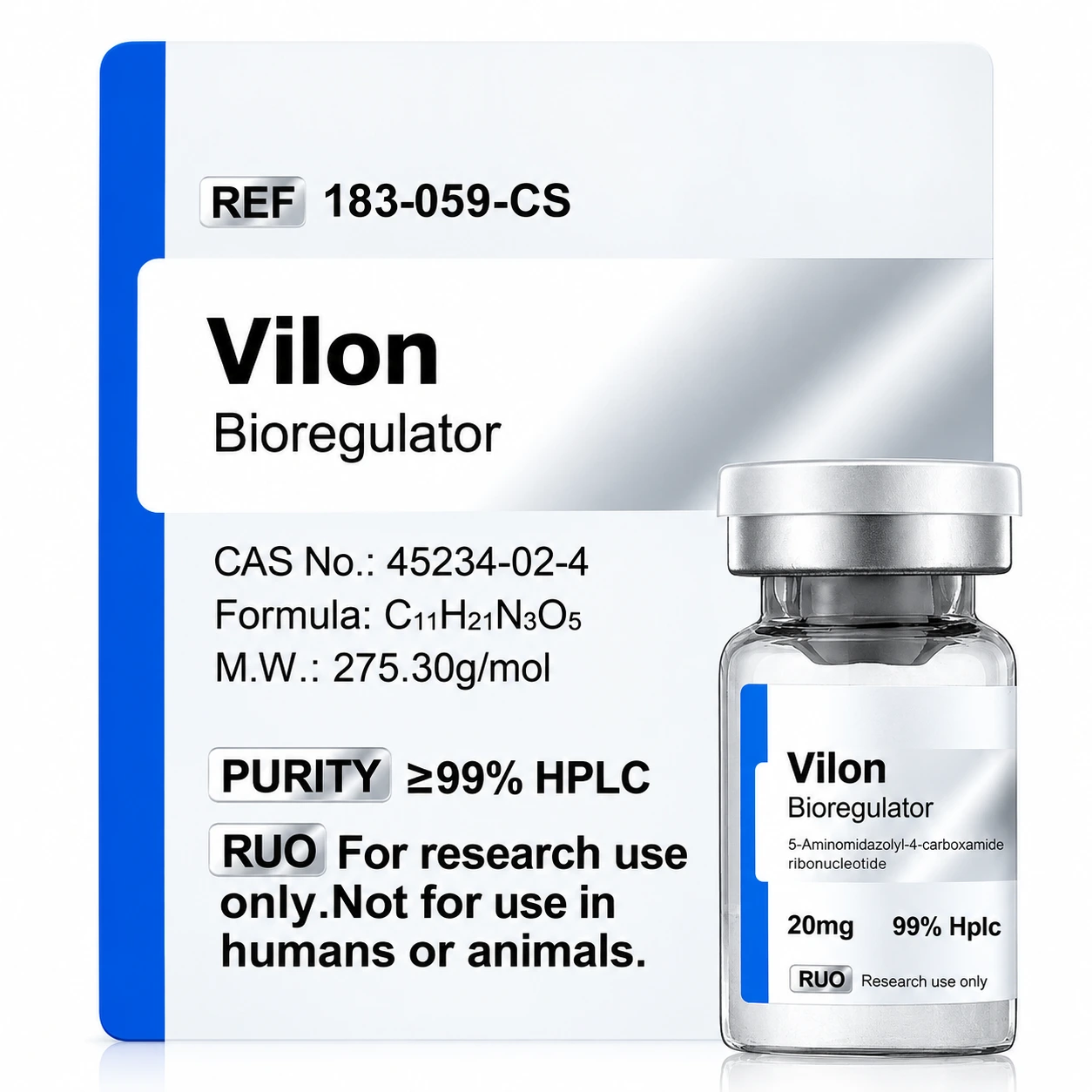
Vilon 20mg: Research Peptide, Lys-Glu, Scientific Evidence & Quality Guide
Vilon 20mg is a short synthetic peptide that has attracted interest in peptide research because of its unusually simple molecular structure and its place within the broader Khavinson short-peptide research program. Vilon is identified in peer-reviewed literature as the Lys-Glu (L-Lys-L-Glu) dipeptide, meaning it consists of two amino-acid residues: lysine and glutamic acid.
Researchers investigating Vilon have examined its effects in cellular and animal models, including research involving immune-cell biology, cellular signaling, aging-related processes, and other biological pathways. However, the distinction between experimental evidence and established clinical efficacy is essential. Current evidence does not establish Vilon as an FDA-approved medicine or as a clinically validated treatment for human disease.
For laboratories evaluating Vilon 20mg, the most important considerations include molecular identity, purity, analytical testing, batch traceability, certificate of analysis (COA), storage information, and transparent research-use labeling.
What Is Vilon 20mg?
Vilon is a synthetic dipeptide also known as Lys-Glu or KE peptide. The peer-reviewed literature identifies its sequence as L-Lys-L-Glu.
The term “20mg” generally describes the quantity of peptide material supplied in a particular research product. It should not automatically be interpreted as a clinically established human dosage.
This distinction is particularly important when researching commercial peptide listings. Product quantity and medical dosage are two different concepts. A 20mg vial indicates the amount of material represented by the product; it does not establish how much, if any, should be administered to a person.
For research applications, experimental quantities and concentrations should be determined according to validated laboratory protocols, study objectives, institutional procedures, and the relevant scientific literature.
Vilon Peptide Structure and Identity
Vilon belongs to the class of very short peptides because it contains only two amino-acid residues.
The primary research literature identifies Vilon as:
- Name: Vilon
- Alternative name: Lys-Glu / KE peptide
- Sequence: L-Lys-L-Glu
- Peptide type: Synthetic dipeptide
- Amino-acid residues: 2
- Research classification: Experimental peptide
- Typical commercial research format: Lyophilized powder
The molecular simplicity of Vilon is one reason it has attracted scientific interest. Researchers can use small peptides like Lys-Glu to investigate relationships between molecular structure, cellular signaling, gene expression, and biological regulation.
However, a simple molecular structure does not automatically establish a particular biological or therapeutic effect.
Vilon 20mg Research Background
Vilon forms part of a broader research program involving short peptides that were initially investigated in connection with tissue-specific peptide preparations.
A 2022 peer-reviewed study examined five peptides—including Vilon, Epitalon, Thymogen, Thymalin, and Chonluten—in the human THP-1 monocyte/macrophage cellular model. The researchers investigated their effects on proliferative and inflammatory pathways under controlled in-vitro conditions.
The study found that the tested peptides could modulate cellular signaling patterns associated with proliferation. Importantly, these observations were made in cell culture, rather than in people receiving Vilon as a medicine.
That distinction is critical when evaluating online information about Vilon. A laboratory observation can provide a foundation for additional research without demonstrating clinical efficacy.
Vilon and Cellular Research
One area of interest surrounding Vilon is cellular signaling.
The 2022 THP-1 study evaluated Vilon alongside several other short peptides and measured biological changes within a human monocytic cell line. The study reported changes in signaling associated with cellular proliferation.
THP-1 cells are widely used as an experimental model for studying monocytes and macrophage-related biology. They allow researchers to investigate cellular responses under controlled laboratory conditions.
For Vilon research, this type of model can be useful for exploring questions such as:
- How does a short dipeptide interact with cellular systems?
- Does exposure influence specific signaling pathways?
- Are measurable changes observed in immune-related cell models?
- How do short peptides compare with one another?
- What experimental concentrations produce observable effects?
These questions remain fundamentally different from asking whether Vilon treats a disease in humans.
Vilon Research in Animal Models
Vilon has also appeared in animal research.
For example, a PubMed-indexed study examined the effects of Vilon and Epithalon in aged Wistar rats. The researchers reported changes in enzyme activity within different layers of the small intestine following oral administration during the experimental period.
Animal studies can provide useful information about biological responses and generate hypotheses for future research. However, results in rodents cannot automatically be translated into equivalent outcomes in humans.
Differences in metabolism, absorption, distribution, peptide stability, receptor biology, and experimental conditions mean that animal findings require further validation before they can support clinical conclusions.
What Does “Vilon 20mg” Mean?
The phrase Vilon 20mg is primarily a product-quantity term.
In a research context, it can describe a vial containing a nominal 20mg quantity of Vilon. It should not be presented as an established therapeutic dose.
This creates an important distinction for both consumers and researchers:
20mg product quantity ≠ validated human dosage.
Search engines often combine product-strength terms with words such as “dose,” “use,” or “benefits.” Scientifically responsible content should separate these concepts rather than using commercial search language to imply medical evidence that does not exist.
For a research supplier, this also provides an opportunity to build trust through transparent documentation instead of unsupported health claims.
Vilon 20mg and Certificate of Analysis
A Certificate of Analysis (COA) is one of the most useful documents for evaluating a research peptide.
A strong COA should be associated with the specific batch or lot supplied to the researcher.
Depending on the laboratory and testing package, Vilon documentation may include:
- Compound identity
- Lot or batch number
- Report date
- HPLC purity
- Mass-spectrometry identification
- Net peptide content
- Appearance
- Endotoxin testing where applicable
- Microbiological testing where applicable
- Testing laboratory
- Analytical methods
Current publicly available Vilon COAs illustrate why batch-specific documentation matters. For example, published certificates have reported HPLC purity together with mass-spectrometric identification and other analytical measurements. These reports apply to the particular samples tested and should not automatically be generalized to every Vilon product on the market.
Why HPLC Testing Matters
High-performance liquid chromatography, or HPLC, is widely used to evaluate peptide purity.
In simple terms, HPLC separates components within a sample and allows the relative abundance of different chromatographic peaks to be evaluated.
A reported purity percentage can therefore provide useful information about the tested sample.
However, HPLC purity alone does not establish every aspect of a research material.
For example, a purity result does not necessarily establish:
- Complete molecular identity
- Correct sequence confirmation
- Sterility
- Endotoxin status
- Stability over time
- Chain of custody
- Clinical safety
- Therapeutic efficacy
This is why complementary analytical techniques can provide a stronger overall characterization.
Mass Spectrometry and Vilon Identity
Mass spectrometry can complement HPLC by providing information about molecular mass.
For peptide research, this can help confirm whether the measured molecular characteristics are consistent with the expected compound.
Some publicly available Vilon COAs report HPLC together with mass-spectrometric analysis. One published certificate, for example, reports Vilon identity alongside HPLC purity and mass-spectrometry testing.
Researchers should ideally review the actual laboratory report rather than relying solely on a vendor’s statement such as “99% pure.”
The most useful documentation connects the product, lot number, analytical result, and issuing laboratory.
How to Evaluate a Vilon 20mg Research Supplier
Researchers comparing Vilon 20mg suppliers can evaluate several quality indicators before selecting a research material.
1. Batch-Specific COA
Look for a COA that matches the lot number on the supplied product.
2. Independent Testing
Third-party analytical testing can provide additional confidence compared with unsupported in-house claims.
3. Identity Confirmation
Look for appropriate analytical evidence supporting the identity of the compound.
4. Purity Data
HPLC or comparable analytical testing should clearly state the reported purity and testing methodology.
5. Transparent Product Information
A professional research listing should clearly state the peptide identity, quantity, physical form, intended research status, and relevant documentation.
6. Clear Research-Use Labeling
Vilon should not be marketed as an established human treatment when clinical evidence is insufficient.
7. Traceability
The product should be connected to a specific lot or batch so that researchers can match their material to its analytical documentation.
Vilon 20mg Quality Control
Quality control is particularly important for short peptides because researchers need reproducible materials for experimental work.
A useful quality-control framework can be summarized as:
Identity → Purity → Quantity → Batch → Testing → Documentation
This approach allows researchers to assess the material systematically rather than relying on marketing language.
Current commercial COAs demonstrate that Vilon products can vary in reported assay, purity, content, and additional testing panels. For example, publicly indexed reports include Vilon samples with reported purity values above 99%, but these figures apply to specific tested batches rather than representing a universal specification for all Vilon products.
Is Vilon 20mg FDA Approved?
Vilon should not be represented as an FDA-approved medication.
The available research record does not establish an FDA-approved Vilon pharmaceutical product or a validated U.S. therapeutic indication. Current evidence remains primarily experimental, including laboratory and animal research.
Consequently, responsible SEO content should avoid statements such as “FDA-approved Vilon,” “clinically proven anti-aging peptide,” or similar claims unless supported by authoritative regulatory evidence.
This is especially important for websites selling or describing research materials because misleading medical claims can undermine both user trust and the credibility of the website.
Is There a Clinically Established Vilon Dose?
There is no universally accepted, clinically validated human dosage for Vilon established by high-quality randomized clinical evidence.
Some websites publish dosing schedules, but commercial protocols should not be confused with established clinical standards. Current evidence reviews note the absence of modern randomized controlled trials establishing a validated Vilon treatment regimen.
Accordingly, “Vilon 20mg” should be treated as a product quantity rather than a recommended human dose.
For laboratory work, experimental concentrations should be selected based on the specific research design and appropriate scientific protocols.
Vilon 20mg Research Applications
Based on the published research landscape, Vilon may be of interest to laboratories investigating:
- Short-peptide biology
- Dipeptide structure and function
- Cellular signaling
- Monocyte and immune-cell biology
- Lymphocyte research
- Aging-related cellular mechanisms
- Gene-expression research
- Peptide characterization
- Comparative peptide studies
- Molecular biology
- Experimental bioregulator research
The 2022 THP-1 study is particularly useful because Vilon was directly included in the experimental design rather than being discussed only theoretically.
Vilon Compared With Other Short Peptides
Vilon is often discussed alongside other short peptides associated with the Khavinson research program.
These compounds are not interchangeable.
For example:
| Peptide | Reported structure | Research context |
|---|---|---|
| Vilon | Lys-Glu | Short dipeptide / cellular and aging-related research |
| Thymogen | Glu-Trp | Thymus-related peptide research |
| Epitalon | Ala-Glu-Asp-Gly | Tetrapeptide / aging-related research |
| Chonluten | Glu-Asp-Gly | Respiratory-related peptide research |
| Thymalin | Peptide complex | Thymic peptide research |
The 2022 study directly evaluated Vilon, Thymogen, Epitalon, Thymalin, and Chonluten in the same broad cellular research framework, making it a useful source for comparative experimental research.
Vilon 20mg Storage and Handling
Research peptides are commonly supplied in lyophilized form, but storage requirements can vary according to the formulation, packaging, manufacturer, and intended research application.
Researchers should therefore follow the storage instructions accompanying the specific batch rather than relying on a generic internet recommendation.
Important considerations may include:
- Maintaining appropriate temperature conditions
- Protecting the material from excessive moisture
- Protecting the container from unnecessary light exposure
- Maintaining vial integrity
- Minimizing unnecessary temperature cycling
- Following validated laboratory handling procedures
Storage information should ideally be included in the product documentation or supplied by the manufacturer.
Frequently Asked Questions About Vilon 20mg
What is Vilon 20mg?
Vilon 20mg is a research-product designation referring to a 20mg quantity of Vilon, a synthetic Lys-Glu dipeptide investigated in laboratory and animal research.
What is Vilon made of?
Vilon is identified in peer-reviewed research as the synthetic L-Lys-L-Glu (Lys-Glu) dipeptide.
Is Vilon a peptide?
Yes. Vilon is a very short peptide consisting of two amino-acid residues.
What has Vilon been studied for?
Research has investigated Vilon in cellular and animal models involving cellular signaling, immune-related biology, aging-associated mechanisms, and other biological processes. These findings remain experimental.
Is Vilon clinically proven?
No. There is insufficient high-quality human clinical evidence to establish Vilon as a proven therapeutic treatment. Current evidence is dominated by preclinical laboratory and animal research.
Does 20mg mean the recommended Vilon dose?
No. “20mg” describes a quantity of research material and should not be interpreted as a clinically validated human dosage.
What should I look for in a Vilon COA?
Look for a batch number, compound identity, purity result, analytical methodology, testing laboratory, date, and preferably complementary identity testing such as mass spectrometry.
Why is batch-specific testing important?
Because analytical results apply to the sample tested. A COA from one batch does not automatically prove that another batch has identical purity or composition.
Conclusion
Vilon 20mg is a highly specific research keyword with strong relevance to the growing interest in short peptides, Lys-Glu research, peptide characterization, and experimental cellular biology.
Peer-reviewed research identifies Vilon as the L-Lys-L-Glu dipeptide and has examined it in laboratory and animal models. A 2022 study also evaluated Vilon directly in human THP-1 monocyte/macrophage cells as part of a broader investigation into short peptides and cellular signaling.
However, the evidence should be interpreted carefully. Preclinical findings do not establish clinical efficacy, and Vilon should not be presented as an FDA-approved medicine or as having a clinically validated human dosage.
For researchers evaluating Vilon 20mg, the strongest purchasing and quality signals are not exaggerated health claims. They are clear molecular identification, reliable analytical testing, batch-specific COAs, transparent specifications, lot traceability, and appropriate research-use labeling.


Reviews
There are no reviews yet.