

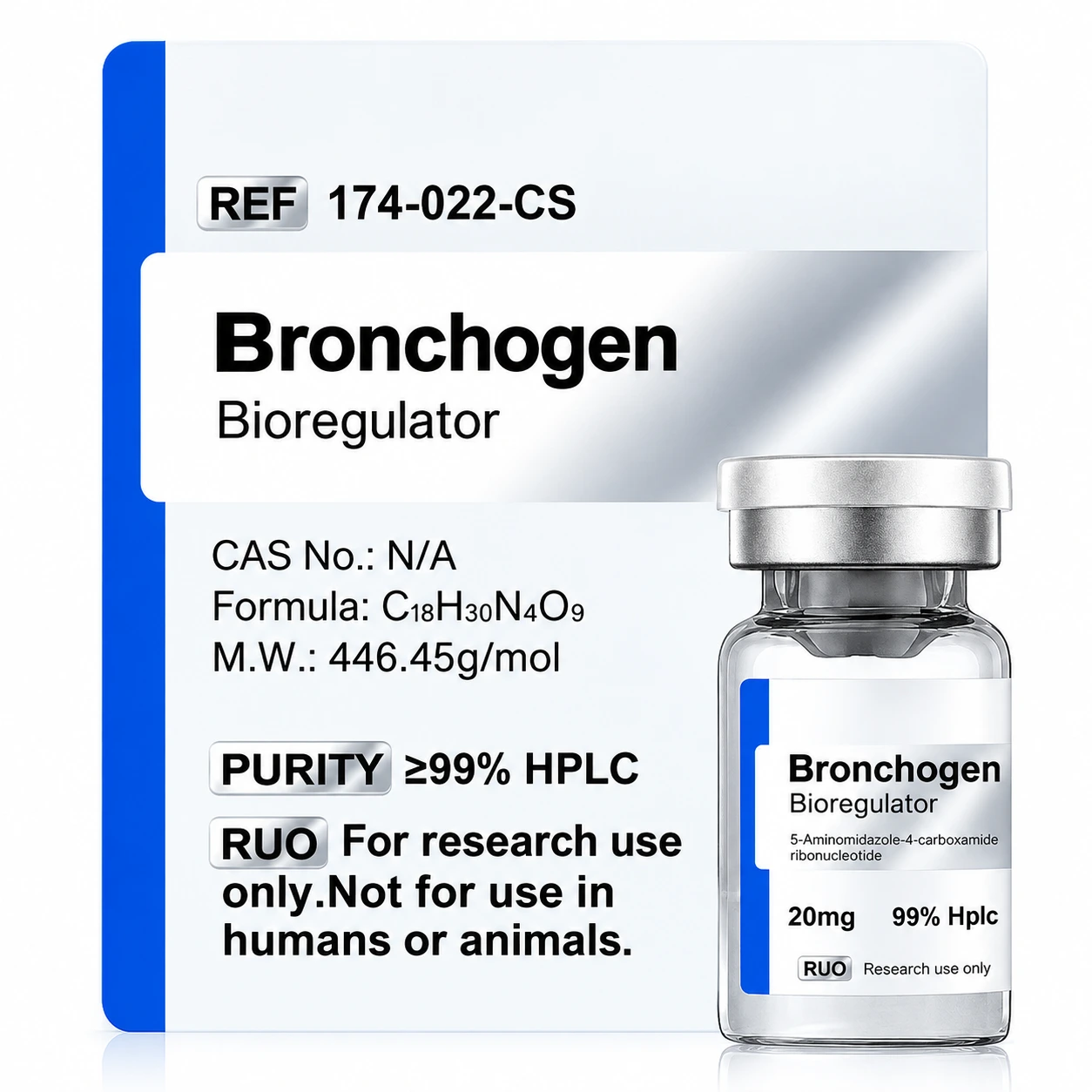
Bronchogen 20mg
$155.00
Bronchogen , a substance with specific biological activity, acts on the respiratory system to improve symptoms of chronic bronchitis, asthma, and COPD. It alleviates inflammation and promotes the repair and regeneration of bronchial tissue. Additionally, Bronchogen aids recovery from acute respiratory infections and relieves symptoms like coughing and dyspnea. Its mechanism involves modulating immune responses and enhancing mucociliary clearance, making it a promising agent for respiratory disease management.
The peptide will be provided as lyophilized powder to ensure maximum stability.
| Dosage: | 20 mg |
| Total amount: | 10 vials / Kit |
| Component: | Bronchogen |
Bronchogen 20mg: Research Peptide, Scientific Profile, Quality & Quality-Control Guide
Bronchogen 20mg is a research peptide that has attracted interest within the field of short bioactive peptides and peptide bioregulator research. The compound is associated with the short peptide sequence commonly reported as Ala-Glu-Asp-Leu (AEDL) in the scientific literature, although individual publications and databases have not always represented the sequence consistently.
Bronchogen has been investigated in experimental research involving molecular biology, DNA stability, cellular regulation, and short-peptide activity. One published study examined the interaction of Bronchogen with DNA and reported an increase in DNA melting temperature under specific experimental conditions.
Other research involving short exogenous peptides has investigated Bronchogen alongside compounds such as Epitalon and Vilon, reporting biological effects in experimental cellular systems.
For researchers evaluating Bronchogen 20mg, however, it is important to distinguish laboratory observations from established clinical outcomes. A research finding does not automatically establish therapeutic efficacy, safety, dosage, or regulatory approval in humans.
What Is Bronchogen 20mg?
Bronchogen is a short synthetic peptide that belongs to a broader group of ultrashort peptides studied for their potential biological effects.
The term “Bronchogen 20mg” generally describes a research-material presentation containing a labeled 20mg quantity. The “20mg” designation should not be confused with a clinically validated human dose.
This distinction is particularly important when developing SEO content for peptide products. Commercial searches frequently combine the name of a peptide with a numerical quantity, but the quantity supplied in a research vial does not establish how much, if any, should be administered to a person.
Bronchogen has primarily been discussed in experimental peptide literature rather than within the framework of a widely established, approved pharmaceutical treatment.
Researchers interested in Bronchogen may therefore focus on:
- Molecular identity
- Peptide sequence
- Purity
- Analytical characterization
- Batch traceability
- Certificate of Analysis (COA)
- Research applications
- Published scientific evidence
- Storage and handling information
Bronchogen Peptide Sequence and Molecular Identity
Bronchogen is commonly described as a tetrapeptide.
A review of ultrashort peptide research identifies Bronchogen (AEDL) and categorizes it among short peptides investigated for biological activity.
A PubMed-indexed publication examining Bronchogen’s interaction with DNA gives the sequence in its title as Ala-Asp-Glu-Leu, highlighting an inconsistency in sequence notation across available sources.
For a research supplier or laboratory purchaser, this makes identity verification especially important.
A quality-controlled research product should provide sufficient information for the buyer to understand exactly what peptide has been synthesized and tested. Where sequence nomenclature differs between sources, researchers should rely on authoritative analytical characterization rather than assuming that two differently represented sequences are automatically identical.
Useful identity information can include:
- Peptide name
- Amino-acid sequence
- Molecular formula
- Expected molecular mass
- Lot number
- Analytical test results
- HPLC chromatogram
- Mass-spectrometry data
What Does Bronchogen 20mg Mean?
The phrase Bronchogen 20mg generally indicates the amount of research material supplied in a particular product presentation.
It does not establish a recommended medical dosage.
This distinction can be summarized as:
20mg product quantity ≠ validated therapeutic dose
There is no basis for treating a 20mg research vial as a standardized human treatment regimen.
Researchers should determine experimental concentrations and procedures according to validated laboratory protocols and relevant scientific literature rather than interpreting the product quantity as a dosing recommendation.
For SEO purposes, this distinction also helps create accurate content around related search terms such as:
- Bronchogen 20mg peptide
- Bronchogen research peptide
- Bronchogen 20mg research material
- Bronchogen peptide COA
- Bronchogen peptide purity
- Bronchogen laboratory research
Bronchogen Research and DNA Stability
One of the more distinctive areas of published Bronchogen research concerns DNA stability.
A PubMed-indexed 2011 study investigated the effect of Bronchogen on the thermal stability of DNA. Researchers used differential scanning microcalorimetry to evaluate DNA melting behavior in the presence of different concentrations of the peptide.
Under the experimental conditions reported, Bronchogen increased the melting temperature of DNA from calf thymus and mouse liver by approximately 3.1°C within a particular peptide-to-DNA ratio range.
The authors interpreted the findings as evidence of Bronchogen acting as a DNA-stabilizing agent under the conditions examined.
This is an interesting molecular biology observation, but it should not be converted into an unsupported claim that Bronchogen improves DNA health, repairs human DNA, prevents disease, or produces a specific therapeutic effect in people.
The study was a controlled experimental investigation of peptide-DNA interactions. Further research would be required to determine whether these observations have broader biological significance.
Bronchogen and Short-Peptide Research
Bronchogen is part of a wider research area involving ultrashort biological peptides.
Short peptides are particularly interesting to researchers because relatively small sequences can interact with biological molecules and influence experimental systems in ways that are distinct from larger proteins.
A 2017 PubMed-indexed study investigated the effects of several short exogenous peptides, including Bronchogen, Epitalon, and Vilon, on growth, development, and differentiation in tobacco callus cultures. The study reported significant effects at specific experimental concentrations.
These findings demonstrate why short peptides continue to attract interest in molecular and cellular research.
However, the experimental model is important. Results observed in plant tissue cultures cannot automatically be extrapolated to human physiology.
This principle should remain central to responsible Bronchogen content:
Bronchogen 20mg Research Applications
Bronchogen may be of interest to laboratories investigating short peptide biology, molecular interactions, and cellular regulation.
Potential research areas include:
Molecular Biology
Researchers can investigate interactions between short peptides and nucleic acids, proteins, membranes, or other molecular targets.
DNA Research
Published work on Bronchogen has specifically examined DNA thermal stability, making DNA-peptide interactions a notable area of experimental interest.
Peptide Characterization
Bronchogen can also serve as a subject for analytical research involving peptide identity, purity, molecular mass, chromatographic behavior, and synthesis.
Cellular Research
Research involving short peptides has examined biological effects in cellular and tissue models, including the tobacco callus model used in the 2017 study.
Structure-Activity Research
Because short peptides can be modified at individual amino-acid positions, researchers can investigate how sequence changes influence molecular behavior.
These applications are research-oriented and should not be confused with established medical indications.
Bronchogen 20mg and Peptide Purity
For laboratories purchasing Bronchogen 20mg, purity and identity are among the most important quality considerations.
A peptide can be correctly labeled but still contain synthesis-related impurities, degradation products, residual reagents, or other components.
For that reason, researchers should look beyond a product title and evaluate available analytical documentation.
HPLC Purity
High-performance liquid chromatography (HPLC) is widely used in peptide characterization to evaluate chromatographic purity.
An HPLC result can help researchers determine the proportion of the major chromatographic component relative to detected impurities.
However, HPLC purity alone does not establish every aspect of peptide identity or suitability.
Mass Spectrometry
Mass spectrometry can provide additional evidence supporting molecular-mass identity.
Using HPLC together with mass spectrometry generally provides more useful characterization than relying on a single purity percentage.
Certificate of Analysis
A Certificate of Analysis (COA) should ideally correspond to the exact batch being supplied.
A useful COA may contain:
- Product name
- Peptide sequence or identity
- Lot number
- HPLC purity
- Mass-spectrometry result
- Testing date
- Analytical method
- Laboratory information
- Appearance or physical description
Batch-specific documentation gives researchers greater confidence that the analytical results correspond to the material they actually received.
Why Batch Traceability Matters
Batch traceability is particularly important for synthetic research peptides.
A transparent quality-control system should connect the product to its corresponding analytical documentation:
Bronchogen 20mg → Lot Number → Analytical Testing → COA
This allows researchers to compare the physical product with the documentation supplied by the manufacturer or distributor.
A generic COA that does not identify the relevant batch provides less useful information than a lot-specific analytical report.
Researchers should also consider whether the testing laboratory and analytical methodology are clearly identified.
Bronchogen 20mg Storage Considerations
Peptide stability can be influenced by environmental conditions such as temperature, moisture, light, and repeated handling.
The appropriate storage conditions for a specific Bronchogen product should therefore be determined from the manufacturer’s documentation and the characteristics of the supplied formulation.
For research materials, laboratories should pay attention to:
- Recommended storage temperature
- Protection from moisture
- Protection from excessive light
- Container integrity
- Exposure to repeated temperature changes
- Manufacturer handling instructions
- Product-specific stability information
Storage requirements may differ between lyophilized material and prepared solutions, so researchers should not assume that one generic storage recommendation applies to every formulation.
Bronchogen 20mg vs. Other Research Peptides
Bronchogen is sometimes discussed alongside other short peptides such as Epitalon, Thymogen, Thymalin, Vilon, and Chonluten.
These compounds should not, however, be treated as interchangeable.
Their amino-acid sequences differ, and their experimental models, molecular interactions, and reported biological effects may also differ.
For example, a research finding involving Chonluten cannot automatically be attributed to Bronchogen simply because both are short peptides.
Likewise, evidence concerning Epitalon does not establish the safety or efficacy of Bronchogen.
For high-quality SEO content, separating these compounds is beneficial because it improves both scientific accuracy and topical relevance.
Is Bronchogen 20mg FDA Approved?
Bronchogen should not be described as an FDA-approved pharmaceutical treatment.
The scientific publications identified in the literature describe experimental investigations rather than establishing an FDA-approved Bronchogen medicine.
Consequently, websites discussing or supplying Bronchogen as a research material should avoid unsupported statements that it is an approved treatment for respiratory disorders or other diseases.
The same principle applies to claims concerning:
- Asthma
- COPD
- Bronchitis
- Respiratory infections
- Lung disease
- DNA repair
- Anti-aging effects
- Immune treatment
Experimental literature can justify discussion of research findings, but it does not automatically establish clinical indications.
Is There a Proven Bronchogen 20mg Human Dose?
A 20mg product presentation should not be interpreted as a validated human dosage.
Published experimental studies use specific concentrations, models, and conditions that cannot simply be converted into a human dosing regimen.
Researchers should therefore avoid interpreting laboratory concentrations as medical dosing instructions.
For a research product, the appropriate focus is instead on:
- Experimental design
- Validated protocols
- Peptide concentration
- Molecular identity
- Analytical quality
- Experimental controls
- Reproducibility
This approach provides a more scientifically defensible foundation for Bronchogen research.
How to Evaluate a Bronchogen 20mg Research Supplier
Researchers comparing sources of Bronchogen 20mg may benefit from evaluating several quality indicators before purchasing research material.
1. Clear Product Identity
The supplier should clearly identify the compound rather than relying on vague peptide terminology.
2. Batch-Specific COA
A COA should ideally correspond to the lot supplied.
3. Analytical Testing
Look for appropriate analytical characterization, including HPLC and mass spectrometry where available.
4. Transparent Research Labeling
The product should be clearly represented as a research material rather than being marketed with unsupported medical claims.
5. Storage Information
The supplier should provide appropriate product-specific storage information.
6. Consistent Documentation
Product information, labeling, COA details, lot numbers, and analytical results should be internally consistent.
These factors help researchers distinguish a professionally documented research material from a poorly characterized peptide product.
Bronchogen 20mg Frequently Asked Questions
What is Bronchogen 20mg?
Bronchogen 20mg refers to a research peptide presentation containing a labeled 20mg quantity. Bronchogen is a short peptide that has been investigated in experimental molecular and biological research.
What is the Bronchogen peptide sequence?
Bronchogen is commonly reported as Ala-Glu-Asp-Leu (AEDL) in peptide research literature, although some publications represent the sequence differently. One PubMed record gives the sequence as Ala-Asp-Glu-Leu, so researchers should verify identity through analytical documentation.
What has Bronchogen been studied for?
Published research has examined Bronchogen in areas including DNA thermal stability and short-peptide biological activity. A 2011 study reported an increase in DNA melting temperature under specified experimental conditions.
Is Bronchogen a respiratory medicine?
Bronchogen should not be represented as an approved respiratory medicine. Research literature may discuss its relationship to bronchopulmonary research, but experimental evidence should not be presented as proof of a clinical treatment effect.
Does Bronchogen 20mg mean a 20mg treatment dose?
No. The 20mg designation describes a quantity of research material and does not establish a validated human dosage.
What should a Bronchogen COA contain?
A useful COA can include the compound identity, batch or lot number, HPLC purity, mass-spectrometry data, testing date, analytical methodology, and laboratory information.
Why is HPLC testing important?
HPLC can help characterize chromatographic purity and identify major components within a peptide sample. It is best considered alongside other analytical methods rather than as the sole proof of identity or quality.
Is Bronchogen suitable for human use?
The available literature does not establish Bronchogen as an approved human therapeutic. It is more appropriately discussed in the context of laboratory and research applications.
Conclusion
Bronchogen 20mg is an interesting short-peptide research material with a history of investigation in molecular and biological research.
Published research has examined Bronchogen in connection with DNA thermal stability, while other experimental work has explored its effects in biological models involving short exogenous peptides.
The scientific evidence should nevertheless be interpreted carefully. Experimental findings do not establish a clinically proven treatment, and a 20mg product quantity should not be presented as a validated human dose.
For laboratories evaluating Bronchogen 20mg, the strongest purchasing and quality considerations are accurate identity, sequence verification, batch-specific COA documentation, HPLC purity, mass-spectrometry confirmation, appropriate storage information, and transparent research-use labeling.
| Quantity | 10 vials / Kit |
|---|
Be the first to review “Bronchogen 20mg” Cancel reply
Related products

Laboratory Peptides
Laboratory Peptides
Laboratory Peptides
Laboratory Peptides
Laboratory Peptides

Laboratory Peptides

Laboratory Peptides
Laboratory Peptides
Reviews
There are no reviews yet.