
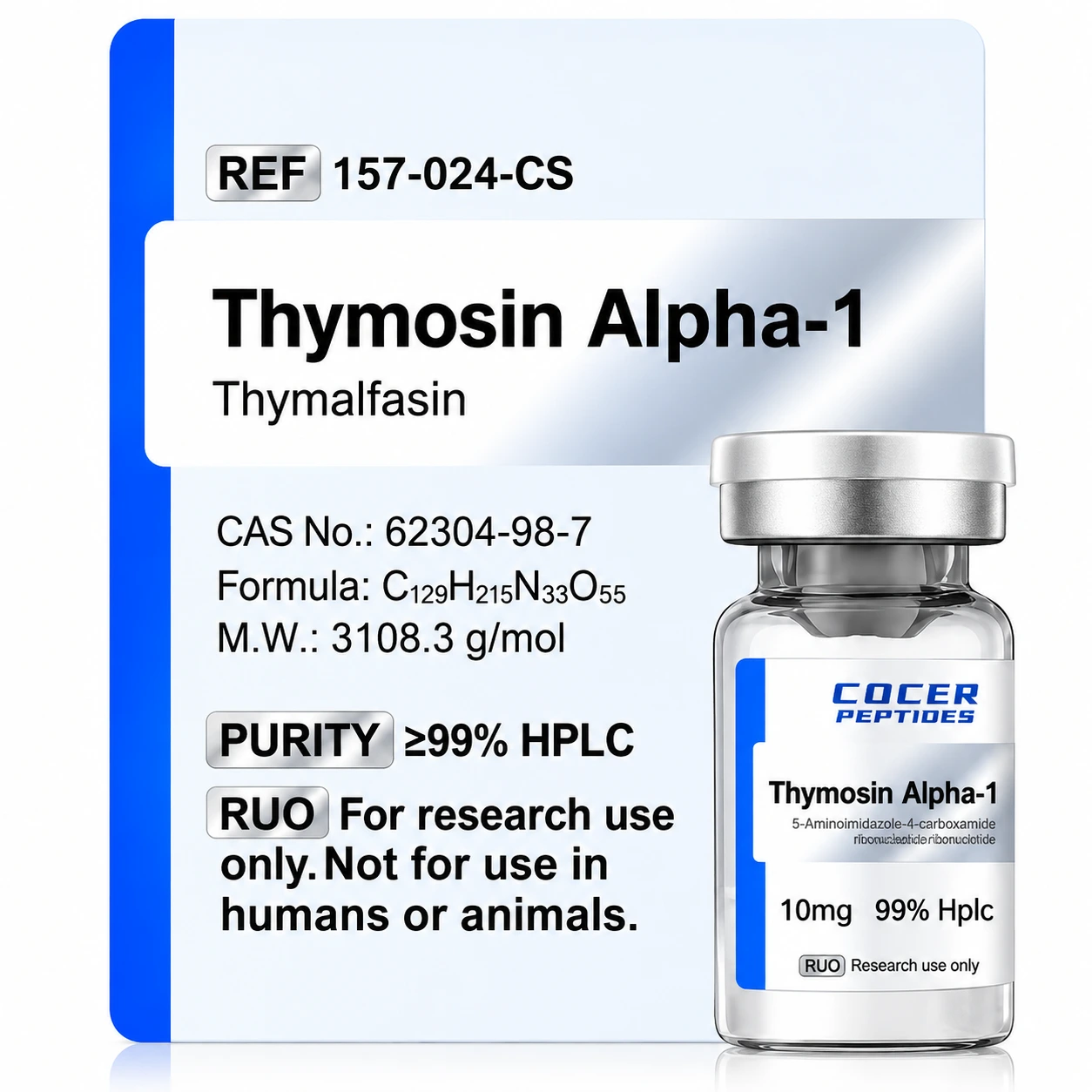
Thymosin Alpha-1 10mg

$185.00
Thymosin Alpha-1 is a biologically active peptide naturally derived from the thymus, composed of 28 amino acids. It possesses remarkable immune regulatory properties. By precisely activating T-cell differentiation and maturation, it significantly enhances the body’s Th1-type immune response, helping to effectively identify and eliminate pathogens and abnormal cells. In conditions such as chronic hepatitis, immunodeficiency, and infectious diseases, Thymosin Alpha-1 rapidly restores immune balance while enhancing the effectiveness of vaccinations, providing a robust boost to the immune system.
The peptide will be provided as lyophilized powder to ensure maximum stability.
| Dosage: | 10 mg |
| Total amount: | 10 vials / Kit |
| Component: | Thymosin Alpha-1 |
Thymosin Alpha-1 10mg: Research, Quality and Scientific Overview
Thymosin Alpha-1 10mg is a search term associated with a synthetic peptide known as thymosin alpha-1, also called Ta1 or thymalfasin. This 28-amino-acid peptide has attracted decades of scientific interest because of its role in immunology and its interactions with components of the immune system.
As peptide research continues to expand, Thymosin Alpha-1 has become a frequently searched compound among laboratories, researchers, and scientific organizations interested in immune-related peptide research. However, scientific interest should always be distinguished from regulatory approval and established medical use.
In the United States, FDA materials state that no drug products containing thymosin alpha-1 are FDA-approved. FDA has also evaluated safety concerns involving peptide aggregation, immunogenic potential, peptide-related impurities, and the challenges associated with characterizing complex peptide materials.
For researchers evaluating Thymosin Alpha-1 10mg, important considerations include chemical identity, peptide quality, analytical documentation, batch traceability, storage information, and the intended research application.
What Is Thymosin Alpha-1?
Thymosin alpha-1 (Ta1) is a synthetic version of a naturally occurring thymic peptide originally identified through research into thymus-derived biological factors.
The synthetic pharmaceutical form is commonly referred to as thymalfasin.
Thymosin Alpha-1 is a relatively small peptide consisting of 28 amino acids. It has been investigated for decades in studies involving immune-cell activity, immune signaling, infectious disease research, vaccine-response research, and other areas of immunology.
The compound has also been marketed internationally under the name Zadaxin in certain markets. However, international availability or regulatory authorization in one jurisdiction should not be interpreted as FDA approval in the United States. FDA materials specifically state that products containing thymosin alpha-1 are not FDA-approved in the U.S.
This distinction is important when creating accurate online content around the keyword Thymosin Alpha-1 10mg.
What Does Thymosin Alpha-1 10mg Mean?
The 10mg designation generally refers to the stated quantity of peptide material in a particular product presentation.
Quantity should not be confused with:
- An approved human dose
- A recommended treatment regimen
- A measure of clinical effectiveness
- A guarantee of purity
- Proof of safety
- Regulatory approval
A product labeled Thymosin Alpha-1 10mg should therefore be evaluated according to its complete specifications.
For research purposes, useful product information may include:
- Exact compound identity
- Peptide sequence
- Stated quantity
- Purity specification
- Batch or lot number
- Certificate of Analysis
- Analytical testing information
- Storage recommendations
- Research-use designation
The amount printed on a label is only one part of the overall product specification.
Understanding Thymosin Alpha-1 and Immune Research
Thymosin Alpha-1 has attracted scientific attention because of its potential interactions with immune-system pathways.
Research has examined the peptide in areas including:
- T-cell-related research
- Immune-cell signaling
- Innate immune responses
- Adaptive immune responses
- Vaccine-response research
- Infectious disease research
- Immunomodulatory mechanisms
These areas of investigation have generated a substantial scientific literature.
However, an important distinction must be maintained between biological activity observed in research and proven clinical effectiveness for a particular medical condition.
FDA’s review of thymosin alpha-1 for compounding purposes noted significant concerns surrounding the safety information available for certain uses and routes of administration. The agency specifically highlighted the potential immunogenicity of peptides, self-association and aggregation, peptide-related impurities, and characterization challenges.
How Does Thymosin Alpha-1 Work in Research?
The exact biological mechanisms of thymosin alpha-1 continue to be studied.
Research has investigated how the peptide may interact with immune-system signaling pathways and influence immune-cell activity.
Scientific studies have explored areas involving:
Immune Cell Signaling
Researchers have examined thymosin alpha-1 in experimental models to investigate its relationship with immune-cell communication and activation.
Innate Immune Research
The innate immune system provides an early biological response to pathogens and other potential threats. Thymosin Alpha-1 has been studied as part of broader research into innate immune signaling.
Adaptive Immune Research
Adaptive immune responses involve specialized immune cells and the development of targeted responses. Thymosin Alpha-1 has also been investigated in this area.
Vaccine-Response Research
Some scientific studies have examined thymosin alpha-1 in connection with immune responses to vaccination.
These research areas remain scientifically distinct from claiming that a peptide is an approved treatment or guaranteed immune-enhancing product.
Thymosin Alpha-1 vs. Other Thymosin Peptides
The word “thymosin” can cause confusion because several different peptides and proteins have similar names.
Thymosin Alpha-1
Thymosin Alpha-1 is a 28-amino-acid peptide also known as thymalfasin.
Thymosin Beta-4
Thymosin Beta-4 is a different peptide with a different structure and biological research profile.
TB-500
TB-500 is commonly described as a synthetic peptide related to a fragment of thymosin beta-4 and is not the same substance as Thymosin Alpha-1.
These compounds should not be treated as interchangeable.
A research website should clearly identify the exact peptide being discussed, because similarities in naming do not mean that two peptides have the same sequence, biological activity, regulatory status, or research applications.
Why Peptide Identity Matters
Accurate chemical identification is essential in peptide research.
A product described simply as “Thymosin” may not provide enough information to establish which specific compound is being supplied.
For Thymosin Alpha-1 10mg, a clear product specification should distinguish the material from:
- Thymosin Beta-4
- TB-500
- Other thymus-derived peptide compounds
- Unrelated immune-related peptides
Accurate identification helps researchers maintain reproducible experimental records and compare results across studies.
A well-documented research product should clearly state the identity of the peptide and provide supporting analytical information.
Thymosin Alpha-1 10mg and Peptide Purity
Peptide purity is an important consideration in scientific research.
A research material may contain the intended peptide together with impurities, degradation products, synthesis-related residues, or other compounds.
These variables can affect experimental results.
Researchers evaluating Thymosin Alpha-1 10mg may therefore consider:
Chemical Identity
Does the analytical documentation support the identity of the intended peptide?
Purity
Is a purity specification provided and supported by an appropriate analytical method?
Batch Consistency
Can individual batches be traced and compared?
Analytical Documentation
Is relevant batch-specific documentation available?
Storage Information
Are appropriate storage conditions clearly provided for the supplied material?
The FDA’s discussion of thymosin alpha-1 specifically notes the importance of peptide-related impurities and characterization challenges when evaluating peptide substances.
Certificate of Analysis for Thymosin Alpha-1 10mg
A Certificate of Analysis (COA) can provide useful information when evaluating a research peptide.
Depending on the analytical program, a COA may include:
- Product identity
- Lot or batch number
- Purity result
- Analytical method
- Molecular characterization
- Testing date
- Product specifications
For peptide research, chromatography and mass-spectrometry methods may be used as part of analytical characterization.
Researchers should review documentation carefully and confirm that it corresponds to the specific batch being evaluated.
A generic certificate should not automatically be treated as evidence that every future batch has identical analytical characteristics.
Research Quality and Batch Traceability
Reproducibility is one of the foundations of scientific research.
If two laboratories use materials that differ in identity, purity, stability, or impurity profiles, their experimental outcomes may not be directly comparable.
For this reason, laboratories working with Thymosin Alpha-1 may maintain records including:
- Exact compound name
- Product quantity
- Batch number
- Purity specification
- Analytical method
- Certificate of Analysis
- Storage conditions
- Experimental protocol
Detailed documentation can help researchers identify potential sources of variation between experiments.
Regulatory Status of Thymosin Alpha-1
Regulatory status is an important part of accurate product communication.
FDA materials from its Pharmacy Compounding Advisory Committee state that products containing thymosin alpha-1 are not approved by the FDA in the United States. The same discussion notes that products have been marketed outside the United States under names including Zadaxin.
It is also important to understand that:
Orphan drug designation is not the same as FDA approval.
FDA representatives have specifically explained that orphan designation provides certain incentives but does not replace the separate scientific and regulatory review required for approval.
Therefore, online content should avoid describing thymosin alpha-1 as:
- FDA-approved in the United States
- A proven treatment for all immune conditions
- A guaranteed immune booster
- A replacement for vaccines
- A substitute for conventional medical treatment
Thymosin Alpha-1 Research and Clinical Investigation
Thymosin alpha-1 has been investigated in numerous scientific and clinical research settings.
Research areas have included:
- Viral disease research
- Immune-system research
- Vaccine-response studies
- Oncology-related immune research
- Sepsis research
- Other immunological investigations
The existence of clinical studies does not mean that a compound is approved for every condition studied.
A registered clinical trial, for example, demonstrates that a scientific question is being investigated. It does not establish that the treatment has been proven safe or effective.
Important Safety and Quality Considerations
Peptides are complex biological molecules that require careful analytical evaluation.
FDA’s 2024 review of thymosin alpha-1 and thymosin alpha-1 acetate highlighted several important concerns relevant to peptide products.
These include:
- Potential immunogenicity
- Peptide aggregation
- Self-association
- Peptide-related impurities
- Characterization challenges
- Limited safety information for certain proposed uses and routes
FDA’s analysis emphasized that peptide substances can present considerations that differ from conventional small-molecule compounds.
For this reason, product marketing should not make broad claims that a peptide is universally safe simply because it has been used in research or marketed in other countries.
How to Evaluate a Thymosin Alpha-1 Research Supplier
Researchers evaluating Thymosin Alpha-1 10mg should focus on transparent documentation.
1. Verify the Exact Identity
Confirm that the material is specifically identified as Thymosin Alpha-1 or thymalfasin.
2. Review Analytical Data
Look for appropriate information supporting peptide identity and purity.
3. Check Batch Traceability
A unique lot or batch number can connect the supplied material to its documentation.
4. Review the Certificate of Analysis
Where available, examine whether the COA is batch-specific and clearly identifies the testing performed.
5. Confirm the Intended Use
Research material should be accurately identified as research material rather than marketed as an approved medicine where no such approval exists.
6. Review Storage Information
Appropriate storage requirements should come from the supplier’s documentation for the specific material and formulation.
7. Avoid Unsupported Claims
Professional suppliers should prioritize accurate specifications over promises of guaranteed health outcomes.
Thymosin Alpha-1 10mg and Research Reproducibility
Scientific reproducibility depends on careful control of experimental variables.
When working with peptide materials, researchers should record the characteristics of the specific batch used.
Useful information may include:
- Compound identity
- Stated quantity
- Batch number
- Purity
- Analytical profile
- Storage conditions
- Experimental conditions
This information can help laboratories determine whether differences between results are related to the experiment itself or differences in the research material.
For research organizations, strong documentation can support both quality-control practices and scientific transparency.
Frequently Asked Questions About Thymosin Alpha-1 10mg
What is Thymosin Alpha-1 10mg?
Thymosin Alpha-1 10mg generally refers to a stated 10mg quantity of the peptide thymosin alpha-1 in a particular research product presentation. The quantity does not establish an approved human dose, purity, or regulatory status.
Is Thymosin Alpha-1 FDA-approved?
No. FDA materials state that no products containing thymosin alpha-1 are approved by the FDA in the United States.
Is thymosin alpha-1 the same as thymalfasin?
Thymalfasin is the name commonly used for the synthetic form of thymosin alpha-1.
Is Thymosin Alpha-1 the same as TB-500?
No. Thymosin Alpha-1 and TB-500 are different peptide compounds with different structures and research profiles.
What is Thymosin Alpha-1 studied for?
Thymosin Alpha-1 has been investigated in immunology, immune signaling, infectious disease research, vaccine-response studies, and other areas of scientific research.
What does 10mg mean?
The 10mg designation generally refers to the stated quantity of material in a particular product presentation. It should not be interpreted as an approved or recommended human dose.
Why is a Certificate of Analysis important?
A batch-specific COA can provide useful information regarding the identity, purity, and analytical characteristics of a specific research batch.
Does orphan drug designation mean FDA approval?
No. FDA representatives have explained that orphan drug designation and FDA approval are separate processes. Orphan designation provides development incentives but does not establish that a product has passed the required approval process.
Can Thymosin Alpha-1 be described as an immune booster?
That phrase can be misleading. Thymosin Alpha-1 has been investigated for immunological effects, but broad consumer claims implying proven immune benefits may go beyond the evidence and regulatory status.
Conclusion: Understanding Thymosin Alpha-1 10mg
Thymosin Alpha-1 10mg is an important search term within peptide and immunology research. The compound, also known as Ta1 or thymalfasin, is a 28-amino-acid peptide that has been studied for decades in connection with immune-system biology and related scientific questions.
For researchers, the 10mg quantity is only one element of a complete product specification.
The most important considerations include:
- Accurate peptide identity
- Analytical purity
- Batch traceability
- Certificate of Analysis documentation
- Appropriate storage information
- Transparent research-use labeling
| Quantity | 10 vials / Kit |
|---|
Be the first to review “Thymosin Alpha-1 10mg” Cancel reply
Related products
Laboratory Peptides
Laboratory Peptides

Laboratory Peptides
Laboratory Peptides
Laboratory Peptides
Laboratory Peptides
Laboratory Peptides
Laboratory Peptides
Reviews
There are no reviews yet.