

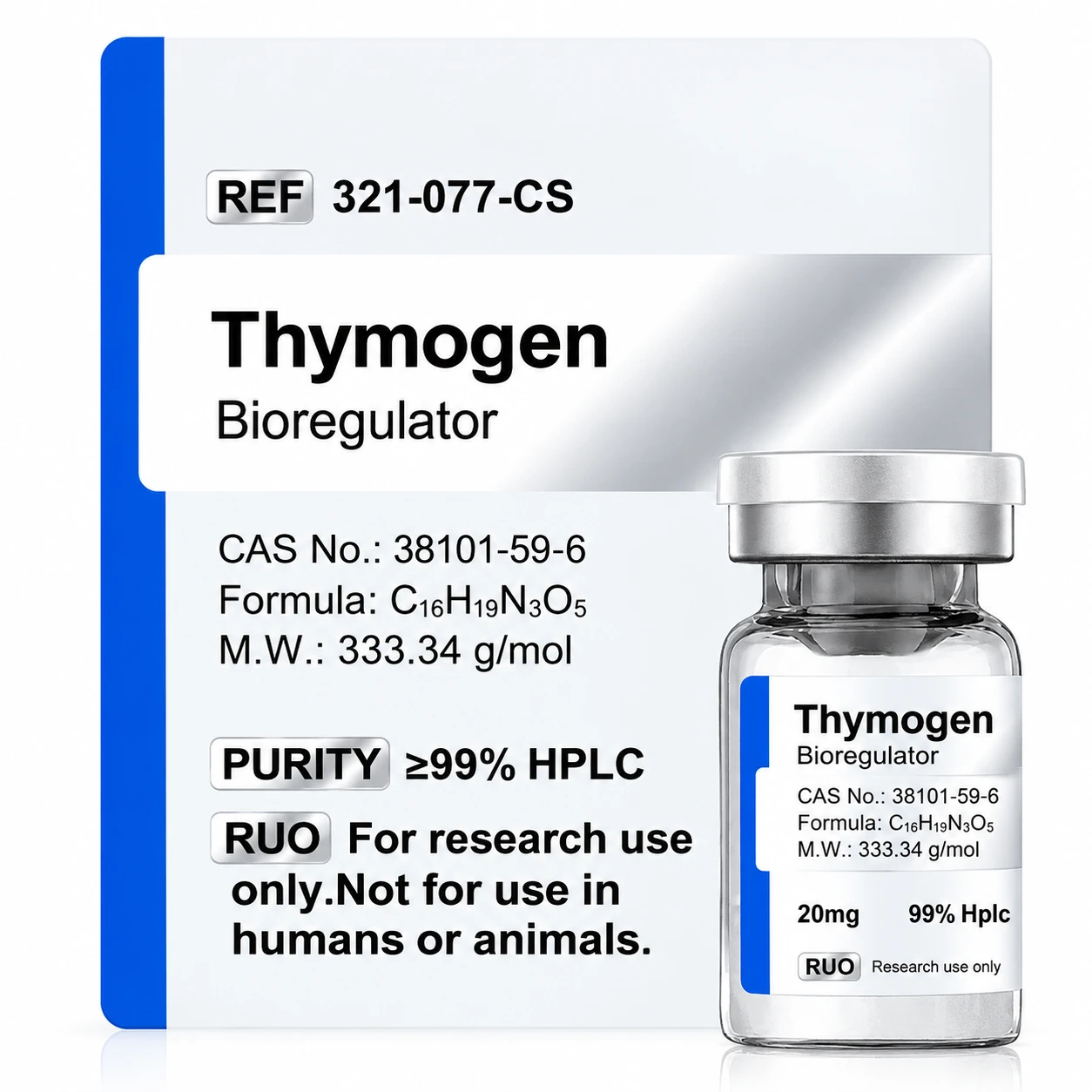
Thymogen 20mg
$160.00
Thymogen is an active peptide with stable biological activity, whose core function revolves around immune regulation. It specifically activates naive T lymphocytes, enhances phagocytic and cytotoxic activity in macrophages and natural killer cells, and promotes the secretion of immune-related cytokines such as interleukin-2. This helps improve compromised immune function, maintain immune balance, and assist in strengthening the body’s resistance to pathogens. Current applications primarily focus on supportive care for immunocompromised populations (e.g., post-surgical recovery, elderly individuals), immune support during infectious diseases, and adjunctive intervention for certain immune disorder-related conditions.
The peptide will be provided as lyophilized powder to ensure maximum stability.
| Dosage: | 20 mg |
| Total amount: | 10 vials / Kit |
| Component: | Thymogen |
Thymogen 20mg: Peptide Research, Properties, Purity & Scientific Guide
Thymogen 20mg is a research peptide product associated with the short dipeptide Glu-Trp (glutamic acid–tryptophan). Thymogen has been investigated in the context of immune-related biology, cellular signaling, inflammatory pathways, and peptide research.
Interest in Thymogen has grown aThymogen 20mglongside broader interest in short biological peptides and compounds historically described as thymic or tissue-derived peptide regulators. Published research has examined Thymogen in both experimental cellular models and older clinical literature. However, the evidence base is heterogeneous, and findings from historical studies should not automatically be interpreted as proof of modern clinical efficacy.
A 2022 peer-reviewed study specifically identified Thymogen as the dipeptide Glu-Trp and examined its effects in the human THP-1 monocyte/macrophage cell line.
For researchers evaluating Thymogen 20mg, important considerations include molecular identity, analytical purity, batch documentation, certificate of analysis (COA), research-use labeling, and appropriate interpretation of the available scientific evidence.
What Is Thymogen 20mg?
Thymogen is described in the scientific literature as a short dipeptide composed of glutamic acid and tryptophan (Glu-Trp). A peer-reviewed 2022 study lists Thymogen among five peptide preparations investigated for effects on inflammatory and proliferative processes in human THP-1 cells. The researchers specifically describe Thymogen as a dipeptide derived from calf thymus.
The 20mg designation refers to the labeled quantity of material in a particular research product or vial. It should not automatically be interpreted as a clinically validated dose.
This distinction is particularly important for SEO content because searches for “Thymogen 20mg” can combine a product quantity with an assumption about human dosing. The scientific evidence does not establish 20mg as a universally validated therapeutic dose for Thymogen.
Consequently, the most accurate way to describe the product is as a 20mg research quantity, where applicable, rather than presenting the number as an established medical dosage.
Thymogen Peptide: Molecular Identity
Understanding the identity of a research peptide is one of the first steps in evaluating its scientific usefulness.
Published research identifies Thymogen as:
- Name: Thymogen
- Peptide type: Dipeptide
- Reported sequence: Glu-Trp
- Abbreviation: EW or Glu-Trp
- Research category: Short peptide / thymic peptide research
- Primary research interest: Cellular and immune-related signaling
The 2022 study is particularly useful because it directly identifies the five peptide preparations used in its experiments. It describes P3 as Thymogen, a Glu-Trp dipeptide associated with calf thymus, alongside Epitalon, Vilon, Thymalin, and Chonluten.
Researchers should nevertheless distinguish between historical biological origin descriptions and the identity of a modern synthetic research material. A contemporary product should be characterized according to its actual manufacturing and analytical documentation rather than relying solely on descriptions of naturally occurring source material.
Thymogen 20mg and Cellular Research
One of the more recent peer-reviewed investigations relevant to Thymogen was published in the International Journal of Molecular Sciences in 2022.
The study evaluated five different peptide preparations in the human THP-1 monocyte/macrophage cell model. The researchers examined inflammatory and proliferative processes and included Thymogen alongside Epitalon, Vilon, Thymalin, and Chonluten.
THP-1 cells are a human leukemia-derived monocytic cell line that can be differentiated into macrophage-like cells under laboratory conditions. This model is commonly used for investigating cellular inflammatory responses and related signaling mechanisms.
In the experiment, cells were treated with the peptides alone or together with lipopolysaccharide (LPS), an experimental stimulus used to activate inflammatory signaling.
These findings make Thymogen relevant to laboratory investigations involving:
- Monocyte biology
- Macrophage biology
- Inflammatory signaling
- Cytokine pathways
- Cellular proliferation
- Peptide-cell interactions
- Experimental immunology
Importantly, in-vitro findings do not establish that the same effects occur in humans. Laboratory cell models are useful for studying mechanisms and generating hypotheses, but they cannot independently establish clinical effectiveness or appropriate human dosing.
Thymogen and Immune Research
The historical literature surrounding Thymogen has frequently focused on immune-related research.
For example, an older PubMed-indexed publication examined Thymogen in patients with type 1 diabetes and reported effects that the investigators associated with immune-cell differentiation.
Another older PubMed-indexed study investigated Thymogen in relation to acute respiratory viral infections in a military population and reported findings concerning morbidity and disease duration.
These historical studies are potentially relevant to the history of Thymogen research, but they should be interpreted carefully. They were conducted decades ago, and their methodologies, populations, formulations, standards of evidence, and clinical contexts may differ substantially from modern pharmaceutical research.
Therefore, an SEO article should avoid converting these older reports into broad statements that Thymogen is proven to prevent or treat infections or immune disorders.
A better scientific description is that Thymogen has historically been investigated in immune-related contexts and continues to appear in experimental peptide research.
Thymogen 20mg vs Thymosin Alpha-1
One of the most important distinctions when researching Thymogen is its difference from thymosin alpha-1 (Tα1).
These are not the same peptide.
Thymogen is described in the 2022 cellular study as the short dipeptide Glu-Trp, while thymosin alpha-1 is a substantially longer peptide with its own molecular structure and research history.
This distinction matters because some online content uses “thymic peptide,” “Thymogen,” and “thymosin” interchangeably. That can create confusion and lead readers to incorrectly attribute clinical evidence from one molecule to another.
For example, thymosin alpha-1 has been evaluated in numerous human clinical studies. A 2025 phase 3 randomized controlled trial investigated thymosin alpha-1 in 1,106 adults with sepsis and found no statistically significant reduction in 28-day all-cause mortality compared with placebo.
That study concerns thymosin alpha-1, not Thymogen. It therefore should not be presented as a direct clinical trial of Thymogen.
Maintaining this distinction improves both scientific accuracy and the credibility of an SEO page.
What Does “20mg” Mean?
The phrase “Thymogen 20mg” can be interpreted in different ways by online shoppers and researchers.
In a research-product context, 20mg generally indicates the quantity of material supplied.
It does not necessarily indicate:
- A recommended human dose
- A clinically established daily dose
- A treatment protocol
- A maximum tolerated dose
- A pharmacologically validated dose
A clinically meaningful dosage requires evidence addressing factors such as pharmacokinetics, route of administration, exposure, efficacy, toxicity, and the target population.
For Thymogen, the available literature does not establish a modern, universally accepted 20mg human treatment dose.
Therefore, researchers should treat the “20mg” label primarily as a quantity specification unless product-specific documentation establishes another meaning.
Thymogen 20mg Research Applications
For laboratory researchers, Thymogen may be relevant to several experimental areas.
Cellular Immunology
Researchers can investigate how short peptides interact with immune-related cell models and signaling pathways.
Inflammatory Pathways
The THP-1 study provides a research framework for examining peptide effects under experimentally induced inflammatory conditions.
Monocyte and Macrophage Research
Because Thymogen has been investigated using THP-1 cells, it may be relevant to experiments involving monocyte differentiation and macrophage-related biology.
Peptide Signaling Research
Short peptides can be investigated for their potential interactions with cellular signaling systems, providing opportunities for structure-activity and mechanism-oriented studies.
Comparative Peptide Research
Thymogen can also be studied alongside other short peptides to investigate whether different sequences produce different cellular responses.
Researchers should define their experimental endpoints and concentrations according to validated laboratory protocols and primary literature rather than assuming that commercial product quantities correspond to experimental concentrations.
Thymogen 20mg Purity and Quality
Quality control is essential when evaluating any research peptide.
A product marketed as Thymogen 20mg should ideally be accompanied by documentation allowing researchers to determine what material was supplied and how its quality was assessed.
Important documentation may include:
- Molecular identity
- Peptide sequence
- Lot or batch number
- HPLC purity
- Mass spectrometry
- Analytical method
- Testing laboratory
- Testing date
- Product quantity
- Storage recommendations
HPLC Purity
High-performance liquid chromatography (HPLC) is commonly used to assess chromatographic purity.
A reported purity percentage can help researchers compare batches, but it should not be treated as a complete measure of product quality.
For example, HPLC purity alone does not necessarily establish:
- Molecular identity
- Correct sequence
- Sterility
- Endotoxin status
- Biological activity
- Long-term stability
Mass Spectrometry
Mass spectrometry can provide complementary evidence concerning molecular mass and identity.
Using multiple analytical techniques can provide a stronger characterization profile than relying on a single analytical result.
Why a Batch-Specific COA Matters
A Certificate of Analysis is particularly valuable when it is linked directly to the batch or lot being supplied.
Researchers should look for a logical connection between:
Product → Batch Number → Analytical Test → Results
A generic certificate that does not identify the actual lot may provide less useful information than a batch-specific report.
For a Thymogen 20mg research material, an informative COA may include the peptide’s identity, purity, analytical method, lot number, test date, and laboratory information.
Quality documentation should support informed laboratory purchasing rather than function as a substitute for independent scientific evaluation.
Is Thymogen 20mg FDA Approved?
Thymogen should not be presented as an FDA-approved pharmaceutical treatment.
The available literature includes historical studies and laboratory research, but this is different from having a current FDA-approved indication.
It is also important not to confuse Thymogen with other peptide medicines or investigational compounds that may have different regulatory histories.
For a research website, responsible wording should therefore describe Thymogen as a research peptide or research material rather than an FDA-approved treatment for a specific disease.
Is Thymogen 20mg Clinically Proven?
The evidence should be divided into several categories.
Laboratory evidence:
There is published cellular research directly involving Thymogen. The 2022 THP-1 study examined Thymogen alongside several other peptides in inflammatory and proliferative models.
Historical human research:
Older PubMed-indexed publications report clinical investigations involving Thymogen, including studies related to type 1 diabetes and respiratory viral infections.
Modern clinical validation:
The available evidence does not establish a contemporary clinical framework that would justify describing Thymogen 20mg as a universally validated therapeutic dosage.
Accordingly, claims about disease treatment, prevention, or guaranteed immune enhancement should not be presented as established facts.
Thymogen Storage and Laboratory Handling
The appropriate storage conditions for a Thymogen research product depend on its specific formulation, packaging, and manufacturer’s validated stability information.
Researchers should follow the storage requirements supplied with the actual product.
Relevant considerations may include:
- Temperature control
- Protection from moisture
- Light exposure
- Container integrity
- Temperature fluctuations
- Reconstitution procedures
- Laboratory handling conditions
Research peptides should be handled using appropriate laboratory procedures and according to applicable institutional requirements.
How to Evaluate a Thymogen 20mg Research Supplier
Researchers comparing suppliers can evaluate several objective factors.
1. Transparent Product Information
The product page should clearly identify the material rather than relying on vague “thymic peptide” terminology.
2. Batch Documentation
The supplier should provide traceable lot information and appropriate analytical documentation.
3. Independent Testing
Where possible, independent or third-party testing can provide additional confidence in reported analytical results.
4. Clear Research-Use Labeling
The intended use of the material should be clearly stated.
5. Accurate Scientific Claims
A credible supplier should distinguish laboratory research from established medical evidence.
6. Appropriate Packaging
Packaging should protect the material during shipping and storage and provide sufficient identification information.
These factors can help researchers make evidence-informed purchasing decisions without relying solely on marketing language.
Frequently Asked Questions About Thymogen 20mg
What is Thymogen?
Thymogen is a short dipeptide identified in published research as Glu-Trp. It has been investigated in cellular and historical immune-related research.
What is Thymogen 20mg?
Thymogen 20mg generally refers to a research product containing a labeled 20mg quantity of Thymogen. The 20mg quantity should not automatically be interpreted as a clinically established dose.
What is the sequence of Thymogen?
Published research identifies Thymogen as the dipeptide Glu-Trp.
Is Thymogen the same as thymosin alpha-1?
No. Thymogen and thymosin alpha-1 are different peptides. Evidence concerning thymosin alpha-1 should not automatically be attributed to Thymogen.
Has Thymogen been studied in human cells?
Yes. A 2022 study examined Thymogen in the human THP-1 monocyte/macrophage cell model.
Is 20mg a recommended Thymogen dose?
The 20mg designation should be treated as a product quantity unless supported by specific validated evidence. It should not automatically be presented as a recommended human dosage.
What should a Thymogen COA contain?
A useful COA may include batch identification, peptide identity, HPLC purity, mass-spectrometry information, testing methodology, testing date, and laboratory details.
Is Thymogen intended for research?
For modern peptide-product content, Thymogen is most appropriately discussed as a research material unless a specific jurisdiction’s regulatory status and an approved medical indication establish otherwise.
Conclusion
Thymogen 20mg is a short peptide research material associated with the dipeptide Glu-Trp and a history of investigation involving immune-related and cellular biology.
Modern peer-reviewed research has directly examined Thymogen in the human THP-1 monocyte/macrophage model, providing a useful experimental basis for investigating peptide effects on cellular inflammatory and proliferative processes.
Historical human publications also provide context for the development of Thymogen research, but they should be interpreted according to their individual study designs and limitations.
For researchers considering a Thymogen 20mg material, the most useful quality indicators include clear molecular identification, batch-specific COA documentation, HPLC analysis, complementary mass-spectrometry testing, appropriate storage information, and transparent research-use labeling.
Most importantly, Thymogen should not be confused with thymosin alpha-1 or other thymic peptides. These compounds have different structures and evidence bases, and clinical findings from one peptide cannot automatically establish the properties of another.
A scientifically responsible approach to Thymogen combines accurate peptide identification, transparent analytical documentation, careful interpretation of research findings, and a clear distinction between experimental evidence and established human medical use.
| Quantity | 10 vials / Kit |
|---|
Be the first to review “Thymogen 20mg” Cancel reply
Related products
Laboratory Peptides
Laboratory Peptides
Laboratory Peptides
Laboratory Peptides
Laboratory Peptides
Laboratory Peptides
Laboratory Peptides
Laboratory Peptides
Reviews
There are no reviews yet.