
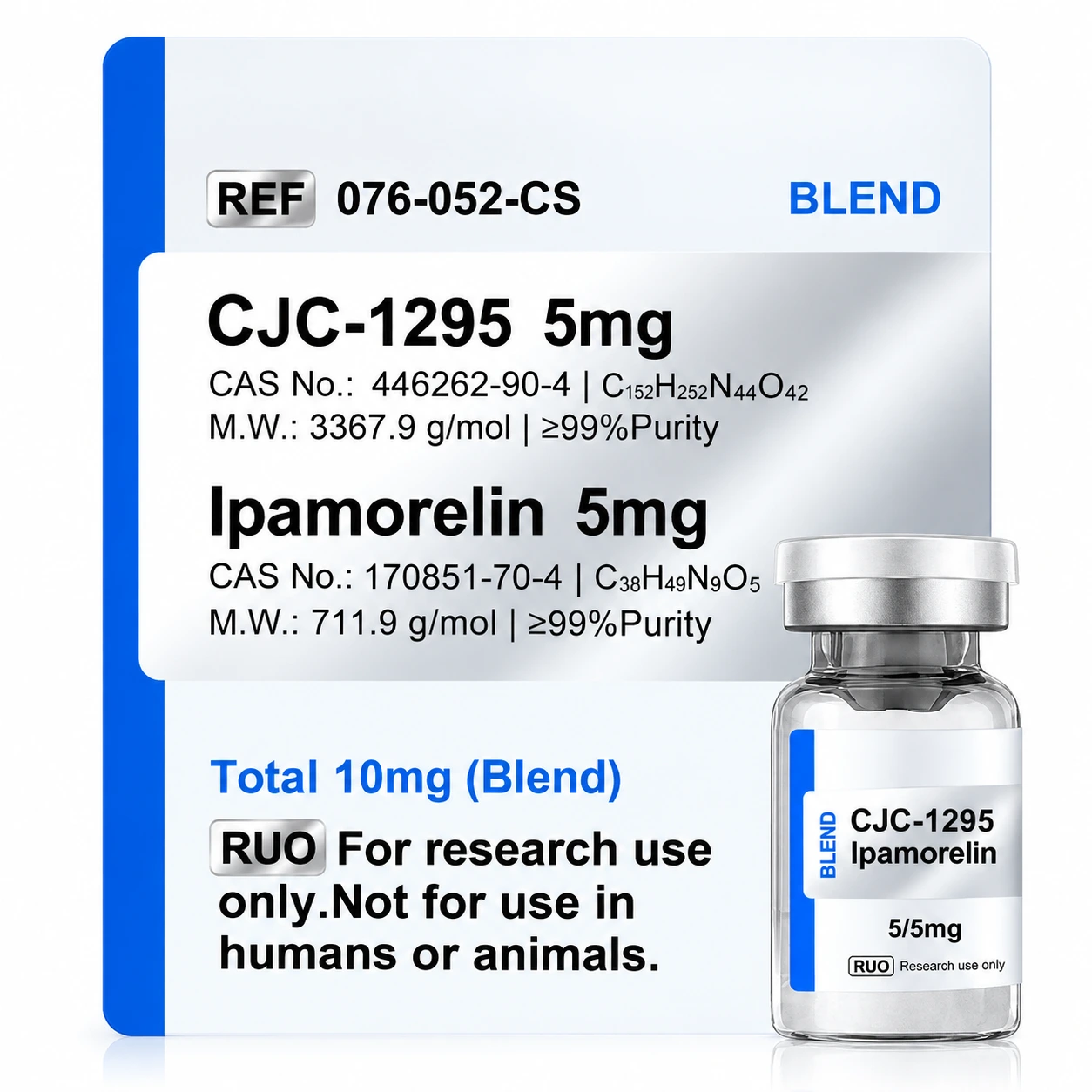
CJC1295, Ipamorelin 5/5 (Blend)

$175.00
CJC1295 no DAC is a synthetic GHRH analog that promotes endogenous growth hormone secretion.
Ipamorelin , a synthetic pentapeptide, is a growth hormone secretagogue that induces GH release and IGF-1 production.
When combined, they significantly boost muscle protein synthesis and accelerate muscle tissue repair. The combination also elevates growth hormone levels, promoting fat breakdown and oxidation, increasing energy production, improving sleep quality, and enhancing immune function. This combined approach holds great potential in anti – aging medicine, sports medicine, and the treatment of endocrine diseases.
The peptide will be provided as lyophilized powder to ensure maximum stability.
| Dosage: | 5/5 mg |
| Total amount: | 10 vials / Kit |
| Component: | CJC1295, Ipamorelin Blend |
CJC1295 Ipamorelin 5/5 Blend: Research Peptide, Mechanism, Quality & Scientific Guide
CJC1295, Ipamorelin 5/5 (Blend) combines two peptide compounds that have attracted substantial interest in growth-hormone research: CJC-1295, a long-acting analogue of growth hormone-releasing hormone (GHRH), and Ipamorelin, a growth hormone-releasing peptide (GHRP) and ghrelin-receptor agonist.
The combination is frequently searched by researchers and peptide enthusiasts because the two compounds act through different pathways involved in growth hormone regulation. CJC-1295 has been investigated for its ability to produce sustained increases in growth hormone (GH) and insulin-like growth factor 1 (IGF-1), while human research on ipamorelin has examined its pharmacokinetic and growth-hormone-releasing properties.
However, CJC1295, Ipamorelin 5/5 (Blend) should not be confused with an FDA-approved combination medicine or a clinically validated 5mg/5mg treatment regimen. FDA materials identify safety and characterization concerns surrounding both CJC-1295 and ipamorelin in compounded-drug contexts, including concerns about immunogenicity, peptide-related impurities, and limited clinical safety information.
For research applications, therefore, the most important considerations are accurate identity, composition, analytical purity, batch documentation, and responsible interpretation of the available scientific literature.
What Is CJC1295, Ipamorelin 5/5 (Blend)?
The name CJC1295, Ipamorelin 5/5 (Blend) generally describes a product containing two peptides in a nominal 1:1 mass ratio:
- CJC-1295 — 5mg
- Ipamorelin — 5mg
- Total labeled peptide content — 10mg
The exact composition should always be verified against the product specification and batch-specific certificate of analysis (COA).
The “5/5” designation is best understood as a product formulation or quantity description, rather than a dosing recommendation.
That distinction is important for both scientific accuracy and responsible SEO. A research product labeled “5mg + 5mg” does not establish that the same quantities are appropriate, effective, or safe for administration to humans.
Researchers should also distinguish between CJC-1295 and CJC-1295 DAC, since terminology in online peptide listings is sometimes inconsistent. CJC-1295 has been studied as a long-acting GHRH analogue, with research demonstrating prolonged GH and IGF-1 responses following administration.
What Is CJC-1295?
CJC-1295 is a synthetic analogue of growth hormone-releasing hormone (GHRH).
GHRH is naturally involved in regulating growth hormone secretion from the pituitary gland. CJC-1295 was developed to produce a longer-lasting pharmacological effect than native GHRH.
One important feature investigated in research is CJC-1295’s ability to produce sustained changes in GH and IGF-1 concentrations.
A randomized, placebo-controlled study published in the Journal of Clinical Endocrinology & Metabolism evaluated CJC-1295 in healthy adults. Researchers reported dose-dependent increases in mean plasma GH and IGF-1 concentrations following administration. The study also reported an estimated CJC-1295 half-life of approximately 5.8–8.1 days under the studied conditions.
Another human study found that CJC-1295 increased basal and mean GH secretion while preserving the pulsatile pattern of GH secretion. IGF-1 concentrations also increased during the study period.
These findings help explain why CJC-1295 continues to attract interest in endocrine and peptide research.
They do not, however, establish CJC-1295 as an approved treatment for aging, muscle growth, fat loss, athletic performance, or other consumer-oriented applications.
What Is Ipamorelin?
Ipamorelin is a synthetic growth hormone-releasing peptide that has been studied for its ability to stimulate GH release.
Unlike CJC-1295, which is related to the GHRH pathway, ipamorelin belongs to a different class of GH secretagogues.
Human pharmacokinetic and pharmacodynamic research has evaluated ipamorelin in healthy volunteers. One study used an infusion-based dose-escalation design and measured both circulating ipamorelin and GH responses. The researchers reported dose-proportional pharmacokinetics and a short terminal half-life of approximately two hours under the experimental conditions.
This distinction between the two molecules is central to understanding why combination formulations are of interest in peptide research.
CJC-1295 and ipamorelin are not simply two versions of the same peptide. They influence GH secretion through different biological mechanisms.
How CJC-1295 and Ipamorelin Differ
A simplified comparison looks like this:
| Peptide | General research classification | Primary pathway of interest |
|---|---|---|
| CJC-1295 | GHRH analogue | GHRH-related stimulation of GH release |
| Ipamorelin | Growth hormone-releasing peptide | Ghrelin/GH-secretagogue pathway |
CJC-1295 has been investigated for sustained GH and IGF-1 responses, whereas ipamorelin research has focused on GH stimulation and pharmacokinetic behavior.
This mechanistic distinction is one reason the CJC1295 Ipamorelin blend is a popular research concept.
Nevertheless, the existence of separate biological mechanisms does not automatically prove that a particular commercial blend produces superior clinical outcomes.
Why Are CJC-1295 and Ipamorelin Combined?
The scientific rationale behind studying the combination comes from the fact that the two peptides interact with different components of the GH regulatory system.
CJC-1295 is associated with the GHRH pathway, while ipamorelin is a GH secretagogue.
Researchers interested in endocrine signaling may therefore investigate whether simultaneous modulation of different pathways produces measurable changes in GH secretion or downstream biomarkers.
It is important to distinguish mechanistic rationale from clinical proof.
A theoretical or physiological rationale can justify further research, but it does not establish that a particular blend improves muscle development, body composition, recovery, sleep, longevity, or athletic performance in humans.
That distinction is particularly important in SEO content because many online pages make stronger claims than the underlying evidence supports.
CJC1295, Ipamorelin 5/5 and GH Research
Growth hormone research is a complex field involving the hypothalamus, pituitary gland, liver, peripheral tissues, GH receptors, and the IGF-1 signaling system.
CJC-1295 research provides evidence that pharmacological stimulation of the GHRH pathway can substantially alter circulating GH and IGF-1 concentrations. In the 2006 clinical study, single administrations produced sustained increases in GH and IGF-1, while repeated administration maintained elevated IGF-1 levels for longer periods.
Ipamorelin research similarly demonstrates that the peptide can stimulate GH release under experimental conditions.
These studies provide useful scientific background for researchers investigating the GH axis.
However, changing GH or IGF-1 concentrations is not equivalent to demonstrating a beneficial clinical outcome. The relationship between hormone levels and outcomes such as body composition, metabolic health, recovery, or disease treatment is considerably more complicated.
What Does “5/5 Blend” Mean?
One of the most important SEO and product-description questions is:
What does CJC1295, Ipamorelin 5/5 mean?
In a product context, 5/5 typically indicates 5mg of CJC-1295 plus 5mg of Ipamorelin.
Therefore:
CJC-1295: 5mg
Ipamorelin: 5mg
Total blend: 10mg
But the exact composition should be verified from the product label and COA.
The term “5/5” should not be presented as:
- A medically recommended dose
- A clinically validated treatment protocol
- An FDA-approved combination
- A guaranteed effective ratio
Instead, it should be described as the labeled composition of the research material.
This approach makes product content more transparent while still targeting high-intent commercial keywords.
CJC1295, Ipamorelin Blend: Research Applications
Potential research applications can include investigation of:
- Growth hormone signaling
- GHRH pathways
- Growth hormone secretagogue activity
- GH and IGF-1 relationships
- Endocrine signaling
- Peptide pharmacology
- Pharmacokinetics
- Pharmacodynamics
- Receptor-mediated signaling
- Hormonal regulation
- Peptide structure-activity relationships
Researchers may also use these compounds when studying how different secretagogue pathways influence endocrine responses.
However, laboratory applications should be determined according to appropriate scientific protocols and institutional requirements.
CJC-1295 and Ipamorelin Quality Considerations
For any research peptide blend, analytical quality is one of the most important purchasing considerations.
A product page should provide clear information about the identity and composition of the material rather than relying exclusively on marketing language.
1. Certificate of Analysis
A batch-specific COA can help researchers evaluate the material supplied.
Useful documentation may include:
- Product name
- Individual peptide identities
- Batch or lot number
- Purity results
- Analytical methods
- Test date
- Laboratory information
- Molecular-weight information
- Appearance or physical description where relevant
2. HPLC Analysis
High-performance liquid chromatography (HPLC) is commonly used to assess peptide purity.
For a blend containing two peptides, it is particularly useful for understanding how each component is characterized rather than relying on a single combined purity statement.
3. Mass Spectrometry
Mass spectrometry can provide additional information about molecular mass and identity.
Using multiple analytical techniques can provide stronger characterization than relying on a single percentage printed on a product page.
4. Batch Traceability
The COA should ideally correspond to the actual lot being supplied.
A transparent chain of:
Product → Batch → Analytical Test → Result
is a valuable quality-control feature for research materials.
Why Purity Matters for Peptide Blends
Peptides are sensitive biological molecules, and their quality can be influenced by manufacturing, purification, storage, formulation, and handling.
FDA has specifically highlighted concerns involving peptide-related impurities, aggregation, and immunogenicity for compounded CJC-1295 and ipamorelin products.
This makes analytical characterization particularly relevant when evaluating peptide materials.
A high reported purity percentage is useful, but it should not be interpreted as proof of sterility, clinical safety, or therapeutic effectiveness.
Researchers should consider the complete quality-control package rather than focusing on a single number.
Safety and Regulatory Considerations
CJC-1295 and ipamorelin require careful regulatory and safety framing.
FDA materials identify limited clinical data for CJC-1295 and have reported safety concerns associated with CJC-1295, including increased heart rate and systemic vasodilatory reactions in the information reviewed by the agency. FDA has also raised concerns about peptide-related impurities and immunogenicity.
For ipamorelin, FDA has identified concerns regarding characterization, immunogenicity, and limited safety information for certain routes of administration. FDA’s review also discussed serious adverse events reported in an intravenous clinical study, although causality for reported deaths was unclear.
These regulatory observations reinforce an important point:
Research availability does not equal FDA approval.
CJC-1295 and ipamorelin should therefore not be marketed as FDA-approved treatments simply because they have appeared in human research.
Is CJC1295, Ipamorelin 5/5 FDA Approved?
The CJC1295, Ipamorelin 5/5 blend should not be described as an FDA-approved combination medication.
FDA’s current materials discuss CJC-1295 and ipamorelin in the context of compounding safety and characterization concerns rather than as an approved combination product.
This is an important distinction for a commercial website.
Product descriptions should avoid unsupported claims such as:
- “FDA-approved CJC-1295 Ipamorelin”
- “Clinically proven muscle-building blend”
- “FDA-approved anti-aging peptide”
- “Guaranteed GH booster”
Instead, a compliant research-oriented description can focus on identity, analytical quality, published research, composition, and laboratory use.
CJC1295, Ipamorelin 5/5: Storage and Handling
Researchers should follow the manufacturer’s or laboratory’s documented storage specifications for the specific product.
Important considerations may include:
- Temperature control
- Protection from excessive light
- Moisture control
- Container integrity
- Minimizing unnecessary temperature cycling
- Proper laboratory handling
- Following product-specific reconstitution or stability documentation where applicable
Because formulation and packaging can influence peptide stability, generic storage claims should not replace product-specific instructions.
Choosing a CJC1295, Ipamorelin 5/5 Research Material
Researchers evaluating a CJC1295 Ipamorelin 5/5 blend can consider several quality indicators.
Look for transparent product information
The supplier should clearly state what the “5/5” designation means.
Check the COA
A batch-specific certificate provides useful evidence for evaluating the supplied material.
Verify analytical methods
HPLC and mass spectrometry can provide complementary information about peptide purity and identity.
Check lot traceability
The lot number on the product should correspond with the analytical documentation.
Avoid unsupported medical promises
Research-focused suppliers should distinguish laboratory research from human therapeutic use.
Evaluate documentation, not just marketing
Professional buyers generally benefit more from transparent specifications and analytical records than from exaggerated claims about results.
Frequently Asked Questions
What is CJC1295, Ipamorelin 5/5?
It generally refers to a blend containing 5mg of CJC-1295 and 5mg of Ipamorelin, for a total labeled peptide quantity of 10mg. The exact composition should be verified using the product specification and COA.
What is CJC-1295?
CJC-1295 is a long-acting analogue of GHRH that has been investigated for its effects on GH and IGF-1 secretion. Human research has demonstrated sustained increases in these hormones following experimental administration.
What is Ipamorelin?
Ipamorelin is a growth hormone-releasing peptide investigated for its ability to stimulate GH release. Human pharmacokinetic and pharmacodynamic research has characterized its disposition and GH response.
Does the 5/5 designation mean 5mg is the recommended dose?
No. The 5/5 designation describes the labeled composition of a blend and should not be interpreted as a validated human dosing recommendation.
Is CJC-1295 Ipamorelin a proven treatment?
The available evidence does not establish the 5/5 combination as an FDA-approved therapeutic treatment. Research has demonstrated biological effects on GH-related pathways, but that does not establish clinical efficacy for consumer health or performance claims.
What should I look for in a CJC1295 Ipamorelin COA?
Look for batch identification, individual component information, purity testing, analytical methodology, test date, and laboratory details. Ideally, the documentation should correspond to the exact lot supplied.
Why are CJC-1295 and Ipamorelin researched together?
They influence different aspects of growth-hormone regulation, making the combination scientifically interesting for research into endocrine signaling. However, mechanistic rationale should not be confused with proof of clinical benefit.
Conclusion
CJC1295, Ipamorelin 5/5 (Blend) is a high-interest research peptide combination centered on two compounds that have independently been investigated for their effects on growth-hormone signaling.
CJC-1295 has been studied as a long-acting GHRH analogue, with human research demonstrating sustained increases in GH and IGF-1. Ipamorelin has separately been investigated as a growth hormone-releasing peptide with measurable pharmacokinetic and pharmacodynamic effects in human volunteers.
The “5/5” designation is best interpreted as 5mg CJC-1295 plus 5mg Ipamorelin, rather than as a clinically established dosing protocol.
| Quantity | 10 vials / Kit |
|---|
Be the first to review “CJC1295, Ipamorelin 5/5 (Blend)” Cancel reply
Related products

Laboratory Peptides
illumineuro (Pinealon/NA Selank/NA Seamx/PE22-28) 50mg Blend
Laboratory Peptides
Laboratory Peptides
Laboratory Peptides
Laboratory Peptides
Laboratory Peptides
Laboratory Peptides
Laboratory Peptides
Reviews
There are no reviews yet.