

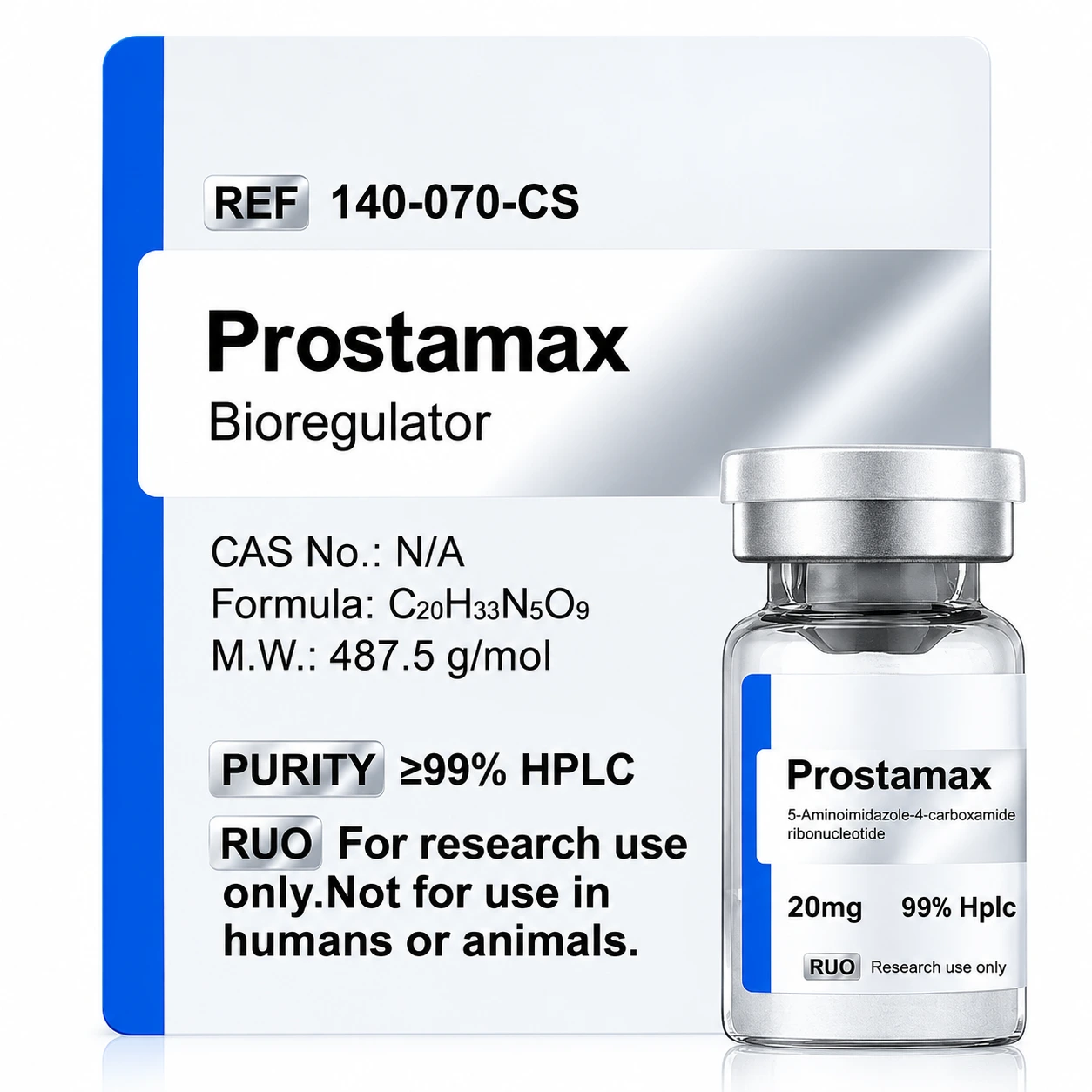
Prostamax 20mg

$160.00
Prostamax, a bioregulatory peptide derived from the prostate, exhibits significant effects in maintaining prostate health and overall physiological balance in the human body. It effectively improves prostate health, alleviates urination problems caused by benign prostatic hyperplasia (BPH), promotes prostate tissue regeneration, and delays degenerative changes in the prostate. Prostamax also possesses anti-inflammatory properties, reducing inflammatory symptoms and relieving pain and discomfort. Additionally, it exerts anti-aging effects by delaying cellular aging and maintaining cell vitality. Furthermore, Prostamax enhances immune function and regulates hormone levels, playing a crucial role in sustaining prostate health and overall male well-being.
The peptide will be provided as lyophilized powder to ensure maximum stability.
| Dosage: | 20 mg |
| Total amount: | 10 vials / Kit |
| Component: | Prostamax |
Prostamax 20mg: KEDP Peptide Research, Quality & Scientific Guide
Prostamax 20mg is a research peptide associated with the broader family of short peptide bioregulators and is commonly identified as Lys-Glu-Asp-Pro (KEDP), a four-amino-acid peptide. Interest in Prostamax has grown among researchers investigating short peptides, chromatin biology, cellular aging, molecular signaling, and prostate-related research.
However, an important distinction should be made at the beginning: the scientific evidence for the synthetic Prostamax peptide itself is limited and predominantly preclinical. Published research has examined Prostamax in cultured human lymphocytes and other laboratory contexts rather than establishing clinical effectiveness for prostate disorders. A 2012 PubMed-indexed study examined the effects of Prostamax on chromosome and chromatin characteristics in cells obtained from older individuals.
Prostamax should therefore be approached as a research compound rather than an established human therapeutic. For laboratories evaluating a Prostamax 20mg research material, peptide identity, analytical purity, batch documentation, and a reliable certificate of analysis (COA) are especially important.
What Is Prostamax 20mg?
Prostamax is generally described as a synthetic short peptide in the Khavinson-associated peptide bioregulator family.
The compound is commonly identified as:
- Name: Prostamax / Prostomax
- Sequence: Lys-Glu-Asp-Pro
- Abbreviation: KEDP
- Peptide length: Four amino acids
- Molecular formula: C20H33N5O9
- Approximate molecular weight: 487.5 Da
A scientific review of ultrashort peptides lists Prostomax as KEDP and associates it with research concerning prostatic functions.
The 20mg designation refers to the quantity of material supplied in a particular research product. It should not be confused with a clinically established 20mg dose.
This distinction is critical because no validated human dosing regimen for synthetic Prostamax has been established through controlled clinical trials.
Prostamax 20mg and KEDP Peptide Research
The identity of Prostamax is important because online information can sometimes combine several different products under similar prostate-related terminology.
Research sources identify the synthetic peptide as Lys-Glu-Asp-Pro (KEDP). PubMed includes a study specifically describing Prostamax and examining its effects on cells from older individuals.
The study investigated chromosome and chromatin characteristics in cultured lymphocytes from people aged approximately 75–86 years. Researchers reported changes in several measured chromosomal parameters following exposure to the peptide and interpreted the findings in relation to chromatin organization and aging.
This makes Prostamax scientifically interesting from a cellular and molecular biology perspective.
It does not, however, demonstrate that Prostamax treats prostate disease, improves urinary symptoms, reduces prostate size, or produces a particular clinical outcome in humans.
That distinction is essential when evaluating search results and product descriptions.
What Does the 20mg Quantity Mean?
One of the most common commercial search phrases is “Prostamax 20mg peptide.”
In a research context, 20mg describes the amount of material contained in a vial or package.
It does not automatically represent:
- A recommended human dose
- A clinically validated dose
- A daily dose
- A treatment course
- A dosage established by a regulatory authority
A research quantity and a therapeutic dosage are fundamentally different concepts.
For example, a laboratory may purchase a 20mg vial for analytical, biochemical, cellular, or other experimental work. The amount required for an experiment depends on the experimental design, concentration, assay, and validated laboratory protocol.
Consequently, websites should avoid presenting “Prostamax 20mg” as though 20mg were an established treatment dose.
What Does Research Say About Prostamax?
The evidence base for Prostamax is relatively small.
The most clearly identifiable PubMed-indexed study specifically naming Prostamax investigated chromatin and chromosome characteristics in cultured human lymphocytes. Researchers measured parameters including sister chromatid exchanges, nucleolar-organizer-region characteristics, and structural changes involving pericentromeric heterochromatin.
The authors reported changes in chromosomal parameters after exposure to Prostamax and proposed that the peptide could influence chromatin organization.
From an SEO and scientific-content perspective, this provides a legitimate research angle:
Prostamax → short peptide → cellular research → chromatin biology → aging-related molecular research.
What it does not provide is evidence that the peptide is clinically effective for a prostate condition.
A strong article should therefore distinguish what researchers measured from what marketers may claim.
Prostamax and Prostate Research
The name Prostamax naturally leads readers to assume that substantial clinical research has been conducted directly on the prostate.
That assumption should be treated cautiously.
Some commercial and secondary sources connect Prostamax with prostate-tissue research and describe it as a prostate-associated bioregulator. However, the available evidence for the synthetic KEDP peptide is not equivalent to clinical evidence for prostate treatment.
This distinction becomes even more important because Prostamax is sometimes discussed alongside Prostatilen/Vitaprost, which are different products involving prostate-derived polypeptide preparations.
Evidence concerning a prostate-tissue extract or another preparation should not automatically be transferred to a defined synthetic tetrapeptide.
For researchers, confirming the exact molecular identity of the material is therefore essential.
Prostamax vs. Prostatilen: Why the Difference Matters
Prostamax and Prostatilen should not be treated as interchangeable products.
Prostamax is commonly described as the defined synthetic tetrapeptide Lys-Glu-Asp-Pro (KEDP).
Prostatilen, by contrast, is associated with a prostate-derived polypeptide preparation.
The distinction is important because evidence for one preparation does not automatically establish the efficacy, pharmacology, safety, or identity of another.
Researchers evaluating Prostamax should therefore ask:
- Is the material a defined synthetic peptide?
- Is the sequence identified?
- Is the molecular mass consistent with the stated sequence?
- Does the COA correspond to the supplied batch?
- Are analytical methods documented?
- Is the product clearly labeled for its intended research purpose?
These questions provide a stronger scientific foundation than relying solely on product names.
Prostamax 20mg for Laboratory Research
Prostamax may be of interest to researchers studying several areas of peptide biology.
Potential research categories include:
- Chromatin biology
- Cellular aging
- Epigenetic research
- Short-peptide biology
- Molecular signaling
- Cellular stress research
- Prostate-related molecular research
- Peptide structure-function studies
- Analytical peptide characterization
- Ultrashort peptide transport research
A 2022 review of ultrashort peptide transport and biologically active peptide systems includes Prostomax/KEDP within a broader discussion of short peptide interactions with transport systems.
Such research is useful for understanding how very short peptides may interact with biological systems. It should not be interpreted as clinical proof.
Prostamax Peptide Quality and Purity
For laboratories purchasing Prostamax 20mg, quality documentation is one of the most important considerations.
A reliable research peptide should have enough documentation to allow the buyer to evaluate what was actually supplied.
Certificate of Analysis
A Certificate of Analysis (COA) should ideally identify the specific batch or lot.
Depending on the supplier and testing laboratory, useful COA information may include:
- Product name
- Peptide sequence
- Lot number
- Manufacturing or testing date
- HPLC purity
- Mass-spectrometry results
- Molecular-weight confirmation
- Analytical method
- Laboratory information
- Appearance or physical description
A generic COA that does not identify the actual batch provides less useful information than a lot-matched analytical report.
HPLC Purity
High-performance liquid chromatography can be used to evaluate chromatographic purity.
A high HPLC percentage is useful, but it should not be interpreted as proof of every possible quality characteristic.
For example, purity testing alone does not necessarily establish:
- Correct biological activity
- Sterility
- Endotoxin status
- Long-term stability
- Clinical safety
- Therapeutic effectiveness
For that reason, complementary analytical methods can provide a more complete characterization.
Mass Spectrometry
Mass spectrometry can help verify whether the observed molecular mass is consistent with the expected compound.
For a short peptide such as KEDP, identity confirmation is particularly useful because the molecule is relatively small and can be analytically characterized using established techniques.
The strongest documentation combines identity confirmation with purity testing and batch traceability.
Why Batch-Specific Testing Matters
A common mistake when purchasing research peptides is assuming that one laboratory report represents every production batch.
Research materials can differ from batch to batch.
A robust quality-control system therefore links the:
Product → Sequence → Lot Number → Analytical Test → Result
For Prostamax 20mg, researchers should ideally verify that the COA supplied with the material corresponds to the exact lot being evaluated.
This improves traceability and makes the documentation substantially more useful for laboratory records.
Prostamax 20mg and Regulatory Status
Prostamax should not be marketed as an FDA-approved drug.
In June 2026, the U.S. Food and Drug Administration issued a warning letter to a company whose website marketed products including Prostamax. The FDA stated that the products identified in the letter were considered unapproved new drugs under the circumstances described in the letter and cited website statements as evidence concerning intended use.
Importantly, this warning letter concerned the specific company’s marketing and labeling, rather than constituting a blanket scientific determination about every Prostamax research material or every supplier.
Nevertheless, it demonstrates why responsible product content matters.
A research website should avoid presenting Prostamax as a treatment for prostate disease or making unsupported claims about diagnosis, prevention, symptom relief, or therapeutic effectiveness.
The FDA action also illustrates that simply placing a “research use only” disclaimer on a webpage does not necessarily resolve regulatory concerns if the surrounding content promotes a product for human drug purposes.
Is Prostamax 20mg FDA Approved?
No.
The synthetic Prostamax/KEDP research material should not be described as an FDA-approved medication.
There is also no basis for representing a generic 20mg research vial as an FDA-approved 20mg treatment.
For SEO content, accurate terminology is therefore preferable:
Recommended: “Prostamax 20mg research peptide”
Avoid: “FDA-approved Prostamax treatment”
Recommended: “Prostamax research material”
Avoid: “Proven prostate treatment”
This approach protects scientific credibility while still allowing the page to target valuable commercial and informational keywords.
Is There a Proven Prostamax Dosage?
There is no established clinical dosage for synthetic Prostamax supported by controlled human clinical evidence.
The 20mg designation should therefore be understood as a product quantity rather than a medically validated dosage.
This is particularly important because some online pages publish detailed administration schedules for research peptides without a corresponding clinical evidence base.
For legitimate laboratory research, experimental concentrations and study parameters should be established from appropriate scientific protocols and institutional procedures rather than copied from commercial dosing charts.
Storage and Research Handling
Prostamax 20mg may be supplied as a lyophilized research material.
Storage and handling requirements should always follow the specific manufacturer’s documentation and the laboratory’s applicable procedures.
Researchers may need to consider:
- Temperature control
- Moisture protection
- Light exposure
- Container integrity
- Storage duration
- Freeze-thaw exposure
- Reconstitution requirements where applicable
The supplier’s product-specific instructions should take precedence over generic internet recommendations.
Maintaining proper storage records can also help preserve experimental consistency.
How to Evaluate a Prostamax 20mg Research Supplier
Before selecting a research peptide supplier, researchers can evaluate several quality indicators.
1. Clear Identity
The supplier should clearly identify the compound and, where applicable, its sequence.
2. Lot-Matched COA
Analytical documentation should correspond to the batch supplied.
3. Independent Testing
Independent laboratory testing can provide additional confidence in reported purity and identity.
4. Transparent Research Labeling
The product description should accurately explain its research status without unsupported therapeutic claims.
5. Traceability
Lot numbers, analytical records, and product documentation should be organized and accessible.
6. Scientifically Responsible Content
A credible supplier should distinguish between published findings, hypotheses, and established clinical evidence.
These factors can help researchers compare suppliers based on quality and documentation rather than marketing claims alone.
Frequently Asked Questions About Prostamax 20mg
What is Prostamax 20mg?
Prostamax 20mg is a research peptide product commonly associated with the synthetic tetrapeptide Lys-Glu-Asp-Pro (KEDP). The 20mg figure describes the quantity of material supplied, not a validated human dosage.
What is the Prostamax peptide sequence?
Prostamax is commonly identified as Lys-Glu-Asp-Pro (KEDP). Scientific literature and peptide databases associate the name Prostomax/Prostamax with this sequence.
What has Prostamax been studied for?
Published research has examined Prostamax in cellular and molecular contexts, including chromatin and chromosome characteristics in cultured human lymphocytes from older individuals.
Is Prostamax clinically proven?
No. The available evidence does not establish Prostamax as a clinically proven treatment for prostate disease or other human conditions.
Is Prostamax the same as Prostatilen?
No. They should not automatically be treated as the same product. Prostamax is commonly described as a defined synthetic tetrapeptide, whereas Prostatilen is associated with a prostate-derived polypeptide preparation.
Does 20mg mean the recommended Prostamax dose?
No. Twenty milligrams describes the quantity of research material in a product. It should not be represented as a clinically established dose.
What should I look for in a Prostamax COA?
Look for a lot number, product identity, sequence where applicable, HPLC purity, mass-spectrometry or molecular-mass confirmation, testing date, and laboratory information.
Is Prostamax approved by the FDA?
The synthetic Prostamax research material should not be described as an FDA-approved drug. The FDA’s June 2026 warning letter specifically identified Prostamax in connection with a particular company’s marketing of the product.
Conclusion
Prostamax 20mg is a niche research peptide associated with the short-peptide bioregulator field and commonly identified as Lys-Glu-Asp-Pro (KEDP).
Its published research profile is substantially narrower than the marketing language sometimes found online. The most directly relevant PubMed-indexed evidence includes laboratory research examining chromatin and chromosome characteristics in cultured human lymphocytes, rather than controlled clinical trials demonstrating prostate treatment outcomes.
For researchers and laboratories, this makes identity verification, analytical purity, batch-specific COA documentation, and scientifically accurate product information particularly important.
The strongest SEO strategy is not to overstate the evidence. Instead, a high-quality Prostamax 20mg page can capture searches around the compound’s identity, KEDP sequence, research applications, purity, COA, laboratory quality, and scientific background while clearly distinguishing research findings from clinical claims.
| Quantity | 10 vials / Kit |
|---|
Be the first to review “Prostamax 20mg” Cancel reply
Related products
Laboratory Peptides
Laboratory Peptides
Laboratory Peptides
Laboratory Peptides
Laboratory Peptides
Laboratory Peptides

Laboratory Peptides
Laboratory Peptides
Reviews
There are no reviews yet.